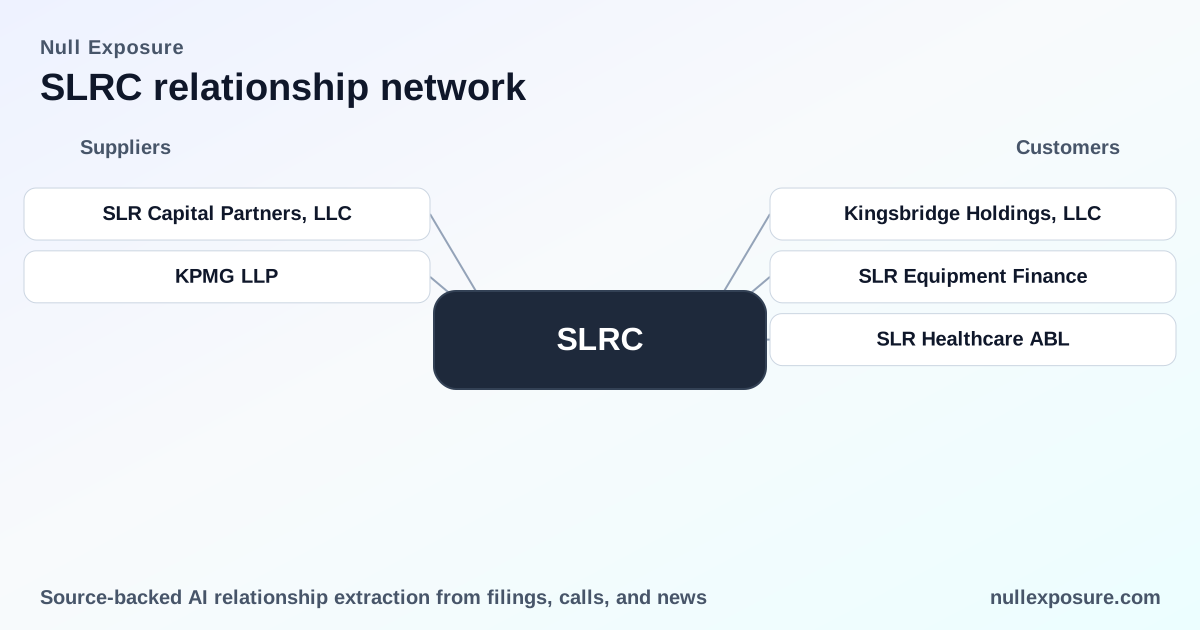
SLRC Customer Relationships: A Practical Map for investors
SLR Investment Corp (SLRC) operates as a business development company that monetizes middle‑market lending and related servicing activities: it provides senior‑secured and subordinated debt, minority equity investments, and administrative services, collecting interest income, fees and dividend distributions. The firm’s revenue mix is driven by yield on direct lending, portfolio servicing fees and occasional capital markets issuance, with dividend policy that converts portfolio cash flows into regular shareholder distributions. For a quick reference to the platform that produced this relationship analysis, visit https://nullexposure.com/.
How SLRC runs the business and gets paid
SLRC concentrates on U.S. middle‑market borrowers through direct cash‑flow lending and specialty finance instruments. Core revenue streams are interest income from unitranche and first/second lien loans, fees from administrative and servicing agreements, and capital gains or carry from minority equity stakes. The company reports a diversified portfolio across equipment finance, healthcare ABL and broader business credit, supporting a mix of smaller average exposures and some larger ticket positions.
Financial context reinforces this model: SLRC reports steady revenues and a high dividend yield relative to its peer set, and it manages portfolio exposures that show both breadth and meaningful per‑borrower balances. These operating features translate into a business that is cash‑flow centric, fee‑oriented and interest‑rate sensitive.
Constraints and operating posture that shape customer relationships
SLRC’s public disclosures and filings convey a clear operating posture that investors should internalize when evaluating its customer book and counterparty dynamics.
- Long‑term contracting posture: The company issues multi‑year securities and structures durable credit arrangements; a filing notes a private offering closed on December 16, 2024 for Series G unsecured notes maturing in 2027 with a fixed 6.24% coupon, underscoring longer duration funding and obligations.
- Middle‑market focus: SLRC explicitly targets privately held U.S. middle‑market companies, so customer credit profiles are concentrated in that segment and underwriting is tailored to illiquid, sponsor‑led borrowers.
- North American geographic concentration: The firm operates primarily within the U.S., concentrating legal, credit and recovery exposure in one regulatory and economic regime.
- Service provider role: SLRC contracts to provide administrative and servicing support to affiliated platforms under fee arrangements, which embeds operational service revenues alongside lending economics.
- Spend and exposure bands: Portfolio information shows a mix of small‑to‑mid ticket exposures. Average balances cited in filings indicate meaningful counts of $1m–$10m exposures alongside a set of $10m–$100m positions, implying a layered risk profile with many smaller accounts and a handful of larger credits.
Taken together, these characteristics indicate a stable, income-driven BDC model focused on repeat lending and fee relationships with middle‑market borrowers, where concentration risk is managed through portfolio breadth but where single large exposures can be material.
What the filings list as named customer relationships
Below are the customer relationships called out in SLRC’s FY2026 press release and related filings. Each entry is concise and tied to the cited source.
Kingsbridge Holdings, LLC (KBH)
SLRC discloses loans to Kingsbridge Holdings, LLC (KBH) in its FY2026 press release and explicitly lists KBH as an obligor whose loans are excluded from an aggregate line item in the announcement. This indicates KBH is a borrower on SLRC’s balance sheet rather than a fee client. According to the company’s FY2026 press release published on The Globe and Mail (Mar 10, 2026), the loans to KBH are part of the portfolio disclosures that management treats separately in reporting.
SLR Equipment Finance (SLR‑EF)
SLRC identifies loans to SLR Equipment Finance (SLR‑EF) and excludes them from a particular aggregate metric in the FY2026 press release, signaling that SLR‑EF is an internally managed equipment‑finance portfolio or affiliate that holds funded leases and loans reported on SLRC’s books. The FY2026 press release on The Globe and Mail (Mar 10, 2026) lists SLR‑EF among entities whose loans are treated discretely in the company’s financial commentary.
SLR Healthcare ABL (SLR HC ABL)
SLRC notes loans to SLR Healthcare ABL (SLR HC ABL) and excludes that portfolio from another aggregated disclosure in its FY2026 release, indicating a dedicated healthcare asset‑based lending vertical with discrete reporting treatment. The company’s FY2026 press release (The Globe and Mail, Mar 10, 2026) names SLR HC ABL among the loan pools that management separated for clarity in the quarter and year‑end disclosure.
Why these relationship entries matter for investors
The three relationships identified in the FY2026 release are not incidental names: they reflect portfolio segmentation and reporting choices. SLRC’s decision to exclude loans to KBH, SLR‑EF and SLR HC ABL from certain aggregates signals that these obligations are large, specialized, or affiliated enough to warrant separate disclosure. That practice has three investor implications:
- Transparency about concentration: Separate line‑item treatment reduces opacity around sizeable or affiliated exposures and helps investors assess true diversification.
- Operational entwinement: The presence of SLR‑branded entities (Equipment, Healthcare ABL) highlights SLRC’s dual role as creditor and service provider; servicing fees and operational support represent recurring revenue alongside loan yields.
- Idiosyncratic credit risk: Large, separately reported obligors can drive quarter‑to‑quarter income volatility and raise event risk if performance deteriorates.
Investment implications and risk checklist
Investors valuing SLRC should weigh both yield and structural exposures. Key takeaways:
- Earnings are driven by interest and fee income, with servicing agreements increasing operating leverage to administrative performance.
- Credit mix is mid‑market U.S. borrowers, which supports higher gross yields but requires active underwriting and workout capabilities.
- Portfolio structure blends many $1m–$10m accounts with a smaller set of $10m–$100m positions, so monitoring large obligors is essential.
- Funding profile includes long‑dated instruments, so interest‑rate and liquidity management remain central.
For a concise dossier and to explore these relationship signals in greater detail, visit https://nullexposure.com/.
Bottom line for analysts and operators
SLRC is a yield‑centric BDC that balances direct lending with fee‑based servicing of specialized verticals. The FY2026 disclosures that separately list KBH, SLR‑EF and SLR HC ABL reflect deliberate portfolio segmentation and the presence of material, often affiliated exposures that investors should track closely. Underwriting discipline, asset recovery capabilities and the company’s ability to manage funding duration will determine whether the dividend yield is sustainable through market cycles.
If you want deeper, source‑level relationship maps and constraint summaries for diligence and portfolio monitoring, explore additional company relationship exports at https://nullexposure.com/.