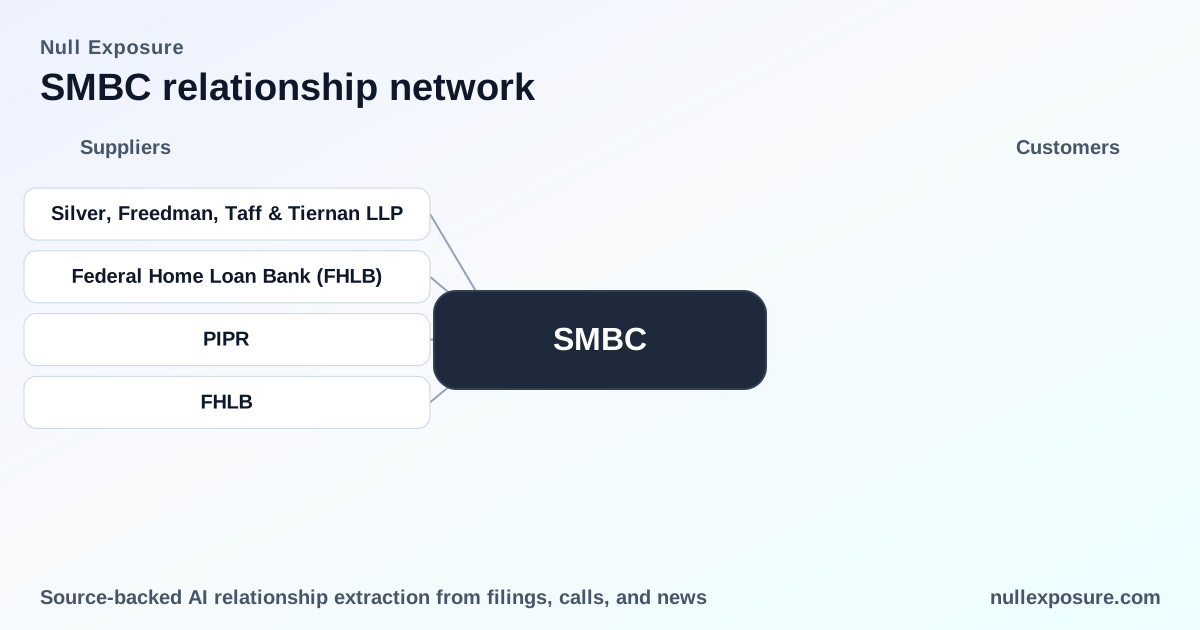
SMBC: Funding Lines, Customer Links, and What Investors Should Price In
Southern Missouri Bancorp, Inc. (SMBC) operates as a regional banking holding company that earns net interest margin from retail and commercial lending, collects fee income from wealth, fiduciary and insurance services, and leverages deposit- and wholesale-funded balance sheet capacity to underwrite loans. The bank monetizes through deposit capture in Missouri/Arkansas/Illinois markets, targeted commercial real estate and consumer lending, and complementary non-interest services such as wealth management and insurance commissions.
Explore our wider coverage at https://nullexposure.com/ for additional customer-relationship intelligence.
Operational profile and business-model constraints you must know
- SMBC is a classic community-regional bank: deposit-heavy funding supplemented by wholesale sources, notably Federal Home Loan Bank advances and brokered deposits, making funding composition a critical driver of earnings volatility.
- Contracting posture mixes long-term lending commitments and shorter-term retail products: the company reported commitments to originate fixed-rate loans with terms greater than one year, while also offering certificates of deposit with 7–12 month terms — this creates a laddered funding and repricing profile that directly impacts net interest margin.
- Geographic concentration is material: the franchise sources deposits and originates loans primarily in Missouri, northern Arkansas, and parts of Illinois, concentrating credit and deposit risk in a localized economic area.
- Service mix leans toward balances-plus-fees: loan interest, deposit spreads and fee revenue from Southern Wealth Management (assets under management expanded materially after a merger) and an affiliated insurance agency diversify income but do not substitute for core spread generation.
- Size and commitments are meaningful: the company reported $944.0 million in commitments to extend credit and smaller standby letters of credit in the low millions, signaling both material forward credit exposure and typical community-bank contingent liabilities.
What the bank does, in plain terms Southern Bank runs a network of branch offices and loan-production facilities to gather retail and commercial deposits, then deploys those funds into one- to four-family mortgages, commercial real estate and business loans, construction financing and consumer loans. Deposits remain the preferred and primary funding source, but the bank uses wholesale lines and FHLB advances to manage liquidity and growth.
Customer relationships in our coverage: the ARCC linkage This section lists every customer-scope relationship flagged by our coverage. Each entry is a concise, plain-English take with source reference.
- Ares Capital Corporation (ARCC) — Ares expanded its SMBC funding facility by $500 million during Q1 FY2026 and secured a modest improvement in pricing (a 5 basis point spread reduction), indicating a deeper funding relationship and improved commercial terms for the borrower. According to an earnings call transcript reported by InsiderMonkey on May 2, 2026, the expansion reflects active engagement between ARCC and SMBC in bank-provided funding facilities.
- Ares Capital Corporation (ARCC) — In its SEC filing and reporting on liquidity composition for FY2026, ARCC lists a SMBC Funding Facility among several wholesale funding sources used to manage a $16.0 billion outstanding debt position as of December 31, 2025, showing that ARCC treats SMBC as a recurring wholesale provider rather than a one-off counterparty. This detail was summarized in TradingView’s reporting of ARCC’s 10‑K on March 9, 2026.
Why these relationships matter to investors
- SMBC as a wholesale provider: The ARCC entries show SMBC participates in third-party wholesale funding activity. That role points to the bank operating not only as a retail deposit gatherer and lender, but also as an originating or intermediary funding source for institutional clients. This diversifies fee opportunities and potentially increases interest-earning asset volume, but it also increases balance-sheet complexity and counterparty credit considerations.
- Pricing and competitiveness: A 5 basis point spread reduction on a $500 million expansion suggests SMBC can be price-competitive on wholesale facilities, which is positive for new business but compresses spread if funding economics are not symmetrically favorable.
- Liquidity interlinkages: ARCC’s reliance on an SMBC facility among a set of other funding sources underscores that SMBC participates in the wider wholesale funding market; this raises both opportunity (fee and yield capture) and operational risk (counterparty credit, settlement, and concentration dynamics).
Reconciling constraints with relationships — what the company-level signals imply
- Contract maturity mix: SMBC explicitly holds long-term commitments to originate fixed-rate loans (evidence: $200.2 million of fixed-rate loan commitments with multi-year terms) while also offering short-term retail products such as 7–12 month CDs. For investors, this means repricing risk is two-sided: assets can lock in long-term rates while liabilities reprice faster, affecting margin under changing rate regimes.
- Funding criticality: Deposits are the primary and preferred source of funding, but the bank actively leverages FHLB advances and external wholesale channels. The company text notes the business relies on retail deposits first, but FHLB and brokered deposits are meaningful supplementary sources; that combination makes liquidity management a central governance and earnings topic.
- Geographic concentration and credit cyclicality: With operations and depositors concentrated in Missouri, Arkansas, and Illinois, SMBC’s credit exposure and deposit behavior are sensitive to regional economic cycles, which amplifies idiosyncratic risk compared with nationally diversified banks.
- Spend and contingency picture: The bank discloses nearly a billion dollars of credit commitments ($944.0 million) and modest standby letters of credit ($4.6 million), indicating forward credit exposure that requires active underwriting discipline and capital planning.
Investment takeaways — what to watch next
- Monitor deposit trends and FHLB/wholesale usage: funding mix shifts quickly affect net interest margin, and continued growth in wholesale funding would raise funding-cost volatility.
- Watch loan commitment conversion and credit performance in the primary markets of Missouri/Arkansas/Illinois; regional downturns will be felt disproportionately.
- Track non-interest income growth from Southern Wealth Management and insurance channels, which provide margin diversification but are comparatively smaller contributors.
If you evaluate customer relationships for credit risk or strategic partnership potential, our platform aggregates and normalizes funding and counterparty disclosures across public filings. Learn more at https://nullexposure.com/.
Bold conclusion SMBC is a regionally concentrated, deposit-centric bank that increasingly interacts with wholesale counterparties like ARCC. The ARCC funding facility expansions are a positive commercial signal for fee and funding activity but raise the importance of disciplined liquidity management and regional credit oversight for investors.