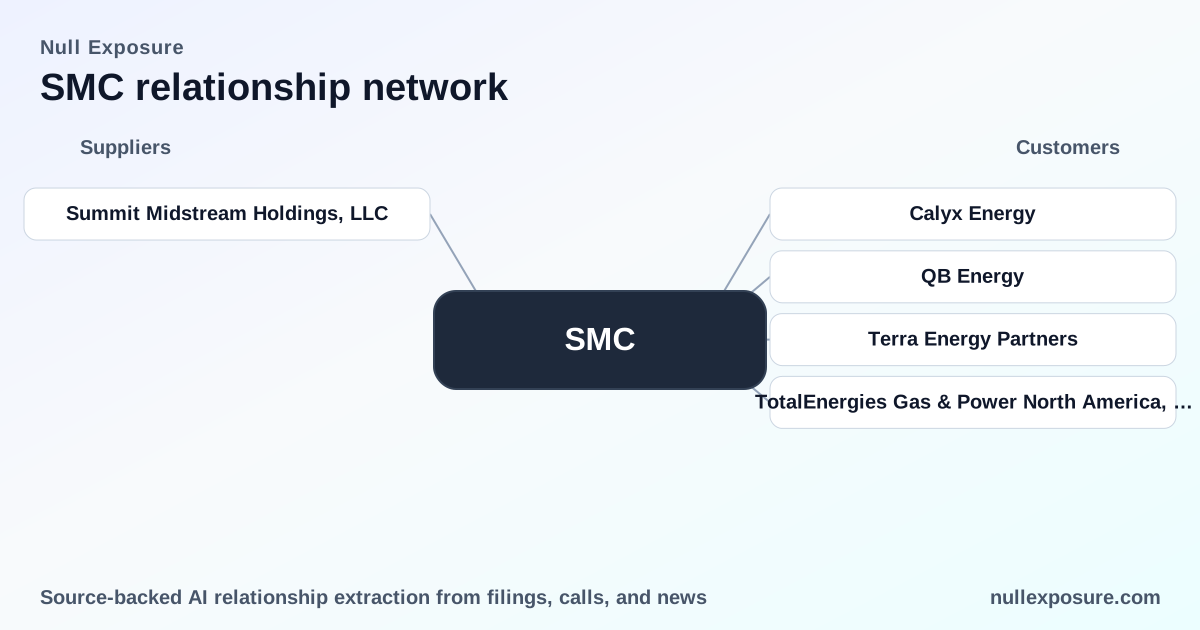
Summit Midstream (SMC): Customer map and commercial posture
Summit Midstream builds, owns and operates natural gas gathering, processing and transportation infrastructure and monetizes primarily through long‑term, fee‑based contracts with producers and midstream counterparties. The company’s cash flow profile is driven by recurring gathering and processing fees, supported by acreage dedications and firm capacity commitments, while concentrated customer exposure and occasional short‑term service lines create both growth leverage and idiosyncratic risk. For a concise, commercial view of SMC’s customer relationships see https://nullexposure.com/.
Operating model and business model constraints — what investors must internalize
- Contracting posture: Summit’s core revenue stream is underpinned by primarily long‑term, fee‑based gathering and processing agreements, which deliver predictable fees and limited volume exposure on many contracts. The company still executes some short‑term agreements for services such as freshwater delivery, which are ancillary to the fee base. (Company 2024 Form 10‑K)
- Concentration and materiality: A relatively small number of customers account for a significant portion of revenues, so customer loss or production curtailments can have material effects on results. This is an intrinsic concentration risk for investors of midstream firms with focused asset footprints. (Company 2024 Form 10‑K)
- Geography and political exposure: All revenue originates in the United States, concentrating operational and commodity‑cycle risk in North American basins while limiting direct foreign revenue exposure. (Company 2024 Form 10‑K)
- Role and cash collection: Summit acts principally as a service provider — gathering, compression, treating and processing — and bills monthly without extended payment terms, supporting near‑term cash conversion. (Company disclosures)
- Business segments: The company operates as an infrastructure owner delivering midstream services; capital allocation therefore emphasizes asset development, contracted capacity and integration with producer customers. (Company 2024 Form 10‑K)
If you want a relationship-centric view for deal diligence, Summit’s customer composition and contract mix are summarized below; for more on commercial exposure and discoveries, visit https://nullexposure.com/.
Customer relationships — what each counterparty means for cash flow and growth
Terra Energy Partners
Terra Energy Partners is identified as one of the producers using Summit’s Grand River system under primarily long‑term, fee‑based gathering agreements, signaling stable contracted throughput on that asset. This placement confirms the Grand River system’s role as a fee‑backbone anchored by active producers. (Summit Midstream 2024 Form 10‑K, FY2024)
QB Energy
QB Energy is listed as a key customer on the Grand River system and is specifically noted after acquiring Caerus Oil and Gas Piceance assets in August 2024, which supports incremental volumes tied to that acquisition. QB Energy’s commitment to Grand River under long‑term agreements strengthens contracted utilization. (Summit Midstream 2024 Form 10‑K, FY2024)
Calyx Energy
Calyx Energy underpins throughput on the Tall Oak system through acreage dedications and is described as the system’s key customer, indicating a structural revenue dependency for that asset. Acreage dedications create a durable volume base for Tall Oak. (Summit Midstream 2024 Form 10‑K, FY2024)
TotalEnergies Gas & Power North America, Inc.
TotalEnergies Gas & Power North America is a funding anchor for the DFW Midstream system via long‑term, fee‑based gathering agreements, representing an investment‑grade counterparty with contractual stability that materially de‑risks that system’s cash flows. (Summit Midstream 2024 Form 10‑K, FY2024)
Verdad Resources
Summit has been affected by customer M&A: a recent earnings transcript and market coverage referenced the acquisition of Verdad Resources by a Peoria Resources entity, which changes the counterparty landscape behind the related system. Customer ownership changes can alter contract economics or credit profiles and therefore deserve attention in risk models. (Earnings transcript coverage, The Globe and Mail / Motley Fool, Q4 2025 results, May 2026)
Verdade Resources
Separate media reports also reference Verdade Resources (variant spelling in coverage) being acquired by a Peoria/JPEX‑linked buyer, underscoring that the underlying customer base for certain systems is consolidating and that counterparty credit and operational plans may shift post‑transaction. Track post‑close integration for any implications to contracted volumes. (Earnings call transcript, Investing.com, May 2026)
Double E
Summit executed multi‑year extensions and firm capacity contracts related to Double E, securing 100–230 MMcf/d of committed capacity in the Williston Basin, which materially expands contracted throughput and provides a clear medium‑term EBITDA ramp for the relevant segment. These agreements are commercial‑growth catalysts for Summit’s infrastructure. (TradingView summary of Summit disclosures, FY2025/2026 commentary, May 2026)
Producers Midstream
Producers Midstream provided an affirmative final investment decision (FID) on a previously announced 200 MMcf/d agreement, converting a contemplated contract into an operational revenue stream that supports medium‑term utilization of Summit’s assets. FID events are high‑confidence near‑term revenue drivers. (Earnings transcript coverage, Investing.com and The Globe and Mail, Q4 2025 results, May 2026)
Producers Midstream II
Producers Midstream II reached FID on Train II of a processing plant in Lea County, which triggered a condition precedent for a 10‑year, 100 MMcf/d firm transportation agreement expected to commence service in late 2026; Summit projects a meaningful uplift to Segment Adjusted EBITDA as these contracts come online. (Company press release, PR Newswire, Q4 2025 results and 2026 guidance, May 2026)
Investment implications — an actionable checklist for investors and operators
- Growth runway from contracted expansions: Agreements tied to Double E and Producers Midstream convert announced capacity into near‑term EBITDA; model these contracts explicitly rather than assuming spot volumes. (TradingView; Investing.com; PR Newswire, May 2026)
- Concentration risk is real: A small set of counterparties delivers a meaningful share of revenue; loss or credit deterioration of a key customer would materially affect free cash flow. (Summit 2024 Form 10‑K)
- Contract tenor provides base resilience: Primarily long‑term, fee‑based contracts preserve margins against commodity swings, but investors must account for fixed‑price transportation contracts that are not cost‑adjustable. (Summit 2024 Form 10‑K)
- Customer M&A is a governance risk: Recent acquisitions of Verdad/Verdade change counterparty profiles and necessitate monitoring for covenant, credit and operational continuity risk. (Market coverage, May 2026)
- Operational levers matter: Ancillary short‑term services (e.g., freshwater delivery) offer incremental revenue but do not change the company’s core capital return profile driven by contracted infrastructure. (Company disclosures)
Conclusion — position and priorities Summit’s commercial model is predictable where long‑term, fee‑based contracts are in place, and growth is tangible where FIDs and firm capacity agreements convert to service (Double E, Producers Midstream). Concentration and customer M&A are the primary risks requiring ongoing diligence; modelers should stress test scenarios where a top counterparty reduces volumes or changes credit profile. For a focused, relationship‑level view of SMC counterparties and contract posture, see https://nullexposure.com/.
Bold claims, clear sources and customer‑level detail should drive valuation scenarios and credit assessments for SMC; incorporate the relationships above directly into EBITDA and cash flow models rather than relying on broad basin assumptions.