Supermicro (SMCI) — Customer Map and What It Means for Revenue and Risk
Super Micro Computer (SMCI) builds and sells high‑performance server, AI and storage systems and complements hardware with software and services. The company monetizes primarily through volume hardware sales to large enterprises, cloud and AI data‑center operators, supplemented by services and OEM channels, with recent revenue acceleration driven by GPU‑optimized systems for generative AI. For primary research on counterparties and channel exposure, see https://nullexposure.com/.
How to read Supermicro’s customer set: scale, concentration and commercial posture
SMCI operates a hybrid commercial model: direct enterprise/OEM sales into large-scale AI and cloud customers, plus an indirect channel of distributors and integrators in APAC, EMEA and the Americas. That posture produces high revenue sensitivity to a handful of large buyers while preserving broad geographic reach through partners. Supermicro’s go‑to‑market mixes product sales (servers, storage, GPU racks) and services/support — a business that scales quickly when AI cycles ramp but also concentrates counterparty risk.
- Concentration: Four customers each accounted for 10%+ of net sales in FY2025, signaling meaningful revenue concentration at the top.
- Geographic balance: The U.S. represented ~59% of FY2025 net sales, with APAC and Europe material as well; the company sells into over 100 countries.
- Channel presence: SMCI uses non‑exclusive distributors (for example, Compuware in Taiwan/China/Australia) to broaden reach while keeping direct enterprise engagement.
For a focused investor read on customer exposures and partner dynamics, visit https://nullexposure.com/ for the underlying extraction.
Customer-by-customer readout (sources and short takeaways)
Leadtek
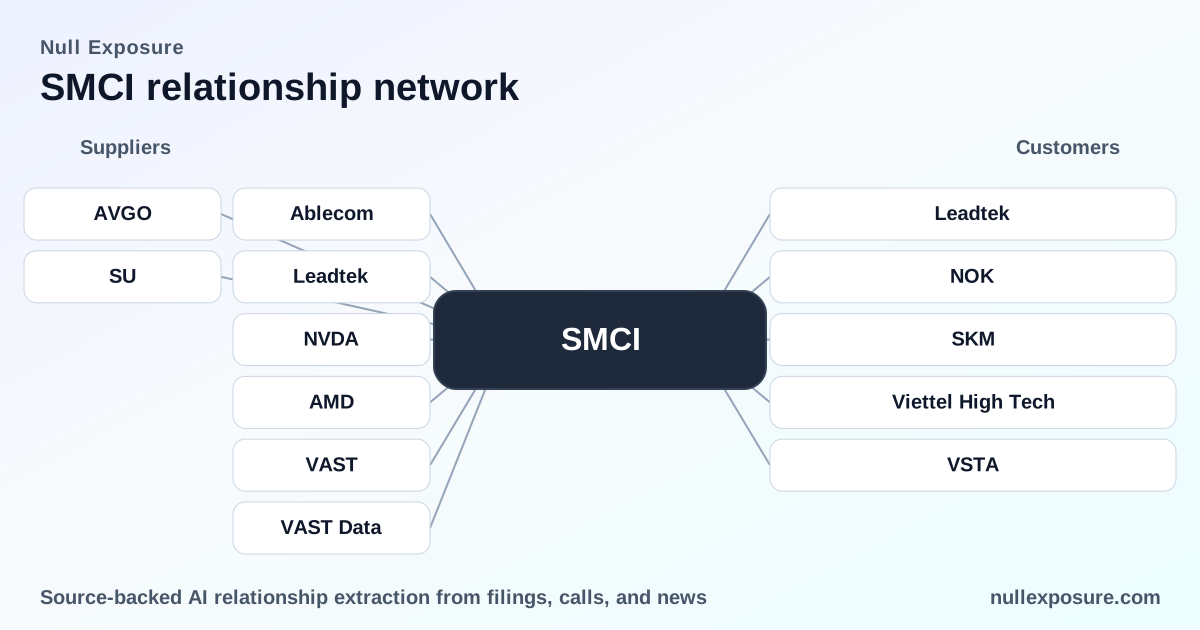
Supermicro sold $0.7 million of servers to Leadtek in FY2025 (and $1.4 million in FY2024), indicating a small transactional relationship rather than a material account. This detail comes from Supermicro’s FY2025 10‑K (year ended June 30, 2025).
Digi Power X (DGXX)
Digi Power X agreed to purchase roughly US$20 million of NVIDIA B300 GPU systems from Supermicro for its Tier‑III AI modular clusters, with initial availability targeted in March 2026; the company is integrating Supermicro hardware into its ARMS/NeoCloudz offerings. Reported in Yahoo Finance and The Globe and Mail (March 2026).
VCI Global (VCIG)
VCI Global is reported to be acquiring NVIDIA H200 AI chips via Supermicro, a transaction described in market commentary aggregators; this points to SMCI acting as the hardware channel into smaller GPU adopters. Noted on Finviz / TipRanks (May 2026).
SK Telecom (SKM)
Under a March 2026 MOU, SK Telecom will contribute operational expertise while Supermicro supplies high‑performance AI servers for a sovereign AI data‑center initiative (the Haein Cluster), which reportedly uses over 1,000 Supermicro AI servers with NVIDIA Blackwell GPUs. Sources include Supermicro press release and SK Telecom press materials (March 2026) and follow‑up news coverage.
Nokia (NOK)
Nokia has showcased solutions built on Supermicro hardware as part of AI‑RAN and sovereign AI offerings highlighted in Supermicro’s March 2026 announcement, signaling telecom OEM and systems integrator adoption of SMCI platforms. See Supermicro investor news (March 2026).
Viettel High Tech
Supermicro’s March 2026 release identifies the Supermicro short‑depth 1U edge server as deployed in Viettel High Tech infrastructure, showing SMCI’s footprint in telecom edge deployments in APAC. Source: Supermicro IR (March 2026).
Quantum (QMCO)
Industry commentary noted long lead times for Supermicro all‑flash systems in the context of Quantum’s sales outlook, underscoring supply/demand dynamics and fulfillment timing for SMCI storage products. See Blocks & Files (Nov 2024, cited in 2026 coverage).
Alpha Ton / ATON
Reports indicate deployment of NVIDIA H200 GPUs and initial B300 chips in Atlantic AI / Alpha Ton projects that use Supermicro HGX systems, suggesting customer‑scale GPU rollouts leveraging SMCI hardware. Source: StockTitan / company press summaries (Dec 2025–Mar 2026).
Climb Global (CLMB)
Climb Global management stated a 10‑year relationship with Supermicro, reflecting a longstanding customer partnership rather than a one‑off purchase, according to Q4 2025 earnings call transcripts and coverage (May 2026).
Oracle Corporation
Market coverage reported that Oracle cancelled a previously discussed large Supermicro order (market estimates $1.1B–$1.4B), an event that triggered stock volatility and underscores sensitivity to order timing from major enterprise buyers. See MarketBeat and related coverage (April–May 2026).
VAST (VSTA)
VAST is packaging Supermicro GPU and storage servers into pre‑integrated “AI data platform” offerings that follow NVIDIA reference architecture, which positions SMCI as the hardware anchor for third‑party AI platforms. Reported by Simply Wall St commentary (March 2026).
Operating constraints and what they signal about the business
SMCI’s public filings and press coverage surface constraints that affect how customers buy and how SMCI executes:
- Contracting posture: Mix of direct enterprise/OEM engagement and non‑exclusive distributors (Compuware named as an authorized distributor in Taiwan/China/Australia with ~$30.2M in sales in FY2025), indicating a multi‑channel go‑to‑market that balances control and reach.
- Concentration and materiality: Four customers ≥10% of net sales in FY2025 — top‑customer risk is real and earnings are sensitive to a few large buyers.
- Geographic footprint: Heavy U.S. concentration (~59% of sales) but meaningful APAC and EMEA channels, creating regional regulatory and supply‑chain sensitivity, particularly around export controls.
- Criticality and maturity: Large AI deployments (SK Telecom’s Haein Cluster, Digi Power X ARMS integration) show SMCI hardware is mission‑critical for customer AI rollouts; CLMB’s decade‑long relationship suggests mature, sticky accounts.
- Governance/sanctions risk: Filings explicitly warn that violations could impede sales to U.S. federal, state and local government entities — a company‑level compliance exposure that investors must monitor.
For investors focused on customer‑level revenue durability, these constraints translate into high upside during GPU cycles but significant downside if order timing from a few large buyers shifts or if regulatory constraints tighten. For deeper relationship analyses and document sourcing, visit https://nullexposure.com/.
Bottom line for investors
Supermicro sits squarely in the AI infrastructure value chain as a high‑velocity hardware vendor whose fortunes track large enterprise and telecom AI deployments. The revenue model is hardware‑heavy, top‑customer concentrated, globally distributed through both direct and distributor channels, and critically exposed to GPU demand cycles and regulatory constraints. Investors should weigh pipeline evidence from named deals (SK Telecom, Digi Power X, VAST) against headline risks (reported Oracle order cancellation) when modeling forward revenue and margins.
Bold takeaway: SMCI is a leveraged play on enterprise and telecom AI deployments — powerful upside in active build cycles, and material revenue concentration risk when large orders re‑price or shift timing.