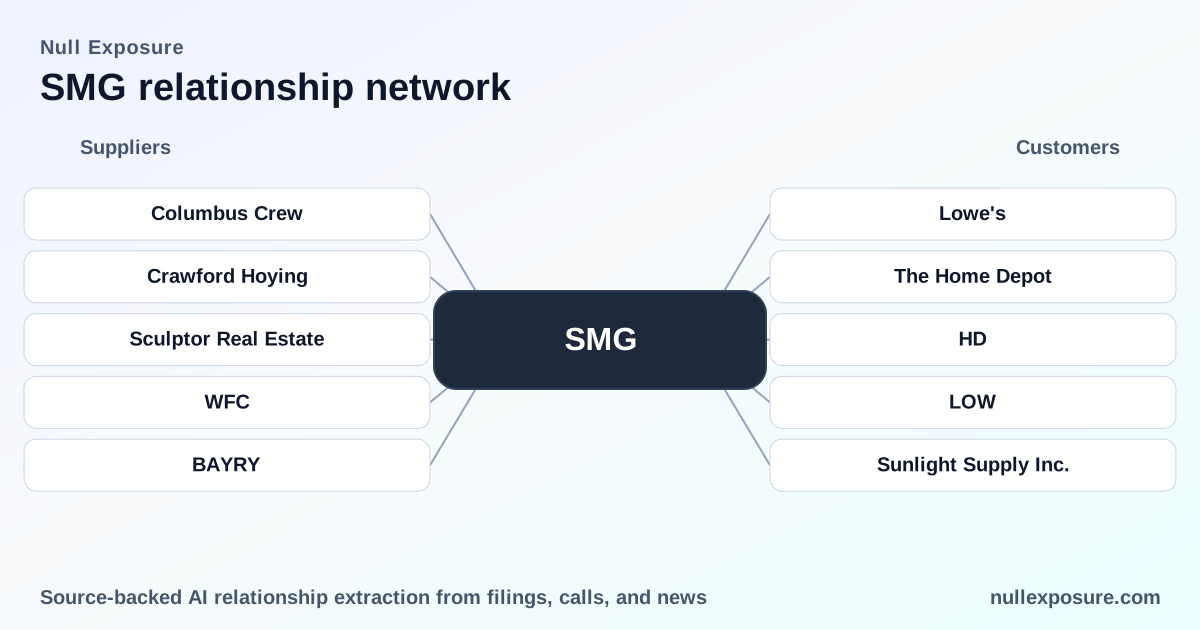
Scotts Miracle‑Gro (SMG): Customer Map and Commercial Levers
Scotts Miracle‑Gro manufactures and sells branded lawn and garden products and monetizes through mass‑retail distribution, e‑commerce, and direct channels; its economics depend on shelf penetration at large home‑center retailers, recurring consumer repurchase, and incremental margin from proprietary branded inputs. For investors, the most salient fact is retailer concentration — a small set of very large customers controls a majority of revenue and therefore drives both growth and risk. For a deeper structural read on counterparty signals, visit https://nullexposure.com/.
Concentration drives both leverage and vulnerability
Scotts runs a classic branded‑consumer, retail‑dependent business model: it invests in product development and marketing, then monetizes primarily through large retail partners that buy at scale and control shelf access. This contracting posture concentrates commercial downside — logistics, promotional funding, and merchandising decisions at a handful of buyers will materially affect top‑line and working capital.
According to the company's FY2025 10‑K, The Home Depot and Lowe’s together accounted for 52% of Scotts’ fiscal 2025 net sales and 25% of outstanding accounts receivable as of September 30, 2025, highlighting both revenue dependence and receivables concentration. That fact is the lens through which every customer relationship below should be evaluated.
Key retail and distribution relationships that matter to investors
The Home Depot
Scotts lists The Home Depot as one of its two largest retail customers; Home Depot’s account is a central channel for mass‑market lawn and garden product distribution and contributes materially to revenue concentration. According to Scotts’ FY2025 10‑K, Home Depot is one of the two customers representing more than 10% of net sales in the three most recent fiscal years (FY2025). Additional historical narrative connects Home Depot’s store expansion to Scotts’ growth in the 2000s. (Sources: SMG FY2025 10‑K; GlobalAgInvesting retrospective.)
Lowe’s
Lowe’s is the other half of the duo driving over half of retail sales: the FY2025 10‑K identifies Lowe’s alongside Home Depot as accounting for 52% of net sales in fiscal 2025 and contributing to the company’s 25% accounts receivable concentration. Lowe’s also referenced Scotts products positively on a 2025 earnings call, noting strength in soils and fertilizers tied to promotional execution. (Sources: SMG FY2025 10‑K; Lowe’s Q2 2025 earnings call.)
Amazon
Scotts leverages major e‑commerce channels as part of a digital transformation, distributing product assortments and consumer kits through Amazon in addition to its own direct sites and retail partners. Company commentary and market coverage in FY2025–FY2026 describe Amazon as a meaningful online channel for kits and direct consumer fulfillment. (Sources: SAHM Capital analysis, Investing.com coverage of Q3 FY2025.)
Sunlight Supply Inc.
Sunlight Supply came into Scotts’ orbit via prior M&A activity in the indoor/horticulture channel; reporting from 2018 around the Sunlight acquisition notes that roughly 20% of Sunlight’s sales historically came from distributing Hawthorne (Scotts’ indoor brand) products, indicating channel overlap and distribution complexity in the indoor gardening segment. This historical relationship underlines Scotts’ strategy to consolidate distribution in adjacent specialty channels. (Source: NewCannabisVentures coverage of the Sunlight Supply acquisition, FY2018 reporting.)
WalMart
WalMart is part of the longer historical growth story; industry coverage recounts how WalMart’s expansion between 2001 and 2009 helped drive an 80% revenue increase for Scotts as mass merchandisers and home centers scaled. While not called out as a top‑two customer in FY2025, WalMart remains a notable large‑format partner in the company’s retail footprint. (Source: GlobalAgInvesting historical summary, FY2016 retrospective.)
What the relationship map implies about contracting posture and risk
The constraints extracted from public filings and market commentary translate into actionable operating signals:
-
Concentration is material and persistent. The top two retailers account for a majority of net sales (52% in FY2025) and a significant portion of receivables (25%), which concentrates credit, promotional and inventory risk with very large enterprise customers. This creates outsized sensitivity of revenues and working capital to retailer inventory decisions and promotional cycles. (Company filing: FY2025 10‑K.)
-
Geography is predominantly North America. Net sales show a heavy U.S. bias: for year ended September 30, 2025 the U.S. contributed $3,134.5 million of $3,413.1 million total net sales, with international sales at $278.6 million — a clear signal that market concentration is regional and that U.S. trade dynamics and retail penetration drive the business. (Source: SMG FY2025 net sales by geography.)
-
Role mix includes distributor and buyer dynamics. Scotts operates both as a supplier to large retailers and as an exclusive agent/distributor for specific products in defined territories (for example, Scotts’ exclusive agent role for certain Roundup® consumer products in the U.S. was noted historically). This mix implies both supplier bargaining power in categories where Scotts’ brands carry premium and distributor obligations that create contractual commitments and channel risk. (Company filings and constraints evidence.)
-
Maturity and criticality: established brand with retailer dependence. Scotts is a mature consumer brand with repeat purchase economics, but its near‑term revenue trajectory is tightly linked to promotional calendars and merchandising outcomes at very large retail partners; this makes short‑term variability a function of retailer negotiations and inventory management rather than solely consumer demand.
Investment takeaways and risk checklist
- Positive: Strong branded economics and improving margin profile. Scotts reports healthy gross profit and an operating margin profile that supports cash generation when retail programs are favorable. (See company financials, FY2025.)
- Negative: Material customer concentration is a primary risk. The top two retailers together accounted for 52% of net sales and 25% of receivables in FY2025, concentrating commercial negotiation leverage and working capital exposure.
- Channel diversification is underway but incomplete. E‑commerce (Amazon and direct channels) and specialty indoor channels (post‑acquisitions) provide strategic offsets, but they have not yet removed retailer concentration at scale.
- Balance sheet and operational monitoring are critical for investors. Watch promotions, retailer inventory turns, A/R aging tied to top customers, and the evolution of direct/e‑commerce penetration.
For investors and operators who want a structured signal view of counterparty exposure and contractual posture, explore the platform at https://nullexposure.com/.
Scotts’ business is a study in tradeoff: a strong, recurring consumer franchise executed through a small number of dominant retail partners. That setup delivers scale and margin when partnerships run smoothly, and concentrated downside if retailer dynamics shift — the primary credit and commercial risk that should guide valuation and monitoring decisions.