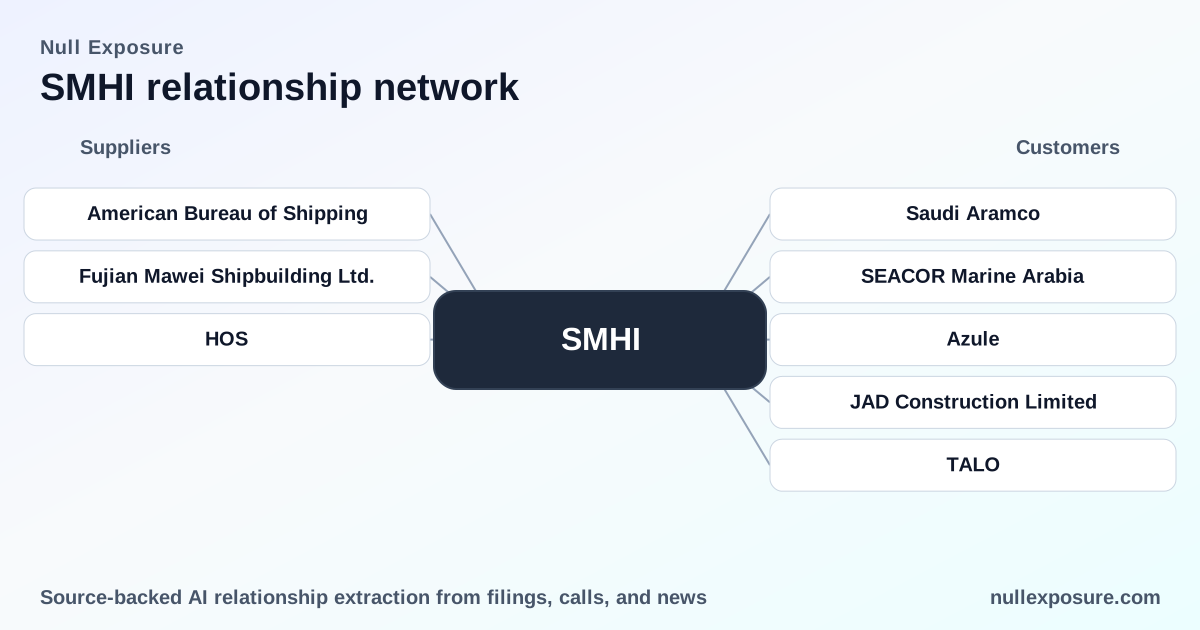
SEACOR Marine (SMHI): Customer map, concentration risk and what it means for investors
SEACOR Marine monetizes its fleet by chartering vessels and selling marine support services to large integrated oil companies, independent producers and offshore wind operators worldwide; revenue is generated through a mix of time charters, bareboat charters and other marine services, with periodic asset dispositions supplementing cash flow. Investors should view SMHI as a capital-intensive services provider whose near-term profitability is driven by charter utilization, contract mix (short-term vs multi‑year) and a high customer concentration profile. For a concise, data-driven view of counterparties and how they influence revenue and credit exposure, visit https://nullexposure.com/.
Concentration matters: the 40% pair and the top-ten skew
SMHI’s customer base is highly concentrated: the ten largest customers produced roughly 76% of operating revenues in 2024, and two relationships — Azule and SEACOR Marine Arabia (servicing Saudi Aramco) — together drove 40% of operating revenues in FY2024. That level of concentration creates asymmetric downside risk to cash flow if a major contract lapses or a partner shifts sourcing. According to the company’s 2024 Form 10‑K, Azule and SEACOR Marine Arabia were each responsible for more than 10% of consolidated revenues, contributing 21% and 19% respectively in 2024.
Who pays and who partners — direct relationship snapshots
Below are the explicit counterparties referenced in public filings and reporting, each condensed into one or two investor‑oriented sentences with source context.
Azule
Azule Energy Angola S.p.A. is a joint venture between BP and Eni that accounted for about 21% of SMHI’s consolidated revenues in 2024, making it a primary revenue driver and a concentrated counterparty for the company. According to SEACOR Marine’s 2024 Form 10‑K, Azule was one of two customers responsible for 40% of the company’s operating revenues in FY2024.
Saudi Aramco
Saudi Arabian Oil Company is the end customer for vessels chartered through SMHI’s joint venture in the region; vessels in service to Saudi Aramco are routed through the SEACOR Marine Arabia JV and contributed materially to 2024 revenues. The company’s 2024 10‑K notes that vessels are chartered to Saudi Aramco via SEACOR Marine Arabia, which was responsible for a significant portion of 2024 revenue.
SEACOR Marine Arabia
SEACOR Marine Arabia LLC is a 45%-owned joint venture through which SMHI provides vessels into service to Saudi Aramco and accounted for ~19% of consolidated revenues in 2024; this JV is explicitly named in the 2024 Form 10‑K as a material customer relationship. The 10‑K identifies SEACOR Marine Arabia and Azule together as being jointly responsible for 40% of operating revenues in FY2024.
JAD Construction Limited (jAD)
SMHI executed definitive agreements to sell two 335-foot class liftboats to JAD Construction Limited for total gross proceeds of $76.0 million, generating an estimated gain of $30.5 million; this transaction was announced in August 2025 and reported in company releases and trade press. A GlobeNewswire/SEACOR Marine press release (Aug 7, 2025) and MarineLog coverage (Mar 2025/2026 press cycle) describe the sale and the expected cash and gain impact.
CME
CME acquired SMHI’s 49% interest in Mexmar in a transaction that raised roughly US$66 million for SMHI; the sale was summarized in a Baird Maritime review covering SMHI’s portfolio moves and prior JV activity. Baird Maritime’s industry coverage (article summarizing FY2018–2022 transactions) cites the Mexmar sale to CME as part of SMHI’s asset reallocation.
Cashman Equipment Corporation
SMHI entered a charter contract with Cashman Equipment Corporation starting November 1, 2022, for firm days plus extension options to support hydraulic drilling and accommodation services; industry press captured the charter’s scope and timing. Baird Maritime reporting (summary of FY2022 contractual activity) documents the firm charter for the liftboat Jill and the FSIV Seacor Brave.
North Star Shipping
SMHI divested its North Sea standby safety business — a fleet of 19 emergency response vessels — to North Star Shipping in 2019, marking a historical exit of aging North Sea assets and a reallocation of fleet exposure. Baird Maritime’s retrospective coverage of SMHI’s fleet sales reports the 2019 transaction.
Talos Energy (TALO)
Talos Energy was the counterparty connected to the SEACOR Power voyage that ended in a 2021 accident; reporting by maritime press locates SEACOR Power en route to a Talos platform at the time of the incident. gCaptain’s coverage of the 2021 incident discusses the vessel’s voyage to a Talos Energy platform.
CMB (CMB Group / CMBGF)
SEACOR sold its windfarm support crewboat fleet in December 2020 to Belgium’s CMB for roughly US$44 million, a strategic de‑risking of wind‑support exposure and tangible evidence of portfolio pruning. Baird Maritime coverage of SMHI’s 2020–2021 disposals highlights the CMB transaction and consideration.
What the public constraints tell investors about the operating model
The company’s filings and reporting collectively outline a distinct operating posture that shapes revenue durability and credit exposure:
- Contract mix and flexibility: SMHI runs both short-term charters (days to months) and multi‑year time or bareboat charters, giving the company mixable cash flow profiles but exposing it to spot‑market swings when short-term utilization is required. The 10‑K states contracts can range from several days to multi‑year periods.
- Framework contracting in core markets: In the U.S. Gulf, time charter terms are often governed by master service agreements, which standardize rates and terms and reduce transactional friction but lock in negotiated commercial structures.
- Counterparty profile: The customer base skews toward large enterprise counterparties — major integrated oil companies and established offshore‑construction firms — implying lower counterparty credit volatility but higher concentration risk when a few majors dominate revenue.
- Global footprint: SMHI operates worldwide; geographic diversification reduces single‑basin cyclicality but creates exposure to multiple regulatory and operational regimes.
- Materiality and credit concentration: The top ten customers represented ~76% of revenues in 2024, and the company typically grants short‑term credit without collateral, which elevates receivable credit risk if a major counterparty weakens.
- Role and revenue mechanics: SMHI acts primarily as a service provider and vessel lessor under time charters (company responsible for operating expenses except fuel) and sometimes as a seller of assets (liftboat sales and fleet disposals) to manage capital and generate one‑time gains.
Where a constraint excerpt explicitly names a counterparty, it supports a direct attribution: the 10‑K explicitly ties Azule and SEACOR Marine Arabia to the materiality signal, confirming they are individually material to 2024 revenues.
Investor implications — what to watch next
- Concentration risk is the primary operational lever. Contract renewals with Azule and the SEACOR Marine Arabia JV will dictate near‑term revenue trajectory and utilization.
- Asset sales are a non‑recurring but valuable cash source. The JAD liftboat sale ($76M) and prior disposals to CMB and North Star reduce capital intensity and can shore up liquidity, but they also shrink revenue‑generating assets.
- Credit exposure is elevated by uncollateralized receivables and large customer weights. Monitor receivable aging and any signs of contract renegotiation or customer capex slowdowns.
- Contract mix will determine margin volatility. A shift toward shorter charters or off‑hire periods will compress margins rapidly given the fixed costs of vessel ownership.
For a structured, investor‑grade summary of SMHI’s customer map and transaction history, including the material relationships above, see the full coverage at https://nullexposure.com/.
Bold takeaway: SMHI is a service‑centric, asset‑lightening marine operator whose credit and revenue profile depends more on a small set of large counterparties and periodic asset sales than on broad, sticky subscription‑style demand. Investors should price in outsized downside from contract losses and value one‑time gains from disposals separately from ongoing operating performance.