Smith-Midland (SMID) — Customer Relationships That Drive Order Flow and Recurring Royalties
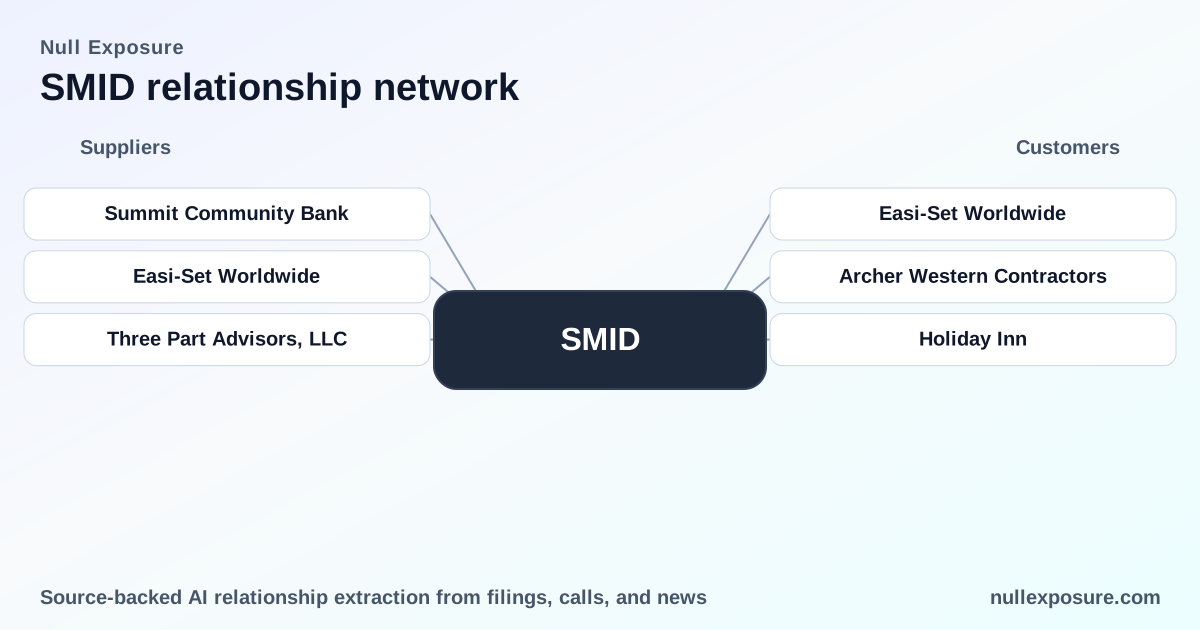
Smith-Midland manufactures and sells precast concrete products and monetizes through direct sales, rental/installation services, and a distinct licensing business operated via its Easi-Set subsidiary; the combination produces project-driven revenue spikes from large transportation and development contracts plus steady royalty income from long-term license agreements. For investors evaluating customer concentration and revenue durability, the FY2026 contract wins and the company’s licensing footprint are the two vectors that determine near-term backlog and medium-term margin stability. Learn more about how we track these customer ties at https://nullexposure.com/.
Large public-works contracts are the growth engine in FY2026
FY2026 headlines show Smith-Midland translating engineering IP into material supply agreements for major DOT and developer-led projects. High-dollar, contract-bound work for state transportation authorities and general contractors creates meaningful near-term revenue recognition events, while licenses and repeat relationships temper volatility.
All reported customer relationships (concise investor view)
Below are plain-English summaries for every customer relationship surfaced in the public record, each with a direct source for verification.
Webber — major partner on Atlanta I-285 and GDOT barrier work
Smith-Midland is supplying precast barriers (Freestanding J-J Hooks system) for the Interstate 285 reconstruction and related GDOT work in Fulton County in partnership with Webber, a Ferrovial company; the arrangement underpins a large FY2026 barrier contract. Source: Investing.com/ZA Investing reports on the May 2026 announcements (May 3, 2026; https://www.investing.com/news/company-news/smithmidland-secures-184-million-barrier-contract-for-atlanta-highway-project-93CH-4460808 and https://za.investing.com/news/company-news/smithmidland-begins-production-on-19-million-noise-wall-contract-93CH-4093029).
Easi-Set Worldwide — the licensing subsidiary that extends product reach
Smith-Midland owns Easi-Set Worldwide, which licenses Smith-Midland’s proprietary products (SlenderWall, SoftSound, J-J Hooks, etc.) to other manufacturers, generating upfront fees and ongoing royalties. Source: Virginia Business profile noting corporate leadership and ownership details (FY2022 context; https://virginiabusiness.com/son-replaces-father-as-smith-midland-corp-chairman/).
Morningstar Community Development — developer for DC SlenderWall order
Smith-Midland will manufacture and supply approximately $1.6 million of SlenderWall architectural precast cladding for a luxury residential redevelopment in Washington, D.C., a project owned by Morningstar Community Development. Source: TipRanks / The Fly news report (FY2026; https://www.tipranks.com/news/the-fly/smith-midland-corp-to-supply-1-6m-in-slenderwall-for-dc-project-thefly-news?mod=mw_quote_news).
Orion Habitats Company — general contractor for the DC redevelopment
Orion Habitats Company is the contractor constructing the DC redevelopment where Smith-Midland will supply $1.6 million in SlenderWall panels, tying product manufacturing to a private-sector residential development. Source: TipRanks / The Fly (FY2026; https://www.tipranks.com/news/the-fly/smith-midland-corp-to-supply-1-6m-in-slenderwall-for-dc-project-thefly-news?mod=mw_quote_news).
Archer Western Contractors — partner on Virginia Beach wall systems
Smith-Midland is collaborating with Archer Western Contractors to produce precast wall systems for the City of Virginia Beach project, a FY2026 award reflected across multiple press reports. Source: TipRanks, Investing, and Intellectia reporting on the Virginia Beach contract (FY2026; see https://www.tipranks.com/news/the-fly/smith-midland-corp-producing-1-9m-in-wall-systems-for-virginia-beach-project-thefly and https://intellectia.ai/en/stock/SMID/news).
Holiday Inn — past architectural integration example demonstrating product versatility
Smith-Midland supplied traditional precast detailing for a Holiday Inn project, illustrating historical use cases of the company’s architectural precast products in hospitality construction (documented work from prior years). Source: The Architect’s Newspaper feature on SlenderWall (FY2016; https://www.archpaper.com/2016/12/slenderwall-high-performance-architectural-cladding-system/).
Flatiron Dragados — contractor on North Carolina Complete 540 project
Smith-Midland was selected to supply about $5.4 million in SoftSound precast noise wall systems for the Complete 540-Triangle Expressway Southeast Extension Segment B, with Flatiron Dragados as the constructing firm. Source: TipRanks / The Fly coverage of the award (FY2026; https://www.tipranks.com/news/the-fly/smith-midlands-softsound-selected-for-north-carolina-complete-540-project-thefly-news).
North Carolina Department of Transportation — public owner of the Complete 540 contract
The North Carolina DOT is the project owner for the Complete 540 extension where Smith-Midland’s SoftSound walls will be installed, representing another state DOT procurement supporting FY2026 revenue. Source: TipRanks / The Fly (FY2026; same reporting as above; https://www.tipranks.com/news/the-fly/smith-midlands-softsound-selected-for-north-carolina-complete-540-project-thefly-news).
What the customer set reveals about Smith-Midland’s operating model
Smith-Midland is a project-centric manufacturer with a recurring-royalty licensing arm. The publicly reported relationships reveal several operating characteristics investors should weigh:
- Contracting posture and maturity: The licensing business runs on multi-year, typically five-year agreements with license fees plus royalties (generally 4–6% of net sales), producing a persistent, low-touch revenue stream alongside the lumpier project sales cycle.
- Customer concentration and geographic mix: Project customers are concentrated in U.S. state DOTs and large general contractors across the Mid-Atlantic, Northeast, Midwest, and Southeast, while licensing reaches international manufacturers (Canada, Belgium, New Zealand, Australia, Mexico, Trinidad). This creates domestic project cyclicality offset by a geographically diverse licensing footprint.
- Relationship roles and criticality: Smith-Midland alternates roles as seller and licensor—direct supplier to contractors and owner/operators of intellectual property licensed to third parties—meaning revenue is both tied to delivered volumes and to ongoing licensee success.
- Contract lifecycle and predictability: Large DOT and developer contracts deliver identifiable near-term revenue (FY2026 examples), but dependency on municipal procurement timing creates uneven recognition; conversely, licensing contracts provide steady, predictable royalty flows.
(Company-level signal: the firm maintains dozens of worldwide licenses—75 total per its disclosures—indicating an established, recurring-license revenue base.)
Investment implications and risk factors
- Upside: FY2026 contract wins with large contractors and state DOTs will materially lift backlog and utilization; SlenderWall and SoftSound product adoption create attractive margins on architectural and noise-wall segments.
- Risks: Revenue remains project-driven and cyclical; execution risk on large barrier and wall shipments is real, and customer concentration in transportation procurement can compress near-term visibility. Additionally, royalty rates (4–6%) limit upside per unit sold by licensees, making scale the lever for meaningful licensing revenue growth.
- Balance: The corporate mix of direct sales plus licensing reduces pure-play cyclicality while keeping performance tied to construction market health and public infrastructure spending.
Conclusion and next steps
Smith-Midland’s FY2026 reporting cycle demonstrates a repeatable model of winning large, discrete infrastructure contracts while collecting recurring licensing royalties—a hybrid that supports revenue stability without eliminating project volatility. For models and a deeper customer-contract timeline, see our research hub at https://nullexposure.com/.
For transaction-level monitoring, investor alerts, and cross-referenced contract sources on SMID, visit https://nullexposure.com/ to subscribe to timely updates.