Summit Therapeutics (SMMT): Commercial and Collaboration Profile for Investors
Summit Therapeutics discovers, develops, and commercializes therapies for infectious diseases and oncology, monetizing through direct drug sales and strategic regional partnerships and clinical collaborations. Revenue and upside are driven by a small number of high-impact partnerships for commercialization and co-development, while operating leverage is constrained by negative EBITDA and a biotech-style balance of development risk versus partner-led market access. For tools and signals that track counterparty exposure across Summit’s customer and partner base, see Null Exposure. https://nullexposure.com/
Why the partner map matters for valuation
Summit’s market capitalization, cash burn profile, and reported metrics reflect a company that commercializes through selective alliances rather than broad direct-sales penetration. Two relationship archetypes dominate the investor thesis: (1) clinical co-development agreements that accelerate trial programs and broaden combination strategies, and (2) regional licensing/commercial partnerships that provide market access outside Summit’s direct footprint. These relationships determine near-term revenue recognition, geographic revenue concentration, and the company’s contracting posture with third parties.
- Contracting posture: Summit operates primarily through collaboration and licensing agreements rather than high-volume vendor contracts; this produces concentrated, high-value counterparties and episodic revenue recognition.
- Concentration and criticality: A small number of partners can represent outsized commercial exposure or access to specific markets—making counterparty performance a critical variable for revenue and market penetration.
- Maturity and operational risk: Relationships are at mixed stages—clinical collaborations are active and materially influence the development timeline, while licensing agreements underpin commercial access in certain jurisdictions.
All reported customer and partner relationships (concise, source-backed)
RVMD — clinical collaboration reported in Finviz news
Summit has an active clinical collaboration with RVMD to evaluate RAS(ON) inhibitors in combination with Summit’s pipeline assets, signalling a strategic focus on combination oncology programs. This linkage was reported in a Finviz news summary referencing an RVMD FY2026 report (Finviz, March 10, 2026).
RVMDW — Q4 earnings confirmation of combination study
RVMDW confirmed on its 2025 Q4 earnings call that the company’s ongoing collaboration with Summit evaluates RVMDW’s RAS(ON) inhibitor alongside Summit’s PD‑1/VEGF bispecific antibody Ivonescimab across multiple solid tumor indications, underscoring a deepening clinical co-development relationship (RVMDW 2025Q4 earnings call, first reported March 7, 2026).
AKESF — commercial partnership referenced in FDA milestone coverage
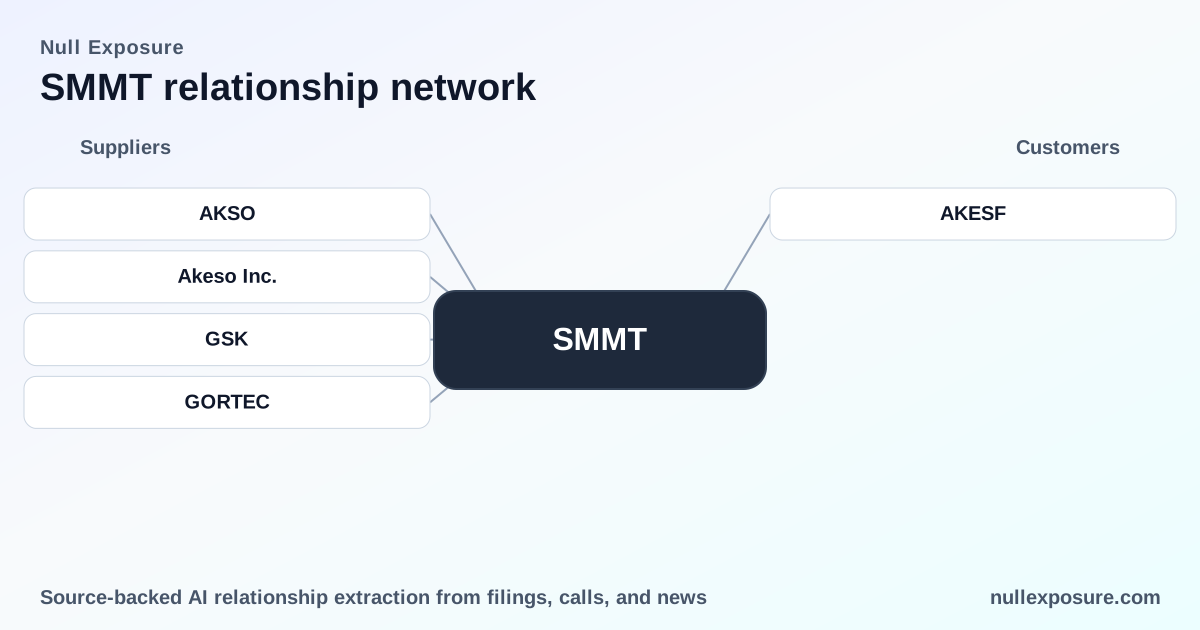
Summit’s commercial exposure in China and its partner-led market access strategy were noted in press coverage of an FDA milestone, which referenced Summit’s partnership with Akeso (AKESF) and estimated eligible U.S. patient counts that frame the commercial opportunity. This was detailed in a Finviz news piece on Summit’s FDA development (Finviz, March 10, 2026).
Akeso — same partner described in market-access context
Media coverage repeated that Summit’s application complements existing commercial exposure in China through its partnership with Akeso, reinforcing Akeso’s role as the regional commercial partner for Summit’s asset(s) in Greater China (Finviz, March 10, 2026).
What each relationship implies for revenue and execution
Summit’s clinical collaborations with RVMD/RVMDW signal a strategy of derisking development via combination studies, which accelerates potential label expansion and value creation if clinical readouts are positive. The earnings-call language about Ivonescimab paired with RVMDW’s RAS(ON) program indicates operational alignment at the program level, not just exploratory linkage, and therefore elevates the clinical and regulatory importance of these collaborations.
The Akeso relationship is a commercial access lever for Greater China, meaning Summit outsources regional commercialization responsibilities and benefits from partner-established distribution and regulatory infrastructure. Media references to 14,000 eligible U.S. patients and existing Chinese exposure frame the commercial TAM narrative and highlight the role of regional partners in unlocking non-U.S. sales.
Company-level constraints and procurement signal
A company-level constraint in the customer relationship scope indicates Summit’s vendor/customer spend band sits between $100k and $1M, based on a high-confidence model (max confidence 0.90). The supporting excerpt cites $156 of sublease income recognized net of operating lease expenses for the year ended December 31, 2024. This points to limited recurring, large-scale third-party procurement in areas captured by this signal and suggests Summit’s external cash flows tied to subleases and small administrative receipts are immaterial to core operations.
Risks and strategic considerations for investors
- Concentration risk: Summit’s model concentrates commercial execution through named partners; any partner misexecution or regulatory delay in key regions (e.g., China via Akeso) will have outsized revenue impact. Investors should treat partner performance as a primary operational risk.
- Clinical execution dependency: Co-development arrangements with RVMD/RVMDW shift clinical risk into combination endpoints and timeline coordination; these relationships increase upside for label expansion but also create additional coordination failure modes.
- Revenue recognition cadence: Licensing and regional partnerships produce lumpy revenue as milestones and royalties are achieved; forecast models must account for milestone timing rather than steady recurring revenues.
- Operational scale signal: The low spend-band signal and the $156 sublease income point to modest non-core operating receipts and a lean vendor footprint relative to large commercial-stage peers.
Investment implications and tactical view
Summit’s valuation is anchored on successful clinical progress and partner commercialization. Positive clinical readouts and smooth partner execution will drive rapid re-rating; conversely, partner setbacks produce binary downside. The evidence set here highlights two actionable monitoring priorities for investors and operators:
- Track trial milestones and coordinated readouts with RVMD/RVMDW for Ivonescimab combination programs.
- Monitor regulatory filings and commercial rollouts tied to Akeso in Greater China for near-term revenue conversion.
For quantitative counterparty exposure and deeper customer analytics on Summit and its partners, visit Null Exposure for attributional models and relationship-level signals. https://nullexposure.com/
Bottom line
Summit’s commercial strategy relies on selective, high-impact partnerships that both advance clinical programs and provide regional market access. These relationships create concentrated upside but require active monitoring of partner execution, milestone timing, and regulatory sequencing. Investors should price Summit as a partner-dependent commercial-stage biotech where partner performance and clinical milestones are the dominant drivers of near-term valuation.