NuScale Power (SMR): Customer Relationships that Define Commercial Risk and Upside
NuScale Power sells modular nuclear power plants (NuScale Power Modules, or NPMs) and adjacent services — engineering, licensing and long‑term plant services — to utilities, government entities and industrial offtakers. The company monetizes through equipment sales (NPMs and associated nuclear hardware) and recurring services across development and operating life, while current revenue predominantly derives from engineering and licensing work. For investors, the critical inflection is converting prospective offtake relationships into binding NPM purchases at scale; that conversion drives both revenue growth and valuation upside. Learn more at https://nullexposure.com/.
How NuScale’s customer map shapes investment outcomes
NuScale’s customer footprint is concentrated and government‑oriented, with commercial scale driven by a small number of large, institutional counterparties. That concentration creates binary outcomes: successful contract conversion leads to multi‑year, high‑value equipment sales and recurring services; failure to convert produces extended development cash burn with limited revenue uplift. The company’s public disclosures and recent media coverage underline both the promise (institutional interest from utilities and governments) and immediate execution risks (large milestone payments, litigation headlines, and partner churn).
Company‑level operating signals investors should use
- Contracting posture — prospect stage. NuScale itself warns it has not yet entered into binding contracts to deliver NPMs, signaling that most commercial upside remains conditional on future awards. This is a company‑level fact from the FY2024 filing.
- Revenue mix — services first, equipment to follow. All revenue to date arises from engineering and licensing fees; NuScale expects a substantial portion of future revenue from NPM sales plus recurring services over plant life.
- Counterparty and geographic profile — government and global. Target offtakers include domestic and international governments, state utilities and industrial customers, indicating sales cycles with sovereign or regulated counterparties and cross‑border complexity.
- Concentration risk. NuScale reports a single Class 1 customer (RoPower) in its most recent filings, signaling high counterparty concentration at this stage of commercialization.
These operating characteristics explain why investors must value NuScale as a staged commercial developer with outsized binary outcomes rather than a diversified industrial revenue story.
Customer relationships: what investors need to know
Below are every customer or partner appearance in the available records, each condensed to a 1–2 sentence investor note with the primary source.
-
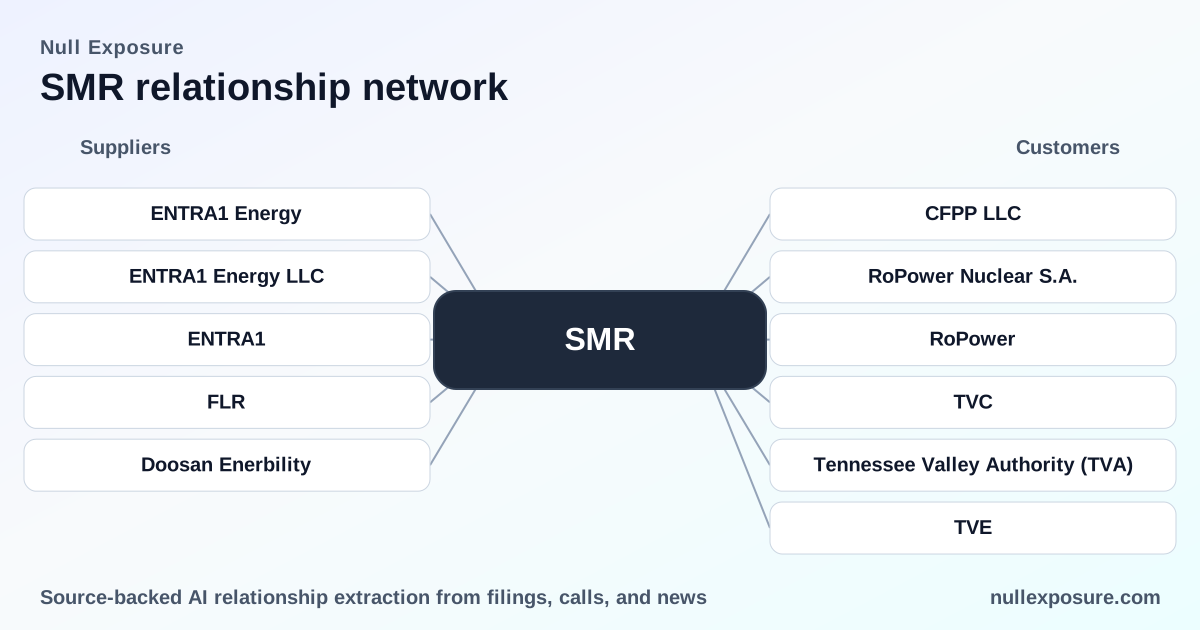
CFPP LLC
NuScale terminated earlier development cost reimbursement and long‑lead material reimbursement agreements with CFPP LLC under a Release Agreement executed in November 2023, indicating a formal unwind of that early customer relationship. This is documented in NuScale’s FY2024 Form 10‑K (disclosed in the company’s 2024 filing). -
RoPower Nuclear S.A.
RoPower Nuclear S.A. is identified in NuScale’s FY2024 10‑K as the company’s sole Class 1 customer, reflecting a concentrated commercial relationship and priority in NuScale’s near‑term pipeline. The FY2024 10‑K names RoPower as the only Class 1 customer. -
RoPower (earnings commentary)
Management has reiterated RoPower’s objective to develop and deploy a six‑module SMR plant in Romania, which frames RoPower as the lead prospective NPM buyer in Europe for NuScale technology. This was stated on NuScale’s Q4 2025 earnings call. -
TVC (institutional interest reference)
Market commentary has cited Romania’s investment decision and NuScale’s engagement with U.S. institutions as evidence of institutional interest in its SMR technology, underlining demand signals beyond a single market. Industry commentary to this effect appeared in a Sahm Capital note in February 2026. -
Tennessee Valley Authority (TVA)
NuScale’s disclosures and subsequent news reports show TVA is linked to a major program contemplated with ENTRA1, where commercial structures envision up to 72 NPMs and milestone payments that could exceed $3 billion, making TVA a potential high‑impact customer for NuScale’s commercialization pathway. This detail surfaced in investor‑facing news releases and class action filings reported in March–April 2026. -
ENTRA1 Energy LLC
ENTRA1 figures as NuScale’s global commercialization partner in various court filings and corporate disclosures, with alleged misrepresentations related to expected synergies cited in litigation; ENTRA1 is central to NuScale’s announced transactions tied to TVA and other programs. News reports and filings in April–May 2026 discuss ENTRA1’s role and related legal claims. -
Fluor Corporation (FLR)
Public commentary and filings note Fluor maintained multiple commercial relationships and arrangements with NuScale, a pointer to past engineering/implementation partnerships that are now under scrutiny as litigation and partner exits have been reported. This relationship was noted in media coverage from March–May 2026.
Financial and execution risk framed by customers
- Concentration amplifies execution risk. With RoPower the only Class 1 customer disclosed, near‑term top‑line growth hinges on a very small number of commercial wins. That increases downside volatility for investors.
- Large program economics are binary but transformative. Contracts with entities like TVA/ENTRA1 contemplate multi‑billion‑dollar milestone profiles; successful delivery scales revenue and services substantially, but such programs impose large upfront payments and counterparty credit and political risks.
- Current revenue base is immature. NuScale’s operating income today stems from engineering and licensing fees rather than NPM sales, consistent with a development‑stage commercial model; that makes cash burn and milestone payments critical to watch.
Key takeaways for investors
- NuScale’s revenue model is dual: high‑value equipment sales (NPMs) plus recurring services. Near‑term value depends on converting prospects into binding, long‑term offtake contracts.
- Concentration and government counterparty profile create both strategic scale and execution fragility. A handful of institutional counterparties can drive rapid growth — or severe project delays and litigation exposure.
- Recent headlines (ENTRA1 payments, partner exits and lawsuits) materially affect execution risk and warrant close monitoring of legal filings and milestone cash flows. See the April–May 2026 news coverage for developments.
If you want a concise, investor‑grade briefing that maps these relationships against NuScale’s announced project timelines and cash‑flow implications, visit https://nullexposure.com/ for tailored exposure and monitoring tools.