Smith Micro Software (SMSI): Customer Map and What It Means for Investors
Smith Micro Software sells software and cloud services that enhance the mobile experience for major wireless and cable operators; it monetizes through a mix of usage-based fees, licenses, and hybrid SaaS subscriptions, with concentrated revenue from a handful of large telco partners. This concentrated enterprise customer base drives both upside (long-term contract economics and platform upsells) and downside (single-counterparty sensitivity). Learn more about coverage and signal-driven customer intelligence at https://nullexposure.com/.
The operating and monetization thesis, in one paragraph
Smith Micro positions itself as a licensor and service provider to large mobile network operators (MNOs) and multiple system operators (MSOs), packaging software (licensed and royalty-free arrangements), hosted services and usage-based billing into products such as the SafePath family safety platform and QuickLink connectivity kits. Revenue is a hybrid mix: recurring usage-based charges capture user activity, while licenses and SaaS-style subscriptions create a baseline — but overall customer concentration means a small number of operators drive most top-line performance.
Relationship catalogue: who’s on the customer and partner roster
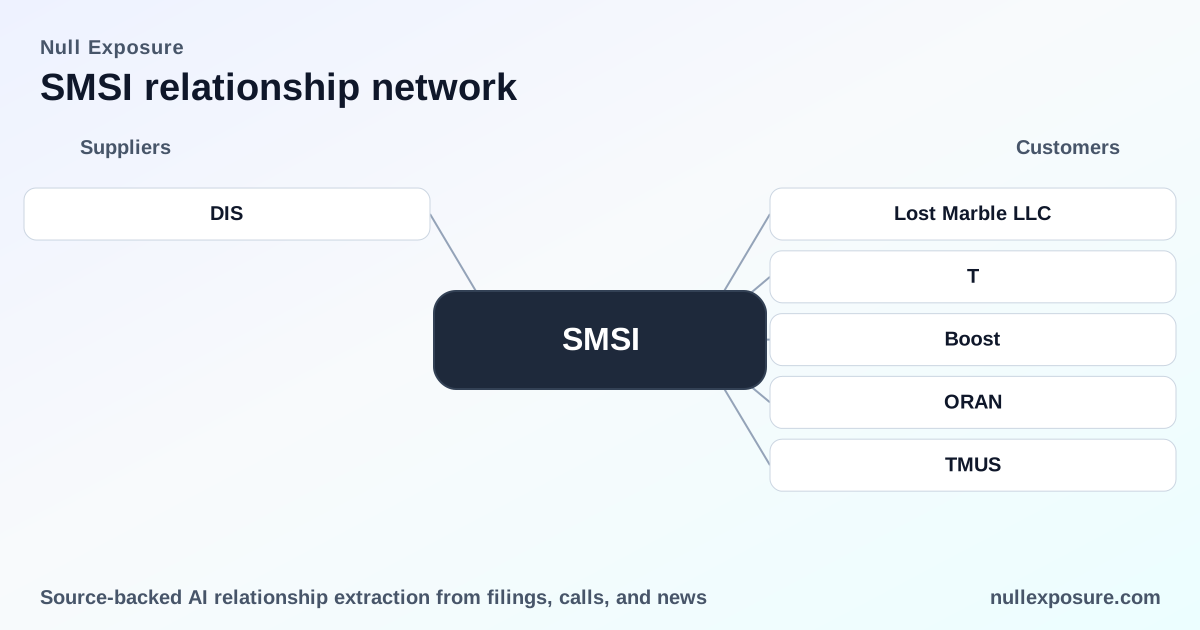
Below are each of the relationships surfaced in public reporting and transcripts; each entry includes a plain-English summary and the cited source.
Lost Marble LLC — Moho product sale and IP transfer
Smith Micro sold the Moho 2D animation product line to Lost Marble LLC, returning the tool to its original creator as part of a divestiture of non-core assets. Source: Animation Magazine (reporting Smith Micro's Moho sale, 2021) — https://www.animationmagazine.net/2021/01/endorsed-by-cartoon-saloon-moho-2d-software-returns-to-original-creator/. An industry news summary later referenced the same transfer in coverage of the Moho acquisition (AWN, 2026). Source: AWN — https://www.awn.com/news/lost-marble-acquires-moho-2d-animation-software.
AT&T (T) — strategic large-enterprise partner and revenue contributor
AT&T is cited repeatedly as a significant strategic partner and strong contributor to recent quarters, reflecting Smith Micro’s reliance on Tier‑1 carrier relationships for volume and distribution. Source: Q4 2025 earnings-call transcript coverage on Investing.com (Q4 2025) — https://m.investing.com/news/transcripts/earnings-call-transcript-smith-micro-softwares-q4-2025-sees-revenue-decline-and-stock-drop-93CH-4542469?ampMode=1. The company also referenced AT&T in its Q3 2025 transcript commentary about coordinated marketing initiatives. Source: InsiderMonkey Q3 2025 transcript — https://www.insidermonkey.com/blog/smith-micro-software-inc-nasdaqsmsi-q3-2025-earnings-call-transcript-1641728/.
T‑Mobile / TMUS / T‑Mobile (multiple entries) — product roadmap and churn impact
Smith Micro highlights ongoing product alignment and new revenue opportunities with T‑Mobile, while also acknowledging that the migration of legacy Sprint subscribers to T‑Mobile reduced recurring Family Safety revenue. Source (future opportunities and alignment): InsiderMonkey Q4 2025 transcript (March 2026) — https://www.insidermonkey.com/blog/smith-micro-software-inc-nasdaqsmsi-q4-2025-earnings-call-transcript-1710593/. Source (migration impact): TradingView summary of the 2025 10‑K and related commentary — https://www.tradingview.com/news/tradingview:40954f880bba8:0-smith-micro-software-2025-10-k-revenue-17-4m-eps-1-46/.
Orange / ORAN / Orange Spain — strategic rollout for family-safety
Smith Micro reports active collaboration with Orange at the group level and with Orange Spain to expand SafePath deployments and deepen joint commercial potential in the family safety market. Source: Investing.com transcript coverage of Q4 2025 and InsiderMonkey Q4 2025 transcript (March 2026) — https://m.investing.com/news/transcripts/earnings-call-transcript-smith-micro-softwares-q4-2025-sees-revenue-decline-and-stock-drop-93CH-4542469?ampMode=1 and https://www.insidermonkey.com/blog/smith-micro-software-inc-nasdaqsmsi-q4-2025-earnings-call-transcript-1710593/. Earlier commentary in Q3 2025 referenced Orange Spain specifically in rollout updates. Source: InsiderMonkey Q3 2025 transcript — https://www.insidermonkey.com/blog/smith-micro-software-inc-nasdaqsmsi-q3-2025-earnings-call-transcript-1641728/.
Hughes Network Systems (HNS) — channel/partner for satellite connectivity bundles
Smith Micro has a deal to supply QuickLink Mobile and QuickLink Fax software plus cable kits to Hughes Network Systems for Thuraya satellite customers, positioning Smith Micro as a bundled software/hardware supplier in satellite broadband offerings. Source: SpaceWar report (dated coverage of the Hughes relationship) — https://www.spacewar.com/reports/Smith_Micro_To_Supply_Mobile_For_Thuraya_Satellite_Customers.html.
Thuraya — end customer endorsement for bundled solution
Thuraya’s executive commentary cited quality, assured supply and integrated hardware/software bundling as reasons for selecting HNS and Smith Micro for Thuraya customer kits. Source: SpaceWar report (Thuraya CEO quote) — https://www.spacewar.com/reports/Smith_Micro_To_Supply_Mobile_For_Thuraya_Satellite_Customers.html.
Boost — collaborative partner on SafePath platform expansion
Boost is described as a solid, collaborative partner with active workstreams to extend SafePath features and platform capabilities across their services. Sources: InsiderMonkey transcripts (Q3 and Q4 2025) and Investing.com Q4 2025 transcript excerpts — https://www.insidermonkey.com/blog/smith-micro-software-inc-nasdaqsmsi-q4-2025-earnings-call-transcript-1710593/ and https://m.investing.com/news/transcripts/earnings-call-transcript-smith-micro-softwares-q4-2025-sees-revenue-decline-and-stock-drop-93CH-4542469?ampMode=1.
Sprint — legacy revenue erosion from customer migration
Smith Micro specifically attributes a decline in Family Safety recurring revenue to the migration of legacy Sprint subscribers into the T‑Mobile base, a discrete headwind to recurring usage-based revenue tied to legacy contracts. Sources: InsiderMonkey Q3 2025 transcript and TradingView reporting on the 2025 10‑K — https://www.insidermonkey.com/blog/smith-micro-software-inc-nasdaqsmsi-q3-2025-earnings-call-transcript-1641728/ and https://www.tradingview.com/news/tradingview:40954f880bba8:0-smith-micro-software-2025-10-k-revenue-17-4m-eps-1-46/.
What the relationship map implies for business risk and upside
- Customer concentration is a defining feature. Company disclosures show three customers accounted for 58%, 20% and 14% of revenue in the most recent year, which creates both leverage to win large contract renewals and vulnerability if a top counterparty scales back. This is a company-level signal from Smith Micro’s filings.
- Contract mix is hybrid and usage-sensitive. Smith Micro’s revenue is generated through a mix of usage-based fees, licensing arrangements, and hybrid SaaS subscriptions, so quarterly revenue can swing with end-user activity and carrier migrations. This operational model amplifies seasonality and churn effects.
- Enterprise contracting posture favors large, long-term engagements. The company markets directly to large MNOs and MSOs, selling software plus hosted ASP services, which suggests tailored integration cycles and multi-year commercial relationships rather than high-volume retail churn.
- Geographic reach is global but operationally split. Smith Micro operates across the Americas and EMEA, supporting global carrier customers while relying on a small number of large accounts for material revenue.
- Smith Micro acts as both licensor and service provider. The firm retains IP ownership when licensing and also delivers hosted services and support, which positions it to recognize revenue on a gross basis but also exposes it to service-delivery obligations.
- There is evidence of churn and termination risk. Company disclosures include at least one Tier‑1 U.S. carrier contract termination with a defined transition period, underscoring the execution and renewal risk inherent to large-enterprise dealings.
Bottom line for investors
Smith Micro’s customer book includes top-tier carriers and strategic partners that legitimize its product-market fit in family safety and satellite connectivity, but the company’s revenue concentration, usage-based exposure, and recent legacy-customer migration headwinds create asymmetric risk around quarterly results and growth trajectory. For investors focused on customer-driven valuation, prioritize monitoring: (1) contract renewal outcomes with the top three buyers; (2) new upsell revenue from T‑Mobile, Orange and AT&T; and (3) stabilisation of usage-based trends post-Sprint migration.
If you want a structured view of counterparty signals and continuous monitoring for SMSI customers, visit https://nullexposure.com/ for signal-driven commercial intelligence and tailored alerts.