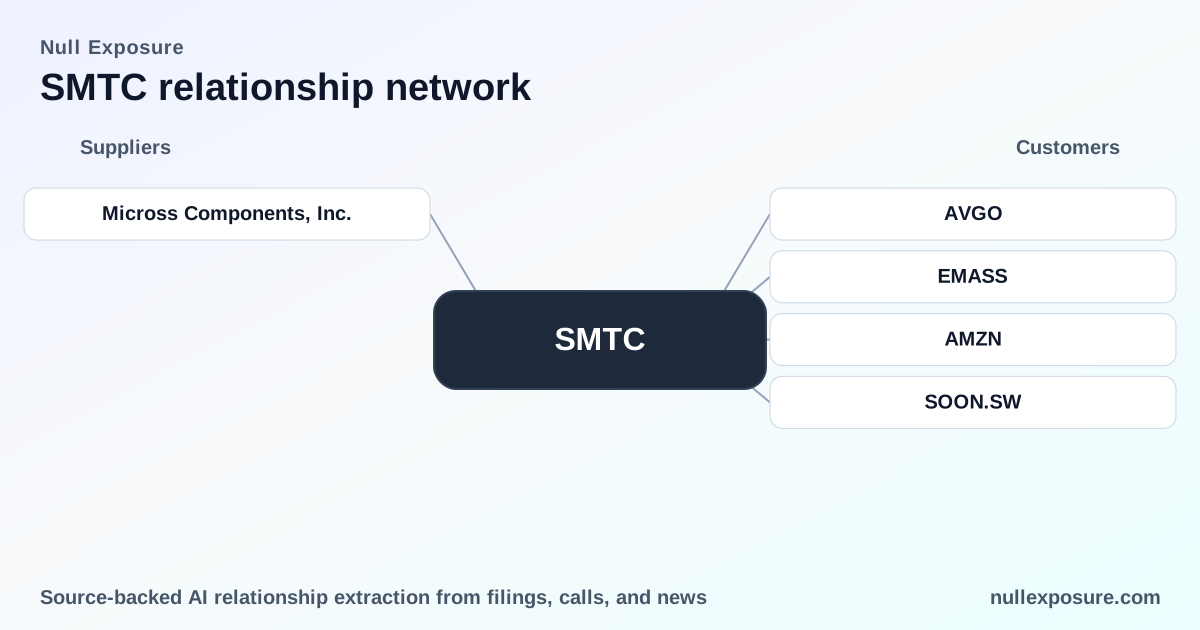
Semtech (SMTC): Customer Relationships That Drive IoT, Optical and Edge AI Revenue
Semtech monetizes through a mix of semiconductor product sales, connectivity services and embedded licensing — selling low-power LoRa radios, optical transceivers and mixed-signal ICs to platform leaders, OEMs and distributors while also recognizing recurring revenue from cloud/connectivity subscriptions and usage-based services. The company’s GTM combines high-volume parts sold through independent distributors with increasingly strategic, engineered engagements that position Semtech as a technology partner across IoT, data center optics and edge AI. For the investor, the key read: Semtech’s growth depends on scalable distribution channels plus a handful of large platform customers that convert product wins into system-level adoption. For more detail on Semtech’s customer footprint and research signals, visit https://nullexposure.com/.
Investment thesis, briefly
Semtech competes where low-power wireless reach (LoRa) and high-performance analog/optical ICs create structural differentiation. Revenue is bifurcated: broad-based distributor-driven semiconductor sales that scale with device cycles, and higher-margin, partnership-driven engagements in connectivity and optical subsystems that underpin longer product lifecycles. Institutional interest reflects this mix: Semtech’s valuation embeds growth expectations in LoRa expansion and optical wins even as near-term margins and EPS fluctuate.
What the relationships demonstrate in one take
- Breadth and depth: relationships span cloud/platform leaders (Amazon), hyperscaler optics and switch vendors (Broadcom, NVIDIA), specialist partners (POET, EMASS), and vertical OEMs (Sonova, Verizon Frontline).
- Channel concentration: independent distributors historically account for the majority of net sales, creating both scale and single-point distributor risk.
- Geographic concentration: Asia-Pacific, particularly China, is a material revenue driver, while the U.S. remains a meaningful but smaller share.
- Contracting mix: Semtech operates with short-term distribution contracts while also recognizing subscription and usage-based revenue within its connectivity businesses.
Customer relationships: the list every investor should know
Below are each of the relationships surfaced in the most recent signals, with a concise plain-English description and a source reference.
-
EMASS — Semtech’s LoRa transceivers are integrated into EMASS’s ECS‑DoT family of AI-enabled SoCs to enable long-range, ultra-low-power edge AI products for industrial and security use cases; featured together at CES 2026. (Embedded.com and SimplyWall.st coverage, March 2026)
-
Broadcom / AVGO — Semtech demonstrated extended-reach 800G and 1.0T switch connectivity using Semtech silicon connected to Broadcom Tomahawk platforms, indicating Broadcom customers are trialing Semtech optics as replacements for copper DACs. (SMTC Q1 2026 earnings call; InsiderMonkey transcript, March–May 2026)
-
Amazon / AMZN — Semtech’s LoRa modulation remains the core radio for Amazon Sidewalk as Amazon expands the network internationally through 2026, underscoring Sidewalk as a major channel for LoRa endpoint proliferation. (BitGet news and multiple Finviz reports, March–May 2026)
-
POET (Poet Technologies) — Semtech supplied FiberEdge 200G‑per‑lane receiver IP integrated with POET’s Optical Interposer to produce 1.6T receiver optical engines, with immediate sampling reported to accelerate optical subsystem adoption. (TS2.tech and Trefis coverage, October 2025–March 2026)
-
NVIDIA — Semtech TIAs and laser drivers are powering NVIDIA 1.6T DR4 transceivers demonstrated in NVIDIA switch platforms, positioning Semtech components inside high-bandwidth AI data-center fabrics. (InsiderMonkey coverage of Q4 FY2026 call references, May 2026)
-
Sonova (SOON.SW) — Sonova selected Semtech to co-develop an ultra-small, ultra-low-power wireless radio and power-management IC for hearing and wearables applications, a classic OEM design-win that converts into multi-year product content if adopted at scale. (SMTC Q1 2026 earnings call, March 2026)
-
Verizon (VZ) — Verizon Frontline named Semtech as a Verified Partner, highlighting a channel relationship where Semtech’s connectivity solutions are positioned for enterprise/first-responder use cases. (SimplyWall.st report referencing Verizon Frontline announcement, May 2026)
Each relationship is supported by public company commentary or press coverage noted above; these engagements collectively map Semtech’s reach across consumer, enterprise and hyperscale ecosystems.
What the relationship mix implies about Semtech’s operating model
Semtech’s customer fabric combines transactional volume through independent distributors with strategic partnerships that are system-critical for select verticals:
-
Contracting posture: The company operates with short-term distribution agreements that allow partners to terminate with little notice, while portions of its IoT Systems & Connectivity revenue come from subscription or consumption-based arrangements where revenue is recognized ratably or by usage. This mix delivers flexibility but elevates revenue volatility relative to long-term OEM contracts. (Company filings summarized for FY2023–FY2025)
-
Channel concentration and criticality: Authorized distributors accounted for ~72% of net sales in FY2025, making distributor relationships materially important to top-line execution and collections. Loss of distributor access would materially disrupt revenue flow. (FY2025 fiscal disclosures)
-
Geographic exposure: Asia‑Pacific dominates, with APAC representing approximately 64% of net sales in FY2025 and China alone comprising 43% of revenue, creating exposure to regional demand cycles, trade dynamics and logistics risk. The U.S. accounted for roughly 21% in FY2025. (FY2025 regional disclosure)
-
Revenue characteristics: Product licensing for on-premise software is recognized upfront at delivery, while cloud/connectivity revenues are either subscription-based (ratable) or usage-based (metered), introducing recurring and elastic revenue components to the model. (Revenue recognition excerpts)
These operating characteristics explain why Semtech’s share price is sensitive to both distributor inventory cycles and headline design wins with platform partners.
Risks and upside to monitor
- Risk — Distributor dependency: the heavy reliance on independent distributors makes near-term results vulnerable to channel inventory swings and negotiating pressure on pricing and payment terms.
- Risk — China concentration: with 43% of sales in China (FY2025), any regional slowdown or trade tension will disproportionately affect Semtech.
- Upside — Platform adoption: continued Amazon Sidewalk international rollout, broader adoption of Semtech optics in Broadcom/NVIDIA switch ecosystems, and emerging use cases with EMASS/POET can convert into sustainable higher-margin engagements.
Bottom line and next steps
Semtech’s customer relationships demonstrate a clear strategic pathway: LoRa scale through platforms like Amazon, and optical/analog platform wins with Broadcom and NVIDIA that embed Semtech IP into long-lived data-center hardware. Distribution gives the company reach but creates cyclicality and concentration risk; partners and design wins are the primary mechanism for durable margin improvement.
For institutional research and deeper relationship tracking on Semtech, explore Null Exposure’s full coverage at https://nullexposure.com/.