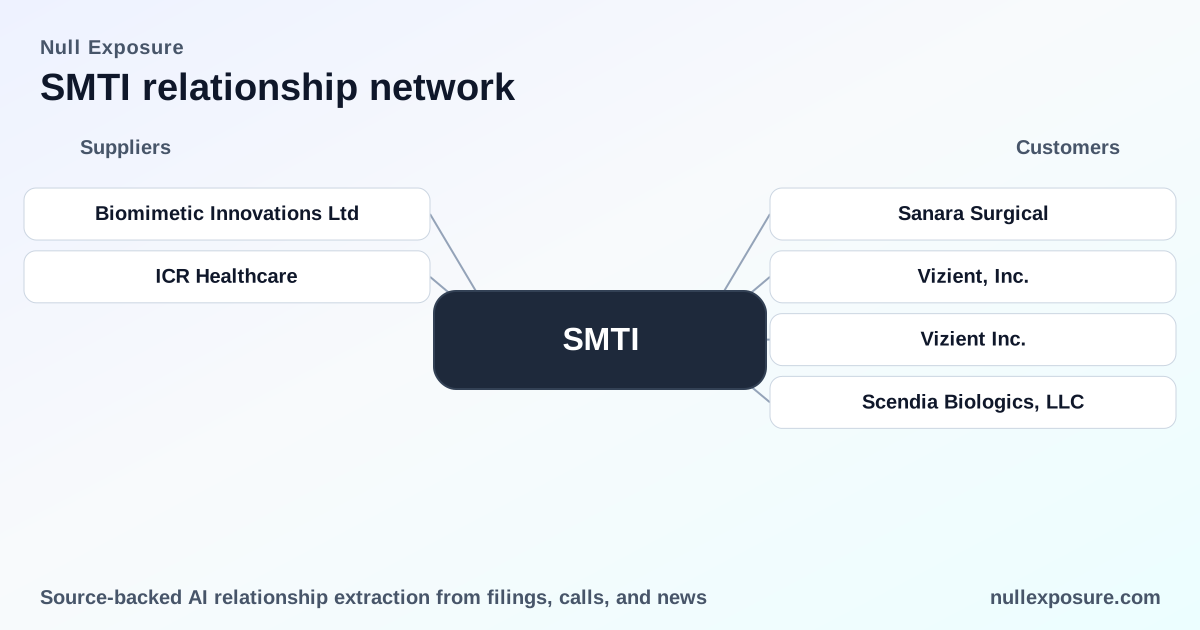
Sanara MedTech (SMTI): Customer Relationships and Commercial Footprint
Sanara MedTech develops, markets and distributes surgical, wound and skin-care products and monetizes through direct sales, distributor agreements and institutional contracts that secure contracted pricing and pre‑negotiated terms for healthcare providers. The company sells proprietary technologies (notably BIASURGE and advanced wound-care lines) into hospitals, ambulatory surgical centers and post‑acute care via a mix of direct channel and distributor relationships, and expands reach through GPO contracts and partnership agreements. For quick access to the full research platform, see https://nullexposure.com/.
Investment thesis in one paragraph
Sanara is a commercialization-stage medical technology operator converting device and wound‑care IP into recurring institutional revenue through a hybrid go‑to‑market: direct proprietary sales via the Sanara Surgical segment, complemented by distributor relationships and GPO contracting that offer scale and price discipline. Key value drivers for investors are adoption of BIASURGE in surgical workflows, incremental revenue from Vizient contracting, and channel economics from distribution and partnership deals; primary risks are adoption tempo, reimbursement dynamics, and customer concentration dynamics even as company disclosures position material customer concentration as low.
Where the revenue actually comes from — the corporate customer line
Sanara’s FY2024 disclosure is unambiguous: Sanara Surgical generated all net revenue for 2023 and 2024, framing the Sanara Surgical segment as the operational sales engine through which the company monetizes its products and services (FY2024 Form 10‑K). This underlines that Sanara’s reported topline is driven by its own commercial segment rather than a set of external single large customers (Sanara Surgical — FY2024 10‑K).
Vizient contract: a distribution multiplier for BIASURGE
Sanara announced that its BIASURGE Advanced Surgical Solution received an Innovative Technology contract from Vizient, making the product available to Vizient’s network under contracted pricing and pre‑negotiated terms effective January 1, 2026. The Vizient agreement significantly broadens access across US hospitals that source through the GPO, potentially accelerating procurement cycles and adoption (GlobeNewswire press release, January 7, 2026; company FY2025/Q4 releases, Jan–Mar 2026).
InfuSystem partnership: wound‑care channel extension
Sanara entered a partnership with InfuSystem in 2022 to enable InfuSystem to offer Sanara’s advanced wound‑care products alongside other NPWT solutions, extending Sanara’s reach into InfuSystem’s customer base for home and outpatient therapy (GlobeNewswire press release, November 3, 2022). This relationship is a channel play that targets post‑acute and outpatient wound‑therapy markets through an established service provider (InfuSystem partnership announcement, 2022).
Scendia Biologics: consolidation of a sub‑distributor and JV partner
Sanara completed the acquisition of Scendia Biologics in mid‑2022; prior to the deal Scendia acted as a sub‑distributor and joint‑venture partner for Sanara products. The acquisition brought distribution capacity and biologics capabilities in‑house, reducing reliance on that third‑party channel (GlobeNewswire press release, July 5, 2022).
What these relationships mean for Sanara’s operating model
- Channel mix and contracting posture: Company disclosures and press releases show a deliberate mix of direct sales (Sanara Surgical), distributor partnerships and GPO contracting (Vizient). This creates a two‑pronged go‑to‑market where large institutional contracts provide breadth while distributors and partnerships deliver niche or regional penetration.
- Contract maturity and pricing: Disclosures indicate an appetite for medium‑term, structured arrangements—company commentary elsewhere notes multi‑year contract frameworks and value‑based pricing structures (company filings and guidance language). Expect contracts that include multi‑year provisions and a mix of episodic and value‑based pricing, which supports revenue visibility but requires sustained clinical and economic performance.
- Concentration and materiality: The company’s FY2024 filing states no single customer accounted for 10% or more of annual sales or receivables, signaling low customer concentration at the aggregate level, even as sales are executed through the Sanara Surgical segment (FY2024 10‑K).
- Role dynamics: Sanara both sells directly (its Sanara Surgical segment markets and distributes products to hospitals and clinicians) and leverages distributors; company disclosures reference exclusive distribution agreements and a network of surgical specialty distributors and credentialed representatives. The company’s prior acquisition activity (Scendia) demonstrates a preference to internalize strategic distribution when advantageous.
- Geographic focus and scale: Commercial activity and product availability are concentrated in the U.S. surgical and advanced wound‑care markets, aligning product development and commercial investments with domestic adoption and reimbursement realities.
Relationship-by-relationship recap (each with a source)
- Sanara Surgical — For the years ended December 31, 2024 and 2023, all of the company’s net revenue was generated from Sanara Surgical, establishing it as the company’s operational sales segment (FY2024 Form 10‑K).
- Vizient, Inc. — BIASURGE received an Innovative Technology contract from Vizient, effective January 1, 2026, giving Vizient’s client network access to the product at contracted pricing and pre‑negotiated terms and materially expanding procurement pathways (GlobeNewswire press release, January 7, 2026; subsequent company Q4/FY2025 reporting in March 2026).
- INFU (InfuSystem) — A 2022 partnership agreement enables InfuSystem to offer Sanara’s advanced wound‑care product line alongside other NPWT devices to InfuSystem’s customers, extending Sanara’s home and outpatient presence (GlobeNewswire press release, November 3, 2022).
- Scendia Biologics, LLC — Before Sanara’s acquisition of Scendia in 2022, Scendia acted as a sub‑distributor and JV partner for Sanara products; the transaction internalized that distribution capability (GlobeNewswire press release, July 5, 2022).
Key takeaways for investors and operators
- Commercial leverage from Vizient is the most consequential near‑term distribution event: GPO contracting materially reduces friction for hospital procurement and should improve penetration if clinical and cost signals are favorable.
- Revenue is driven through the Sanara Surgical segment, so investors should monitor adoption metrics, unit economics and the conversion of GPO access into booked revenue.
- Customer concentration is low at the reported level, but the business relies on institutional adoption pathways that can produce lumpier procurement; operational execution across direct and distributor channels is therefore critical.
- Partnerships and M&A (InfuSystem collaboration, Scendia acquisition) are explicit levers to expand reach and internalize distribution; continued strategic allocation here will determine channel efficiency and margin profile.
For a concise, investor‑grade dossier and relationship tracking dashboard on Sanara MedTech, visit https://nullexposure.com/ to access the underlying filings and curated news chronology.