SolarMax Technology (SMXT): Project-led revenue growth from EPC battery storage contracts
SolarMax Technology operates as an integrated solar and battery energy storage contractor that monetizes through three primary channels: EPC (engineering, procurement and construction) contracts for utility-scale BESS projects, sale and installation of distributed PV and battery systems in California, and periodic energy sales under PPAs for assets it develops or services. Recent public announcements show SolarMax accelerating into large BESS EPC work that can materially shift revenue mix and backlog. For deeper diligence and contextual deal-mapping, see https://nullexposure.com/.
Why the new contracts change the investment story
SolarMax has transitioned from a predominantly residential and small commercial installer to a contractor bidding larger utility-scale storage projects through its subsidiary SolarMax Renewable Energy Provider, Inc. Large EPC awards (hundreds of millions) are lumpy and back-end loaded; they drive revenue growth but create execution and working-capital demands. The company’s financials still show negative EBITDA and slim gross profit relative to revenue, so scaling EPC execution is the immediate operational imperative.
What the company disclosures say about how it contracts and delivers
Company-level disclosures and filings present a clear operating posture: SolarMax routinely wins multi-year engagements and recognizes over-time revenue for construction activities. The material signals are:
- Long-term contracting posture: Disclosures state agreements generally have a ten-year term and the company recognizes revenue on a cost-based input method for long-term construction contracts, indicating multi-year project economics and revenue recognition aligned with progress.
- Mixed payment terms: The company also uses short-term payment terms for product deliveries (typically on delivery or 30 days), with limited extended terms up to 12 months in special cases.
- Usage and PPA exposure: For energy sold under PPAs, the company recognizes revenue based on delivered energy volumes, creating a usage-based, recurring revenue element separate from EPC lump-sum work.
- U.S.-centric operations: All recent revenue has been generated by the United States segment, with concentrated installation activity in California; China-related operations have been inactive in recent years.
- Seller + service provider role: SolarMax functions both as a seller of installed systems and as a general contractor for commercial and utility projects, relying on licensed subcontractors for on-site execution.
These are company-level signals about business model concentration, maturity and contractual mix rather than statements about any single counterparty.
Customer relationships and project counterparties (what we found)
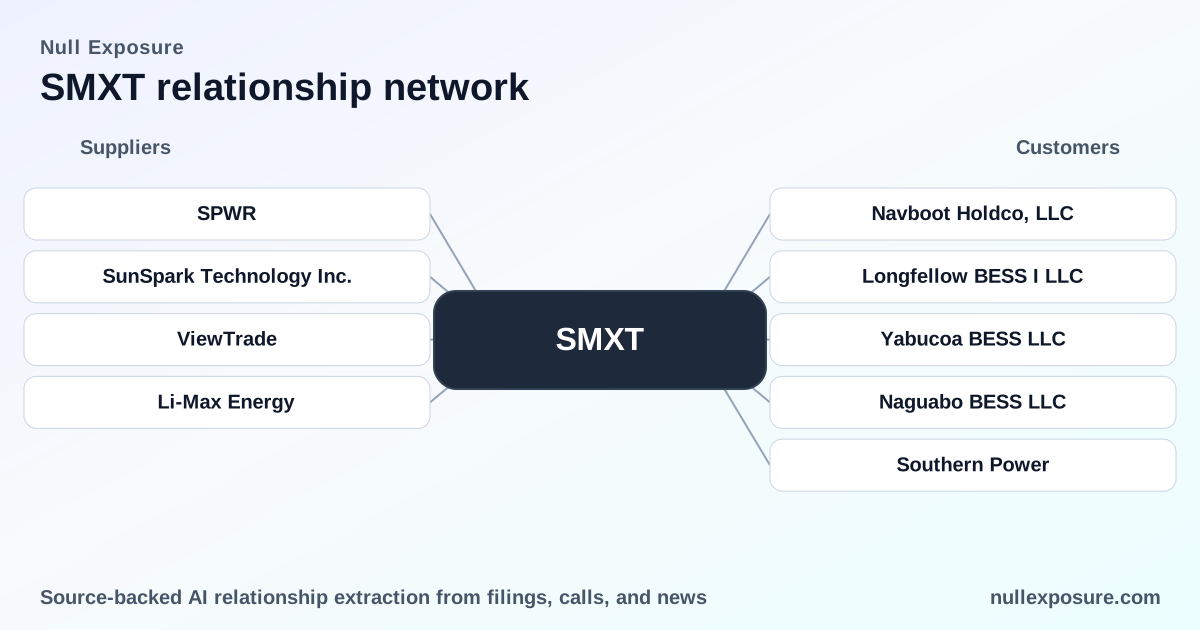
Below are the customer and project counterparties disclosed in public reporting and news, with concise takeaways and source citations.
Naguabo BESS LLC
SolarMax’s subsidiary signed an EPC agreement with Naguabo BESS LLC for a utility-scale battery energy storage project in Ceiba Municipality, Puerto Rico, forming part of a two-project Puerto Rico engagement. Source: GlobeNewswire distribution via EnergyDigital press release, May 3, 2026.
Yabucoa BESS LLC
SolarMax’s subsidiary entered into an EPC agreement with Yabucoa BESS LLC for a utility-scale BESS in Humacao, Puerto Rico; the award was announced alongside the Naguabo contract. Source: GlobeNewswire distribution via EnergyDigital press release, May 3, 2026.
Yabucoa (as referenced in trading news)
Trading outlets reported the same Yabucoa agreement in headline form (Agreement 2), reinforcing market visibility of the Puerto Rico EPC awards. Source: TradingView news summary, May 3, 2026.
Navboot Holdco, LLC
SolarMax announced a large EPC contract with Navboot Holdco, LLC for a Corpus Christi, Texas battery storage project valued at approximately $258.1 million, representing a material contract for the company’s backlog. Source: Company announcement syndicated via QuiverQuant and multiple news outlets, March 10, 2026.
Navboot (alternate listing)
Newswire feeds and market reporting repeated the Navboot disclosure as a separate listing in their headlines (Agreement 3), providing additional distribution and investor awareness of the Corpus Christi award. Source: TradingView and Marketscreener coverage, March 10, 2026.
Longfellow BESS I LLC
SolarMax’s subsidiary contracted with Longfellow BESS I LLC to provide EPC services for a 430 MWh battery energy storage system in Pecos County, Texas, work that contributed to contract revenue recognition in recent quarters. Source: RagingBull reporting and company progress comments, March 2026 (project activity reported as FY2025/FY2026).
Longfellow (alternate listing)
Trading summaries listed Longfellow as the counterparty in project activity descriptions and in the company’s 10-K commentary about EPC work and revenue recognition tied to the Longfellow engagement. Source: TradingView synopsis of company filings and press commentary, 2026.
Southern Power
Historical commentary (2018) identified Southern Power as a utility counterparty in prior China and regional strategies; it is cited as a past utility relationship and bank-relationship context rather than a current EPC counterparty. Source: pv‑magazine interview/Q&A, March 27, 2018.
Financial and operational implications for investors
- Revenue concentration and lumpy cash flow: Recent EPC awards (Navboot, Longfellow, Puerto Rico projects) are large relative to trailing revenue (Revenue TTM ~$90.98M). These projects will materially influence quarterly revenue recognition and working capital needs.
- Margin and profitability pressure during scale-up: SolarMax’s latest reported EBITDA is negative and gross profit is modest; heavy EPC activity risks compressing margins if procurement, logistics or subcontractor execution underperform. Execution risk is the primary near-term equity risk.
- Contract maturity and counterparty mix: Company disclosures show a blend of long-term construction contracts, PPAs and short-term product sales. This duality creates both predictable, usage-based cash flows (PPAs) and lumpy, high-volatility project revenues (EPC).
- Geographic concentration: Despite project awards in Texas and Puerto Rico, the firm’s historical revenue base and installation operations are concentrated in California and the U.S., which concentrates regulatory and weather exposure.
Portfolio decision points
Investors assessing SMXT should weigh three linked considerations: (1) execution capability on large EPC projects, (2) cash and balance-sheet capacity to fund contracts through construction, and (3) the company’s ability to convert project backlog into recurring PPA or O&M revenue. For a more detailed counterparty map and to track future contract announcements, visit https://nullexposure.com/.
Bottom line: SolarMax is shifting its revenue profile toward large, high‑impact EPC BESS contracts which can accelerate growth but raise execution, working‑capital and margin volatility risks. Investors must trade the upside of substantial backlog against the operational discipline required to deliver multi‑hundred‑million dollar projects on time and within budget.