Snap Inc. (SNAP) — Customer Relationships, Revenue Drivers, and Operational Constraints
Snap Inc. operates a camera-first social platform that monetizes primarily through advertising on Snapchat while layering higher-value offerings — augmented reality (AR) experiences, subscription-like services, and sponsored AI features — to diversify revenue. Core monetization remains impression-based ad sales to brands, agencies and a mix of small and large advertisers, while strategic partnerships with AR, measurement and AI firms produce incremental and sometimes sizable, short-duration revenue streams. For investors, the key read is simple: Snap’s top-line stability depends on high-frequency, short-term ad contracts supplemented by episodic large partnership deals that can materially swing annual revenue.
Explore focused relationship intelligence at NullExposure.
Why these relationships matter to investors
Snap’s customer relationships reveal a hybrid revenue model: high-volume, usage-based advertising plus discrete commercial agreements that are short in duration or subscription-limited. Operating characteristics that follow from the company disclosures:
- Contracting posture: Advertising contracts typically settle on an impressions-delivered basis or as fixed-fee arrangements recognized ratably over short service periods. Subscription revenue is recognized ratably over terms generally one year or less, indicating limited long-term revenue lockups.
- Concentration and spend: Advertising customers range from small businesses to major brands; Snap records both high-volume advertiser traffic and mid-sized anchor buys (a disclosed affiliate group purchased roughly $16.9 million of ad product in 2025).
- Criticality and maturity: Ads are Snap’s core product and account for the substantial majority of revenue; AR and AI partnerships are strategic enhancers but not yet core recurring revenue lines.
- Geographic footprint: Billing-address revenue is concentrated in North America (
$3.47B) with meaningful EMEA contribution ($1.09B), underscoring sensitivity to regional advertiser demand cycles.
These signals drive an operational profile of high revenue churn, predictable seasonality, and episodic upside from one-off enterprise deals — a mix investors should value differently than companies with long-term SaaS contracts.
Relationship breakdown — who pays Snap, and why it matters
IAS — attention measurement for Snapchat (IAS)
IAS entered a strategic partnership with Snap and Lumen Research to deliver customized attention measurement for Snapchat ad placements, improving advertisers’ ability to quantify ad engagement on the platform. According to IAS’s Q2 2025 earnings call, the collaboration targets richer advertiser measurement capabilities tied directly to Snapchat inventory and should improve yield for premium placements.
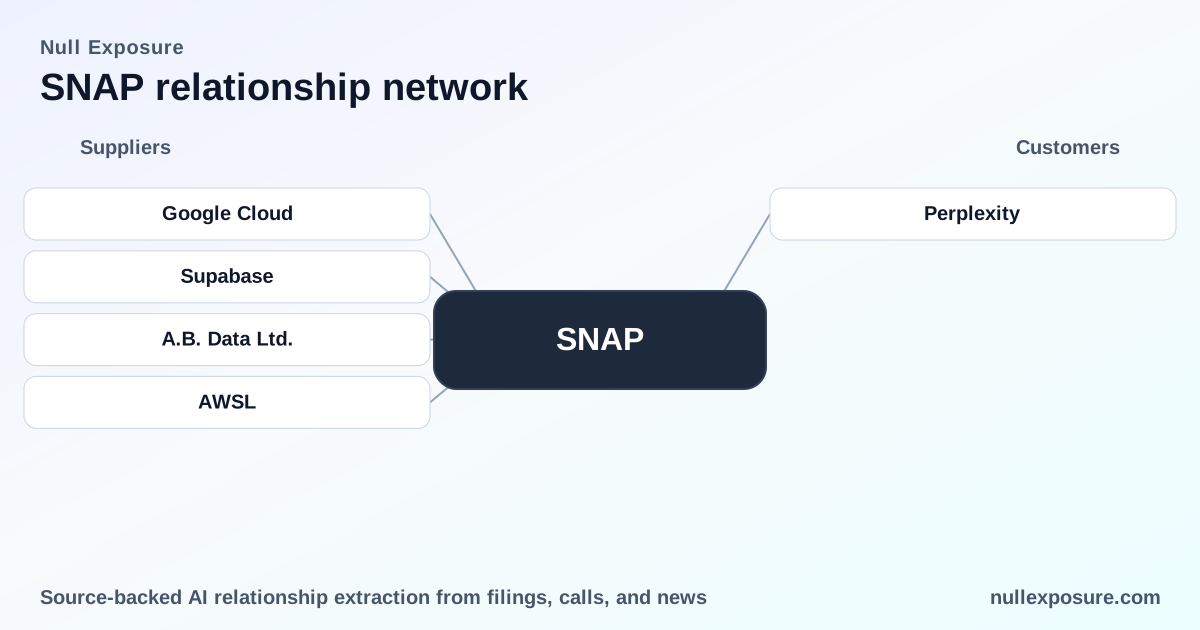
Perplexity — large incremental revenue commitment (Perplexity)
A market report in FY2025 identified a deal in which Perplexity is slated to pay $400 million to Snap over one year, constituting a sizable, largely incremental revenue stream for that period. This kind of transaction demonstrates how one-off enterprise agreements can materially boost Snap’s annual revenue beyond base ad sales.
Perfect Corp — AR virtual makeup experiences (PERF)
Perfect Corp supplies AR virtual makeup technology integrated into Snapchat’s AR ecosystem, enabling shoppable AR beauty experiences that drive engagement and advertiser spend. MarketScreener coverage in FY2025 referenced Perfect Corp’s AR Virtual Makeup offerings for Snapchat as part of Snap’s broader AR monetization strategy.
Shake Shack — Arcadia partnership for branded AR (SHAK)
Snap’s Arcadia initiative, launched to commercialize mobile AR advertising, secured partnerships at launch including Shake Shack alongside P&G Beauty and other brands, positioning branded AR experiences as a premium advertising channel. Snap’s own newsroom announcement (FY2021) details these early Arcadia partnerships and their role in monetizing advanced AR units.
Experian — Snapchat AI Sponsored Snaps integration (Experian)
Experian integrated with Snapchat AI Sponsored Snaps to expand financial education content within the platform, signaling brand use of Snapchat’s AI-sponsored formats for content-driven advertising. Marketscreener reported this integration in FY2025, illustrating cross-industry adoption of Snapchat’s AI-enabled advertising products.
What these relationships imply for revenue, risk, and valuation
- Revenue volatility is structural. The Perplexity $400 million commitment exemplifies how large, short-duration deals create step-changes in revenue that are not guaranteed to recur. Snap’s standard revenue recognition (impression-based or short-term fixed fees) produces a cyclical and event-driven revenue profile.
- Ads remain the revenue backbone. As Snap discloses, the substantial majority of revenue comes from advertising on Snapchat; AR and AI partnerships increase monetization per user but are currently additive rather than core recurring engines.
- Contract maturity is short. Evidence shows subscription terms are generally one year or less and fixed-fee services are typically recognized over periods under 30 days, constraining forward revenue visibility relative to enterprise SaaS models.
- Spend concentration is moderate. While the advertiser base spans small businesses to large brands, the company disclosed an affiliate group purchasing about $16.9 million of ad products in 2025 — a mid-range anchor that underscores a reliance on a mix of many small buyers and a handful of larger spenders.
- Geographic risk is real but diversified. North America drives the largest share of billed revenue (
$3.47B) with Europe ($1.09B) contributing meaningfully; regional ad market weakness in either region will transmit directly to Snap’s top line.
Key financial context: Snap reported roughly $5.93B in trailing twelve-month revenue with negative EPS (-$0.26) and a modest positive operating margin figure in TTM reporting. Analysts’ consensus pricing and rating mix signals continued scrutiny around profitability and growth trade-offs.
Bottom line and investor action
Snap’s business is an advertising engine with optionality from AR and AI partnerships; investor returns will track execution on monetizing new ad formats and the company’s ability to convert episodic large contracts into repeatable revenue. Monitor the cadence of enterprise agreements like the Perplexity arrangement, the commercialization of Arcadia partnerships, and the spread between usage-based ad revenue and subscription/short-term fixed-fee income.
For research teams and operating partners seeking continuous coverage and deal-level intelligence on Snap and comparable digital-ad platforms, visit NullExposure for tailored relationship analytics and on-demand reporting.
Actions for investors:
- Watch for renewal or follow-on deals to large one-year commitments; absent recurrence, revenue will normalize to core ad sales.
- Track uptake and ROI performance of AR and AI ad units, as measurement partners (e.g., IAS) materially affect advertiser willingness to pay.
- Pay close attention to regional advertiser trends in North America and EMEA for forward revenue signals.
Primary takeaway: Snap combines a high-frequency advertising core with episodic, high-impact partnerships; valuation should reflect both the structural volatility of impression-based revenue and the upside from successfully commercializing AR/AI formats.