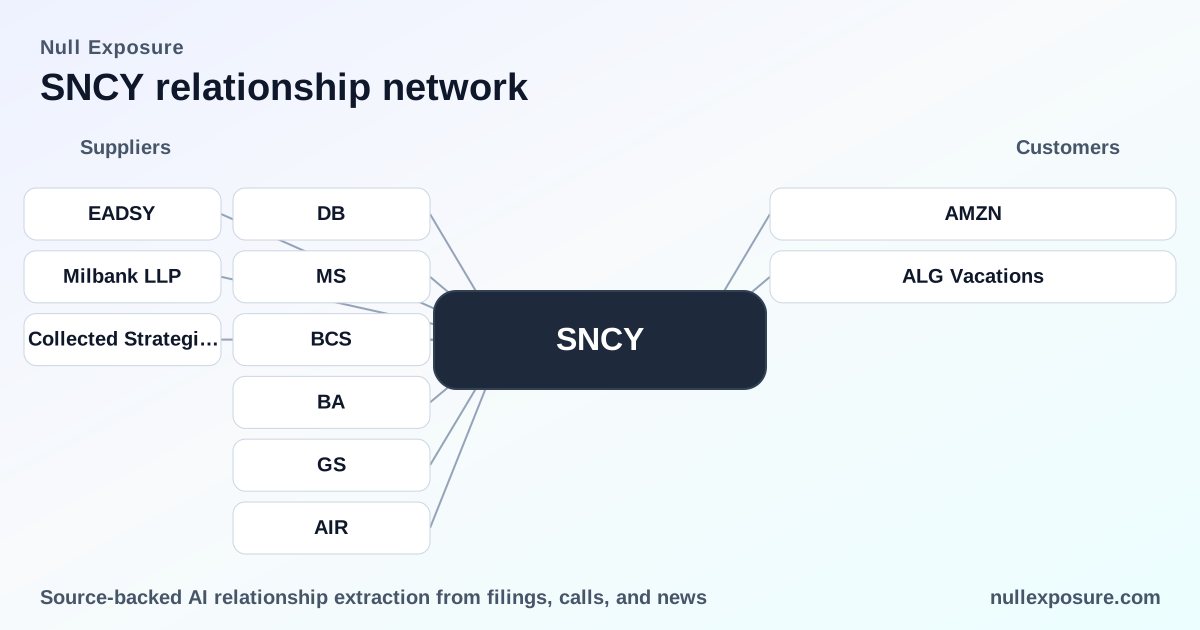
Sun Country (SNCY) — Customer Relationships and the Amazon Flywheel
Sun Country operates a hybrid leisure airline with a significant, asset-light cargo business executed under long-term contracts. The company monetizes through passenger fares and ancillary services, charter agreements, and a multi-year Crew, Maintenance and Insurance (CMI) arrangement and ATSA with Amazon that pays fixed aircraft, flight and block-hour fees — a combination that turns aircraft utilization into a predictable revenue stream and concentrates operational risk. For deeper coverage of commercial relationships and contract-level signals, visit https://nullexposure.com/.
Why Amazon defines Sun Country’s commercial posture
Sun Country’s cargo relationship with Amazon is the dominant customer story in the public record: Amazon provides aircraft under sublease and Sun Country provides crew, maintenance, and insurance, with a confirmed fleet scale and multi-year commercial structure. Below I cover every cited relationship entry in the public results so investors can trace the reporting sources and assess commercial concentration.
Earnings call: completion of the cargo expansion (2025 Q3)
This quarter’s earnings call states, “This quarter marked the completion of our cargo expansion with all 20 aircraft now operating under the Amazon contract,” highlighting that the Amazon fleet scale reached 20 freighters as of 2025 Q3. The company disclosed this on its 2025 Q3 earnings call (March 2026).
QuiverQuant: corporate description referencing Amazon (FY2025)
A QuiverQuant press release used Sun Country’s corporate description to note that the airline provides cargo service to Amazon across the U.S., Mexico, Central America, Canada and the Caribbean, underscoring Amazon’s role in Sun Country’s cargo footprint (QuiverQuant, March 2026).
Duplicate earnings-call record (same 2025 Q3 transcript)
The 2025 Q3 earnings call is also captured under the name “Amazon” in the results, reiterating the completion of the 20-aircraft phase of the Amazon contract (2025 Q3 earnings call, March 2026).
MarketRealist: origin of Amazon cargo flights (FY2021)
MarketRealist reported that Sun Country began flying cargo for Amazon in May 2020 with an initial flight from Florida to Kentucky, establishing the operational origin of the CMI relationship (MarketRealist, FY2021).
MarketRealist duplicate entry (same FY2021 passage)
A second MarketRealist mention repeats that May 2020 start for Amazon cargo flights, which is the historical anchor for the current contract (MarketRealist, FY2021).
QuiverQuant schedule note (FY2025)
A QuiverQuant schedule update reiterates Sun Country’s public positioning as a leisure and VFR carrier that also provides cargo services to Amazon, reinforcing multi-segment revenue reporting (QuiverQuant, FY2025).
Intellectia.ai: investigation story with CMI language (FY2026)
An Intellectia.ai piece references an investigation and quotes Sun Country language that it provides crew, maintenance and insurance (CMI) service to Amazon.com Services, LLC, confirming the specific contractual role Sun Country plays (Intellectia.ai, FY2026).
Intellectia.ai duplicate (AMZN) entry
A second Intellectia.ai capture lists the same CMI description and highlights the company’s operational scope with Amazon (Intellectia.ai, FY2026).
Finviz: Allegiant acquisition report (FY2026)
Finviz reported that Sun Country shares jumped after Allegiant struck a deal to acquire Sun Country for roughly $1.5 billion, a corporate-development item that directly affects Sun Country’s customer portfolio (Finviz, May 2026).
QuiverQuant flight-schedule extension (FY2025)
QuiverQuant also covered an extended Sun Country flight schedule and reiterated cargo service to Amazon as part of the airline’s public communications (QuiverQuant, FY2025).
QuiverQuant duplicate (AMZN) citation
A duplicate QuiverQuant entry reiterates the same corporate description and Amazon mention (QuiverQuant, FY2025).
Allegiant investor release referencing Sun Country’s Amazon role (FY2026)
Allegiant’s investor release describing the combination noted that Sun Country remains a major narrow-body freighter operator with a multi-year agreement with Amazon Prime Air, explicitly recognizing the Amazon contract in the rationale for combination (Allegiant IR release, March 2026).
WBOC: law firm investor alert about Allegiant sale (FY2026)
WBOC cited a law firm investigating the proposed sale of Sun Country to Allegiant, an event that introduces process and valuation scrutiny for the company’s Amazon-linked cash flows (WBOC, May 2026).
Allegiant IR duplicate referencing Amazon (FY2026)
Allegiant’s release appears again in the record stating Sun Country’s cargo operations and Amazon relationship as part of the combination rationale (Allegiant IR release, March 2026).
Allegiant IR noting Amazon Prime Air (FY2026)
Allegiant’s release explicitly mentions Amazon Prime Air and Sun Country’s multi-year agreement, tying Sun Country’s operational identity to Amazon’s air-hub strategy (Allegiant IR release, March 2026).
Investing.com: note on expansion supporting Amazon cargo (FY2026)
An Investing.com insider-trading story noted that Sun Country’s fleet/base expansion will primarily support cargo operations for Amazon, confirming strategic capacity allocation to the Amazon relationship (Investing.com, May 2026).
Investing.com: operational base at Cincinnati to support Amazon (FY2026)
Investing.com reported Sun Country’s plan to establish a new operational base at Cincinnati/Northern Kentucky International Airport by Jan 31, 2026, explicitly tied to supporting Amazon’s air hub (Investing.com, May 2026).
Yahoo Finance: public schedule extension mentioning Amazon (FY2026)
Yahoo Finance covered Sun Country’s schedule extension and included the company’s statement that it provides cargo service to Amazon across its network (Yahoo Finance Singapore, March 2026).
Yahoo Finance duplicate (AMZN) entry
A second Yahoo Finance capture repeats the corporate statement about Amazon cargo service (Yahoo Finance Singapore, March 2026).
Investing.com company-news: new base supports Amazon hub (FY2026)
Investing.com also published a company-news note that the new base will primarily support Sun Country’s cargo operations for Amazon, reiterating the strategic geography of the relationship (Investing.com, May 2026).
TravelMarketReport: ALG Vacations seasonal flights run on Sun Country (FY2025)
TravelMarketReport lists ALG Vacations’ use of Sun Country on several seasonal nonstop vacation routes for winter/spring 2026, showing a non-cargo, leisure distribution partnership (TravelMarketReport, FY2025).
Investing.com NG: SVP Neale insider sale with Amazon base tie (FY2026)
Investing.com NG reported an insider sale by an SVP and restated that the Cincinnati base is being established to support Amazon, repeating the operational linkage (Investing.com NG, May 2026).
10-K (Sun Country 2025): Amazon is the only CMI service customer (FY2025)
Sun Country’s 2025 Form 10-K explicitly states “Amazon is currently our only CMI service customer,” confirming single-customer concentration for the CMI arrangement (Sun Country 2025 10‑K, filed Dec 31, 2025).
10-K duplicate entry (identical FY2025 10-K capture)
The 10‑K appears again in the results reiterating that Amazon is Sun Country’s sole CMI customer in the filing (Sun Country 2025 10‑K, filed Dec 31, 2025).
Constraints and what they reveal about Sun Country’s operating model
The public evidence establishes several contract- and business-model signals at company level and, where explicit, linked directly to Amazon:
- Long-term contracting posture: Sun Country signed the original ATSA with Amazon in December 2019 and the A&R ATSA includes an initial term through October 2030 plus renewal options — this is a long-tenor commercial arrangement that stabilizes cargo revenue and capital planning (10‑K evidence).
- Usage-and-fixed hybrid economics: The A&R ATSA includes fixed monthly payments per aircraft and per flight plus an amount per block hour, so revenue to Sun Country is a mix of recurring fixed and variable, utilization-linked components (10‑K evidence).
- Geographic concentration in North America: The operations cited are predominantly U.S., Canada, Mexico and the Caribbean, with new bases (Cincinnati) aligned to Amazon’s U.S. hub topology — this situates the economic exposure regionally (public filings and press coverage).
- Service-provider role and buyer signals: Sun Country functions as service provider under CMI while Amazon acts as the aircraft subleasing buyer; the 10‑K explicitly names Amazon as the only CMI customer, confirming customer concentration for the CMI segment.
- Relationship stage and capacity ramp: The relationship is active and operational at scale (20+ freighters in service as of late 2025, with additional aircraft added in early 2026), and the company described incremental ramp to 22 aircraft, indicating ongoing capacity scaling (earnings call and filings).
- Segment characteristics: Cargo is reported as a services segment (CMI/ATSA) rather than pure asset ownership for Sun Country; this is an asset-light revenue stream complemented by passenger and charter businesses.
Investment implications and risk framework
- Concentration vs. predictability: Amazon provides predictable, long-dated revenue through hybrid fixed/usage contracts, but Sun Country’s CMI revenue is concentrated—the 10‑K confirms Amazon is the sole CMI customer. That concentration supports stable cash flow but raises single-counterparty risk.
- Operational exposure and scalability: The company has demonstrated ability to scale aircraft and bases to meet Amazon demand, which creates operating leverage if utilization stays high; however, integration of fleet and labor to Amazon schedules is a strategic dependency.
- Corporate event risk: The Allegiant acquisition proposal changes control dynamics and will reprice buyer expectations for those Amazon-derived cash flows; Allegiant’s investor materials and market reports anchor that corporate-development risk (Allegiant IR and Finviz coverage).
For analysts and operators modeling SNCY, treat Amazon cash flows as committed but concentrated, with hybrid fixed-plus-usage mechanics and North American operational footprint, and incorporate transaction-level tail risk from the Allegiant combination coverage. For a deeper, structured read on counterparty and contract signals, visit https://nullexposure.com/.