Sonida Senior Living: revenue-driven operator with capital partners stepping in
Sonida Senior Living operates, owns and manages senior housing communities across the United States and monetizes primarily through resident fees for independent living, assisted living and memory care, supplemented by management fees on third‑party properties and opportunistic real‑estate investments. The business model is revenue‑intensive, resident‑centric and capital‑sensitive—operations generate high recurring cash inflows from many small counterparties while capital events (equity injections, mergers) materially reshape the balance sheet and strategic options.
For a concise map of these customer and capital relationships, see Null Exposure: https://nullexposure.com/
How Sonida actually sells and collects — the operating constraints that matter
Sonida’s commercial posture is shaped by the nature of senior housing demand and the mechanics of property management.
- Short‑term contracting posture: Resident lease agreements are generally one‑year terms and are frequently terminable on short notice, which creates ongoing occupancy and churn risk and requires active operational focus on retention (company filing language describing leases and 30‑day notice provisions).
- Usage‑based revenue from management contracts: When Sonida manages communities for third parties it charges fees tied to gross revenues plus incentive fees, aligning Sonida’s economics with occupancy and pricing performance (company disclosures on property management agreements).
- Individual counterparty base, geographically concentrated in the U.S.: The customer is the resident—primarily those aged 75 and older—and Sonida’s footprint is domestic, operating 94 communities across 20 states as of late 2024 (company reporting).
- Business criticality and scale: Resident revenue is a major and critical revenue line—resident receipts represented the vast majority of operating revenues in the cited period (disclosures show resident revenue ≈ $267.8M and a material share of total revenue). That creates a structural dependency on occupancy and resident mix.
- Active, service‑oriented relationships: Sonida both owns and actively manages properties; as of December 31, 2024 it owned or managed 94 communities, including 13 managed for third parties, indicating ongoing, operationally embedded customer relationships rather than one‑off transactions.
- Large revenue base from many small payers: The company’s resident revenue places it in a high spend band at the company level (resident revenue > $100M), but that revenue is fragmented across many individual payers, reducing counterparty concentration risk while increasing operational complexity.
These signals combine into a clear investor framework: Sonida’s revenue is recurring and operationally critical, but sensitive to occupancy trends and demographic mix; capital partners that provide equity or liquidity can materially change strategic flexibility and valuation.
What the recent financing relationships are and why they matter
Below I cover each relationship identified in public reporting and what it implies for investors evaluating Sonida’s customer/capital landscape.
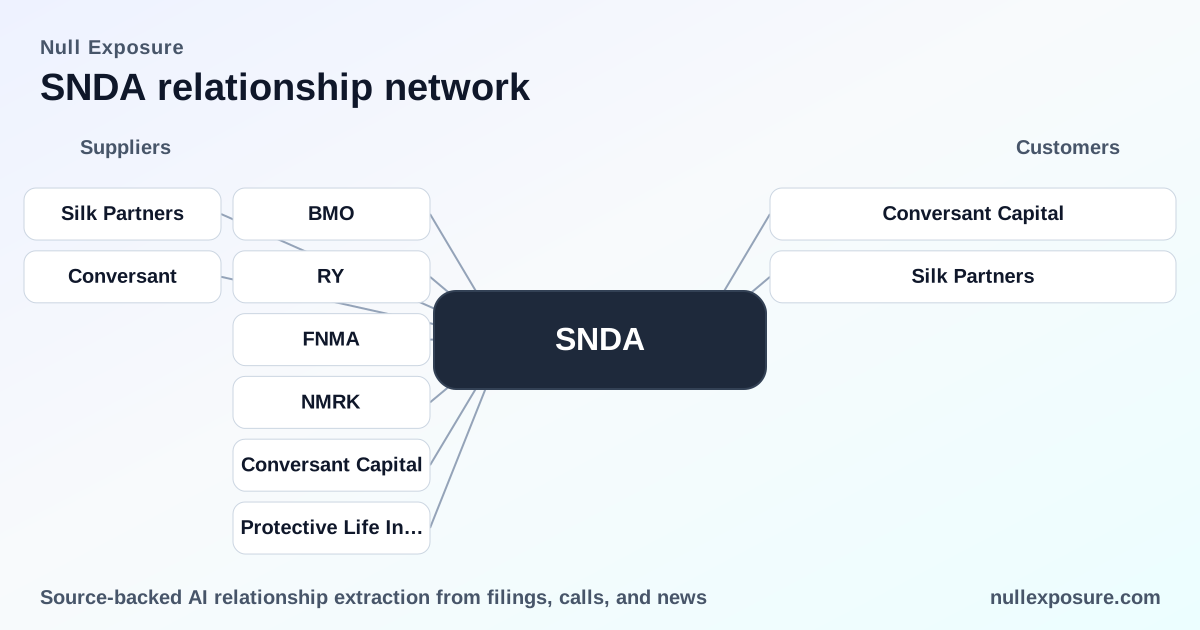
Conversant Capital — strategic equity investor backing the financing package
Conversant Capital agreed to acquire a portion of newly issued Sonida common equity as part of a $110 million placement at a reference price of $26.74. This is a direct capital infusion that strengthens Sonida’s balance sheet and supports the proposed transaction referenced in the same report. A CityBiz report dated March 10, 2026 described the Conversant participation in the equity placement tied to Sonida’s merger activity.
Silk Partners — co‑investor alongside Conversant in the equity issuance
Silk Partners joined Conversant Capital to acquire the remainder of the $110 million newly issued common equity at the same $26.74 reference price. Silk’s participation indicates a co‑investment structure rather than a single‑sourced recapitalization, and it signals third‑party confidence in Sonida’s operating plan associated with the merger announcement. This was also reported by CityBiz on March 10, 2026.
Both entries above reference the same CityBiz article that covered Sonida’s announced transaction activity and the equity placement tied to the broader corporate action.
Why these relationships change the investment calculus
The two investors above are equity acquirers, not customers in the classical sense, but their involvement has immediate consequences for operators and holders of Sonida stock:
- Balance‑sheet flexibility: The $110 million equity infusion reduces near‑term liquidity pressure and creates headroom to execute a merger or portfolio re‑positioning without resorting to high‑cost debt.
- Governance and strategic alignment: Co‑investment by dedicated real‑estate/capital managers like Conversant and Silk typically comes with active oversight and a horizon for operational improvements or asset dispositions—expect governance engagement.
- Valuation signal: Pricing the issuance at $26.74 establishes a mid‑cycle reference point for the company and can influence market perception and target price negotiations; this has direct implications for trading dynamics and potential future primary raises. (CityBiz coverage, March 2026.)
Operational implications for customer relationships and risk
The capital event does not change Sonida’s fundamental customer exposure: resident cash flow remains the core revenue engine and management contracts continue to provide usage‑linked revenue. Key risk and opportunity vectors for operators and investors:
- Occupancy and pricing sensitivity: Short‑term lease terms and an elderly resident base create asymmetric downside if occupancy softens; conversely, improving occupancy and mix generate quick upside through resident revenue and management fee incentives.
- Concentration vs. fragmentation: Revenue reliance on residents is large (material to total revenue), but the counterparty universe is highly fragmented, so institutional counterparty concentration is low—yet operational execution across many sites is critical.
- Capital allocation choices: New equity opens options—portfolio growth, debt paydown, or operational investment—and investor priorities (growth vs. yield vs. restructuring) will determine how resident services and third‑party management are funded.
For investors focused on counterparty dynamics, the combination of short‑term, usage‑linked contracts and a broad base of individual customers makes Sonida more like an operating services company than a pure real estate landlord in terms of revenue volatility and operational leverage.
For more detailed relationship mapping and ongoing coverage, visit Null Exposure: https://nullexposure.com/
Bottom line — what to watch next
- Occupancy and resident mix are the primary operational KPIs; they directly drive resident revenue, management fees and incentive economics.
- Integration of new capital and governance from Conversant and Silk will set the tempo for strategic moves; monitor filings and public statements for governance changes and use of proceeds.
- Short‑term lease structure and usage‑based contracts put a premium on operational execution; investors should price in both downside occupancy risk and upside from rapid operational improvements.
Key takeaway: Sonida is a revenue‑heavy, operations‑intensive senior housing operator whose near‑term trajectory is now materially influenced by a $110 million equity placement backed by Conversant Capital and Silk Partners; that infusion improves flexibility but places a premium on execution across Sonida’s short‑term contracted resident base and third‑party management portfolio.