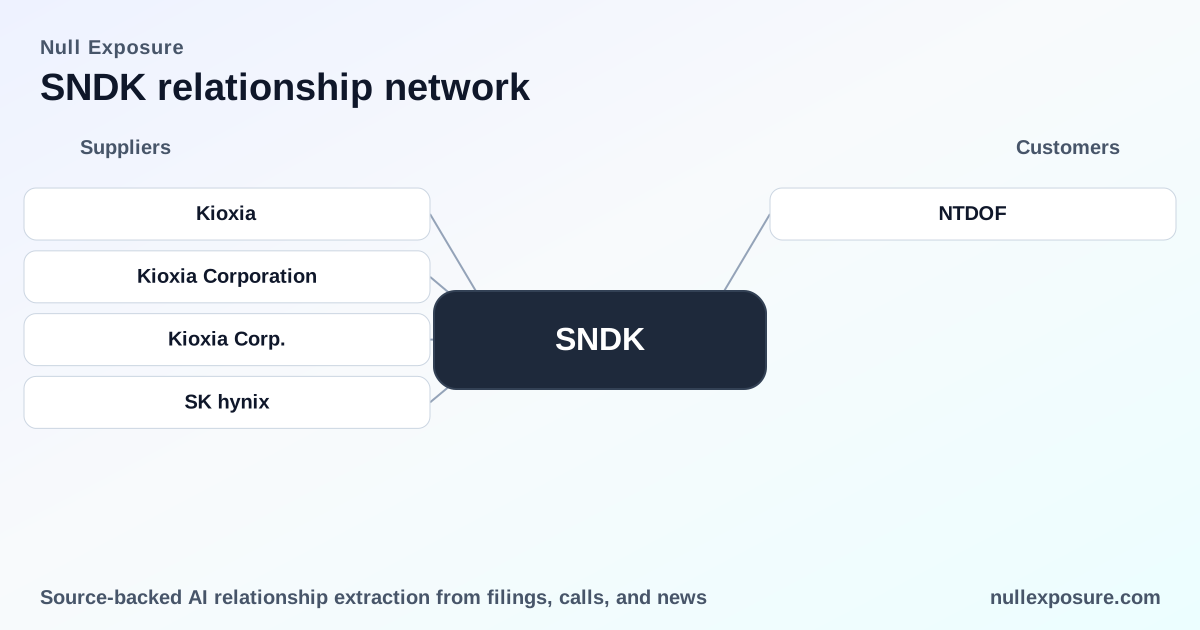
Sandisk (SNDK) — Customer Relationships That Drive Revenue and Risk
Sandisk builds, manufactures and sells NAND flash storage — SSDs, embedded storage, memory cards and USB drives — and monetizes through a mix of OEM contracts, cloud and hyperscaler supply agreements, and retail/reseller channels. Revenue comes from high-volume, hardware-driven sales to very large enterprises and individual consumers across a global footprint, with a growing bias toward hyperscaler demand for AI data centers. For a quick read on our methodology and signals, visit https://nullexposure.com/.
Why customers matter for Sandisk right now
Sandisk is a hardware-centric supplier whose growth and margin profile are directly tied to a relatively small set of large buyers and broad consumer distribution. The company sells through OEMs, resellers and cloud service providers, and its international footprint is dominant — Sandisk reported that international sales represented roughly 80–86% of net revenue across recent years, underscoring global concentration as a structural fact of the business. The company’s contracting posture is therefore a mix of long-term supply relationships with hyperscalers and platform partners, plus high-volume retail/reseller distribution for consumer products.
Key operating-model signals from company disclosures and public reporting:
- Customer mix: Serves both individuals and very large enterprises; Sandisk’s product set addresses the full spectrum from students and gamers to hyperscale cloud customers.
- Geography: Revenue distribution is heavily international — reported regional figures list Asia, Americas and EMEA (Asia: 4,457; Americas: 1,618; Europe/Middle East/Africa: 1,280; total: 7,355 in the referenced revenue breakdown).
- Channels and roles: The company sells to OEMs, resellers, distributors, retailers and cloud providers — indicating a hybrid direct/OEM/reseller contracting posture with different margin and renewal dynamics.
- Segment maturity: Sandisk operates in established hardware markets (SSDs, removable media) where product cycles and manufacturing scale are critical competitive levers. These characteristics create high vendor dependence for a few large buyers, meaningful exposure to regional demand cycles, and sensitivity to capital spending at hyperscalers.
Named customers and what each relationship implies
Below are every named relationship in the available results, with a concise take and source for each.
Nvidia (NVDA)
Sandisk added Nvidia as a new customer in FY2026, which represents a strategic tailwind given Nvidia’s central role in AI infrastructure and GPU-accelerated systems. According to a May 3, 2026 news report on Bloomingbit, Nvidia’s emergence as a customer is explicitly identified as a growth catalyst for Sandisk. (Bloomingbit, May 3, 2026)
NTDOF (financial symbol reference)
Sandisk highlighted durable adoption of its co-branded Switch 2 microSD Express Card, with the product eclipsing 900,000 units sold in fiscal Q1 — a clear consumer hardware win that drives volume in removable-media channels. This detail is drawn from Sandisk’s FY2026 Q1 earnings call (March 2026). (SNDK Q1 FY2026 earnings call, March 2026)
Nintendo
Sandisk’s partnership with Nintendo remains material in consumer segments: the co-branded Switch 2 microSD Express Card is an adopted product in the installed base and is a visible example of product placement and volume sales through a platform partner. Management cited the 900,000-unit milestone on the FY2026 Q1 earnings call (March 2026). (SNDK Q1 FY2026 earnings call, March 2026)
Microsoft (MSFT)
Sandisk is positioned to benefit from hyperscaler AI data-center buildouts; a SiliconANGLE piece (April 30, 2026) noted that Microsoft is among four major cloud players whose combined AI data-center commitments create large addressable demand for flash storage — an important demand vector for Sandisk. (SiliconANGLE, April 30, 2026)
Alphabet (GOOGL)
Alphabet is cited alongside peers as a major spender on AI-capable data centers; Sandisk stands to capture share as hyperscalers purchase flash storage at scale to support training and inference workloads. The linkage is discussed in the April 30, 2026 SiliconANGLE coverage of hyperscaler capex. (SiliconANGLE, April 30, 2026)
Amazon (AMZN)
Amazon’s cloud investments are enumerated in the same industry coverage; Sandisk’s exposure to Amazon Web Services and related procurement channels is a meaningful growth lever when hyperscaler capex accelerates. The point is drawn from SiliconANGLE’s April 30, 2026 article on AI data-center spending. (SiliconANGLE, April 30, 2026)
Meta Platforms (META)
Meta is the fourth hyperscaler named in the market reporting; Sandisk’s opportunity set includes large-volume purchases to support Meta’s AI compute and storage needs as covered in the April 30, 2026 SiliconANGLE article. (SiliconANGLE, April 30, 2026)
What these relationships mean for investors
The list above shows a dual-revenue model: high-volume consumer/OEM sales (Nintendo, retail/reseller channels) plus large, lumpy enterprise/hyperscaler contracts (Nvidia, Microsoft, Alphabet, Amazon, Meta). That mix creates three investment implications:
- Concentration and criticality. A disproportionate share of upside depends on securing and scaling relationships with hyperscalers and major platform partners. When these customers accelerate AI capex, Sandisk benefits materially; conversely, slowdowns in hyperscaler spending would compress demand.
- Contracting posture and maturity. Sandisk’s agreements look like a blend of long-term supply and transactional OEM/reseller sales. The hardware segment is mature, so competitive advantage arises from manufacturing scale, product performance and cost per bit — not from rapid new-technology adoption alone.
- Global exposure. With roughly 80–86% of sales outside the U.S. and explicit regional revenue splits (Asia largest, then Americas and EMEA), macro and regional cycles in APAC and EMEA materially affect performance.
Considerations for risk/reward:
- Upside: If hyperscaler AI spending continues, Sandisk’s margin and revenue profile can re-rate materially because of higher ASPs for enterprise-grade flash and scale-driven margins.
- Downside: Dependence on a handful of very large buyers and the capital-cycle nature of hyperscaler spending introduces earnings volatility and execution risk on manufacturing scale and pricing.
Bottom line and next steps
Sandisk is a hardware supplier whose near-term trajectory is governed by hyperscaler AI budgets and continued wins in consumer OEM channels. The company’s global reach, hybrid channel strategy, and specific wins (notably with Nvidia and Nintendo) create a clear path to growth, but with concentration-driven cyclicality that investors should monitor.
For a deeper view of counterparty signals and how they map to revenue exposure, see our coverage at https://nullexposure.com/.