Security National Financial (SNFCA): Customer relationships, revenue drivers, and what R1 RCM occupancy reveals
Security National Financial operates three clearly delineated businesses—life insurance, cemetery & mortuary services, and mortgage origination—and monetizes through life insurance premiums and investment income, pre-need cemetery sales that are deferred and invested, and mortgage origination and interest income. The company’s cash generation is driven by recurring premium flows and long-duration pre-need liabilities, complemented by higher-margin mortgage fees and mortgage interest when market conditions allow. For an investor-oriented view of how customer relationships influence that model, read on. If you want an integrated view of counterparty signals across SNFCA’s footprint, visit https://nullexposure.com/.
How SNFCA’s customer relationships translate to dollars
Security National’s operating model combines steady, contractually deferred revenue with transaction-level sales. The life and cemetery businesses generate long-duration cash flow characteristics: customers pre-pay for goods and services, funds are placed in trust and recognized when obligations are satisfied—sometimes years later. At the same time, cemetery and mortuary at-need sales and mortgage originations produce point-in-time revenue that lifts near-term cash flow. These mechanics are evident in the company’s financial statements and segment disclosures (company filings, FY2024–FY2025).
Key company-level signals drawn from filings that shape counterparty exposure and revenue recognition:
- Contracting posture: mixed long-term and spot. Pre-need cemetery contracts are long-term and deferred; the company also reports goods transferred at a point in time (reported $18,147,136), reflecting at-need and merchandise sales.
- Counterparty profile: predominantly individuals. Funeral plan policies are sold primarily to older, lower-to-moderate income individuals; mortgages are retail-originated and secured by single-family dwellings.
- Geographic concentration: regional, not national uniformity. As of Dec 31, 2024, 56% of mortgage loans were in Utah, with material footprints in Florida, Arizona and Texas; the company is licensed in 42 states.
- Role and segmentation: seller and service provider across three segments. The company is a seller of insurance and cemetery merchandise and a mortgage service provider, operating life insurance, cemetery & mortuary, and mortgage segments (company filings, FY2024–FY2025).
These signals produce a predictable core revenue base with episodic upside from mortgage activity and investment returns, and they define concentration and timing risks investors must monitor.
What the public record shows about SNFCA’s customer relationships
R1 RCM Inc — building occupancy arrangement reported
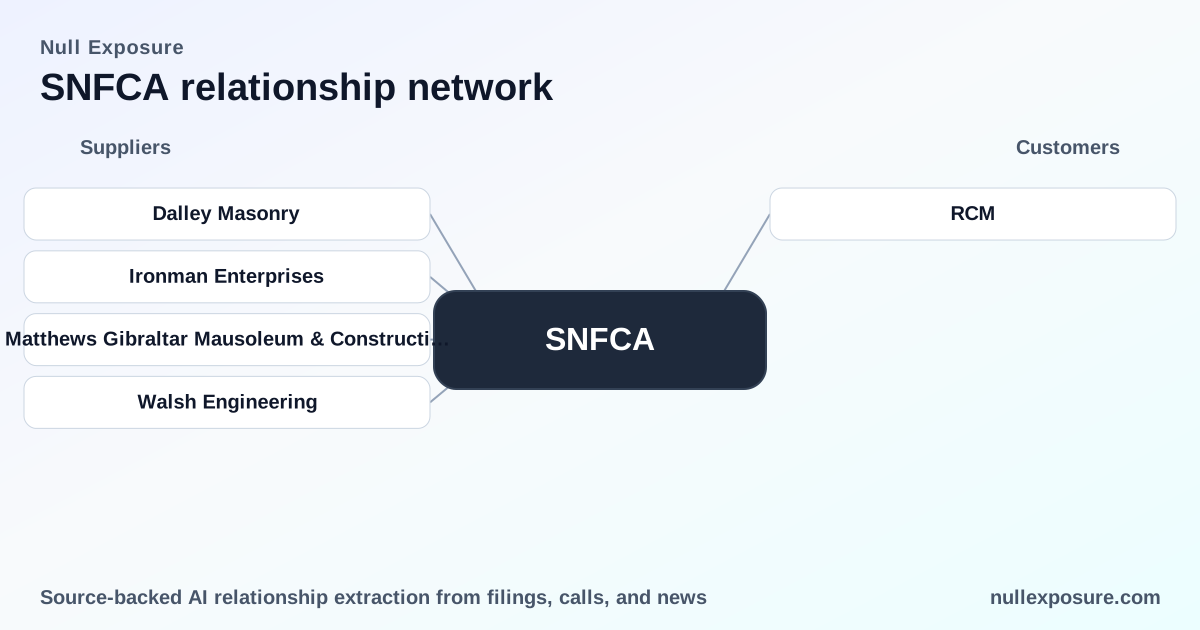
Security National disclosed that a building it owns will be 100% occupied, with the company occupying approximately 51% and R1 RCM Inc occupying the remainder, demonstrating a tenant relationship that converts real-estate assets into operating occupancy rather than leaving space idle. According to a company announcement posted on Yahoo Finance on March 10, 2026, this occupancy arrangement was described as part of a facilities update tied to corporate property usage. (Yahoo Finance, company press release, Mar 10, 2026)
RCM — duplicate naming entry for the same tenant arrangement
The same press release was captured under a shortened name, RCM, which reiterates that SNFCA’s property will be fully leased with R1 RCM occupying the portion not used by the company, supporting rental stability and full occupancy of the asset. The source is the same Yahoo Finance press release published March 10, 2026. (Yahoo Finance, company press release, Mar 10, 2026)
Note: both relationship records reference the same underlying announcement and reflect SNFCA’s posture as a property occupant/landlord rather than a buyer of third‑party services from R1 RCM.
Why the R1 RCM occupancy matters to investors
The occupancy disclosure is small but strategically relevant. Full occupancy reduces vacancy risk and stabilizes ancillary property-related cash flows, which has an outsized effect on a small-cap insurer with significant operating property. SNFCA’s balance sheet and cash flow profile benefit when owned facilities are leased at market rates rather than held empty or sold at distressed prices. Investors should treat this as an operational de-risking event—it lowers fixed-cost absorption per square foot and preserves liquidity that otherwise would come from asset sales or capital raises.
This relationship does not change SNFCA’s core underwriting or mortality exposure, but it does influence non‑underwriting cash generation and expense absorption in the near term. Company filings indicate large portions of mortgage exposure are concentrated regionally and that pre-need trust accounting delays recognition, so stable ancillary rental income complements the principal business model by smoothing operating margins.
Constraints and structural risk profile you should monitor
The company-level constraints flagged in filings explain how customer relationships behave and where monitoring should focus:
- Long-term recognition cycle: Pre-need cemetery merchandise and services are deferred and invested, with recognition occurring when services are delivered—this creates duration risk on liabilities and investment dependence.
- Spot sales component: At-need goods and services are recognized at a point in time, generating episodic revenue that can swing headline results.
- Individual counterparty concentration: The customer base is largely retail individuals for insurance and mortgages, implying high transaction volume but limited single-counterparty credit exposure.
- Regional concentration: Mortgage loan concentration in Utah (56% of mortgage loans as of Dec 31, 2024) signals state-level housing and regulatory sensitivity.
- Segment mix: Life insurance, cemetery & mortuary, and mortgage operations coexist, so capital allocation and reserve adequacy require cross-segment discipline.
These are company-level signals drawn from SNFCA’s public filings (FY2024–FY2025) and should frame how investors stress-test earnings and solvency scenarios.
Practical monitoring checklist for investors
- Track occupancy and rent terms for SNFCA-owned properties; full occupancy reduces operating leverage risk.
- Watch pre-need trust balances and the pace at which those funds are recognized—investment returns on trust assets fund future obligations.
- Follow geographic loan performance in Utah, Florida, Arizona and Texas for mortgage credit trends.
- Monitor mortgage origination volumes and fee income, which drive near-term revenue volatility.
- Assess investment portfolio returns against the long-duration liability profile to evaluate surplus sufficiency.
For a deeper cross-counterparty view and to see how these signals compare across peers, check the integrated coverage at https://nullexposure.com/.
Bottom line
Security National Financial’s business model combines predictable, deferred revenue from pre-need cemetery and life products with transactional mortgage income and investment returns. The R1 RCM occupancy disclosure is a modest but meaningful operational detail: it converts an idled balance-sheet asset into a stabilized cost-offset, improving near-term operating leverage. Investors should continue to treat SNFCA as a cash-flow driven insurer whose credit and market exposure are determined more by reserve and investment management than by any single tenant relationship, while using the constraints above to stress-test scenarios.