Soligenix (SNGX): Government Funding Anchors the Business — Biodefense Partnerships Drive Near-Term Value
Soligenix operates as an advanced-stage biopharmaceutical company that monetizes primarily through government grants and contracts today and aims to monetize through rare-disease product commercialization over time. The company funds clinical development via government-sponsored programs, acts as a contracted service provider on government awards, and positions late-stage clinical assets for global regulatory filing and commercial launch.
For a concise view of Soligenix’s customer exposures and program funding, visit https://nullexposure.com/.
Why the customer map matters to investors
Soligenix’s revenue profile is government-driven and funding-dependent. Public filings and company releases describe a funding mix dominated by grants and cost-reimbursed contracts, not product sales to commercial payers. That operating posture creates a distinct set of investment dynamics: near-term cash flow is tied to award timing and scope, while long-term upside depends on successful clinical outcomes and regulatory approvals that enable commercialization worldwide.
Key business-model signals: long-term contracting posture, government counterparties, service-provider billing models, and an explicit global commercialization objective for lead programs.
The government partners that underpin the biodefense segment
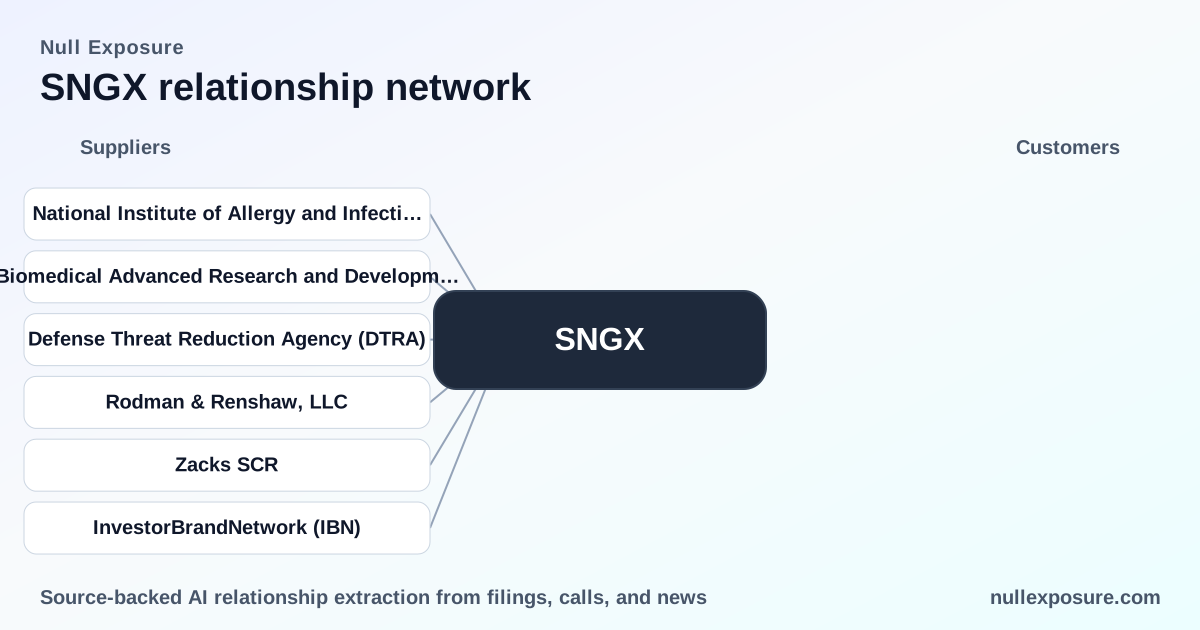
Soligenix lists three public-sector sponsors as material supporters of its biodefense work: BARDA, DTRA and NIAID. Company statements published in early May 2026 consolidate these partners as the primary grant and contract sources for the biodefense division.
Biomedical Advanced Research and Development Authority (BARDA)
Soligenix cites BARDA as a supporting funder for its biodefense business segment, indicating BARDA-provided contract/grant funding underpins development activities. A Finviz summary of Soligenix’s year‑end FY2025/FY2026 financial results (published May 4, 2026) references BARDA alongside other federal sponsors as key supporters. (Finviz, May 4, 2026)
Defense Threat Reduction Agency (DTRA)
The Defense Threat Reduction Agency is named by the company as a contract/grant source for biodefense programs, reflecting DoD-affiliated support for countermeasure development. TradingView’s finance wire coverage of Soligenix highlights DTRA in the same funding cluster reported in the fiscal year commentary. (TradingView finance wire, May 4, 2026)
National Institute of Allergy and Infectious Diseases (NIAID)
NIAID is identified as a central research sponsor—the company’s biodefense segment has been supported by NIAID grants and contracts, supplying research and development capital for program advancement. Both Finviz and TradingView coverage of Soligenix’s FY2026 disclosures list NIAID among the named federal supporters. (Finviz / TradingView, May 4, 2026)
How the disclosed constraints shape operational risk and upside
The company-level evidence available describes several structural constraints that determine how those government relationships translate into value:
-
Long-term contract posture: Soligenix reports awards that span multiple years, including an FDA Orphan Products Development subcontract for approximately $1.1 million over four years for an expanded HyBryte™ study. That structure implies stable, multi-year funding streams on specific programs rather than one-off grants. This is a company-level signal from public filings and historical award excerpts.
-
Government counterparties dominate revenue: The company explicitly states that principal purchasers and sources of R&D funds for key products are U.S. government agencies, and that revenues are primarily derived from government grants and contracts. Revenue concentration with government sponsors is a defining characteristic of current cash flow.
-
Service-provider billing model: Revenue recognition is based on subcontractor and internal costs incurred under cost-reimbursed arrangements plus an overhead/facilities rate and management fees. That implies limited margin leverage until product sales replace grant-funded reimbursement.
-
Global commercialization intent: Soligenix plans to seek regulatory approval to enable potential worldwide commercialization upon successful completion of pivotal studies (for example, Phase 3 FLASH2 referenced in filings). This is a strategic pivot from a grant-funded R&D model toward a commercial distribution orientation.
These constraints translate to a clear risk/reward profile: near-term value is driven by government award flow and contract execution; medium-term value depends on clinical milestones and regulatory filings; long-term value depends on successful commercialization and payer adoption.
Operational implications for investors and operators
-
Concentration risk: Heavy reliance on a small set of federal sponsors creates funding concentration; loss or delay of an award can materially impair program timelines and liquidity.
-
Contracting mechanics: The company functions as a service provider under cost-reimbursement terms, meaning revenue growth scales with awarded program scope and eligible cost recovery rather than high-margin product sales today.
-
Milestone-driven valuation: Clinical readouts and award renewals are de facto de-risking events that revalue the equity; active tracking of grant/contract notices and BARDA/DTRA/NIAID funding decisions is essential.
-
Commercial transition friction: The stated global commercialization objective requires building commercial capabilities and payment pathways that are currently outside the firm’s primary expertise as a grant-funded developer.
Relationship-by-relationship takeaways for decision makers
-
BARDA: A named source of biodefense funding supporting program development. Company FY2026 communications list BARDA among the federal sponsors that support the biodefense segment. (Finviz, May 4, 2026)
-
DTRA: DoD-linked funding identified as part of the biodefense support network. Public reporting on Soligenix’s FY2026 results includes DTRA as a contract/grant counterparty for relevant programs. (TradingView finance wire, May 4, 2026)
-
NIAID: NIAID grants and contracts are a primary research sponsor for biodefense efforts. Company statements for FY2026 name NIAID alongside BARDA and DTRA as key funders. (Finviz / TradingView, May 4, 2026)
For deeper, structured monitoring of these public-sector relationships and their operational impact, see https://nullexposure.com/.
Bottom line
Soligenix’s customer profile is anchored in government funding with a deliberate but challenging path toward commercial revenue. Investors should treat federal awards and clinical milestones as the principal drivers of near-term valuation and view any commercial upside as contingent on successful regulatory outcomes and a transition from grant-funded development to payer-funded sales. Operators evaluating partnerships or vendor integrations should design support models that accommodate long-term, cost-reimbursed contracts and milestone-driven workflows.
Primary investment thesis: government-sponsored funding underwrites development today; successful clinical and regulatory execution unlocks the potential for higher-margin, global commercialization.