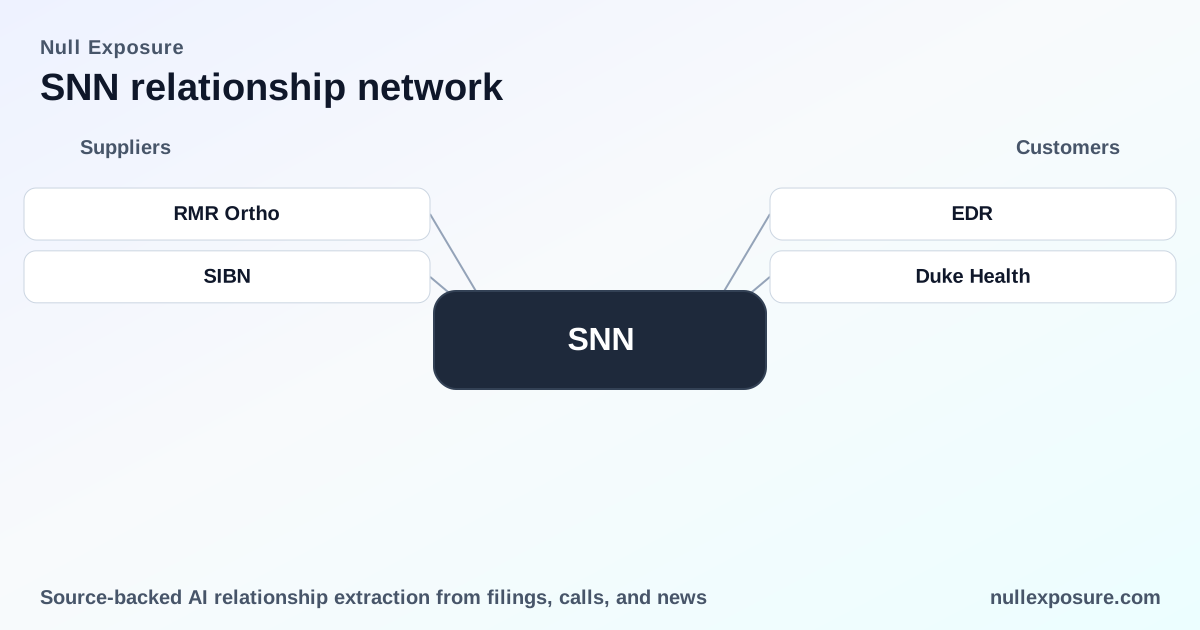
Smith & Nephew (SNN): Customer relationships that extend distribution reach and brand muscle
Smith & Nephew operates as a global medical‑devices manufacturer that monetizes through product sales, recurring disposables, and strategic distribution partnerships across orthopedics, sports medicine, ENT, and wound care. Revenue flows from high‑margin implants and devices plus recurring consumables, amplified by multi‑year commercial and distribution agreements that push products into hospitals, trauma centers and home care channels. For investors, the customer relationships tracked here illuminate distribution expansion, marketing leverage, and tactical channel plays that contribute to both top‑line growth and durable aftermarket revenue.
Learn more about the research process at NullExposure: https://nullexposure.com/
Why these customer ties matter to valuation and cash flow
Smith & Nephew’s partnerships illustrate a deliberate operating posture: pragmatic partnering to scale distribution rather than acquisitive entry into every niche. Contracts reported in recent coverage are predominantly multi‑year distribution or preferred‑partner arrangements, supporting predictable device placement and recurring disposables sales. That contracting posture reduces go‑to‑market risk while letting Smith & Nephew leverage established relationships (sports organizations, specialist distributors, trauma centers) as marketing assets.
Key business model characteristics drawn from the relationship set:
- Concentration: Partnerships span different channels — home care distributors, sports/marketing partnerships, trauma center distribution, and leading academic hospitals — indicating low single‑counterparty concentration for customer reach.
- Criticality: Relationships are strategically important for specific franchises: wound care needs home‑care channels, pelvic trauma devices require trauma center access, and sports partnerships generate brand equity for Sports Medicine & ENT.
- Contracting maturity: The reported agreements are multi‑year and distribution‑oriented, signaling mature, operationally embedded relationships rather than short promotional ties.
- Commercial implications: These relationships support recurring revenue from consumables and create referral and training pathways that accelerate implant adoption and aftermarket spend.
Explore detailed relationship signals at NullExposure: https://nullexposure.com/
Relationship snapshot — what the coverage shows
Below are every customer‑related result captured in the sample feed, each summarized in plain English with the source cited.
InfuSystem Holdings (INFU)
Smith & Nephew signed a three‑year distribution agreement with InfuSystem to deliver the RENASYS EDGE negative pressure wound therapy (NPWT) system into home‑based care for chronic wounds, expanding home delivery channels for a core wound‑care product. According to a Yahoo Finance story (Mar 10, 2026), this contract targets patients requiring home‑based chronic wound management and positions RENASYS EDGE in InfuSystem’s rental and home‑care service network.
EDR (listed as EDR in the coverage)
Smith & Nephew extended a multi‑year commercial partnership that keeps it as the preferred sports‑medicine technology provider for the UFC, using the organisation as a marketing and branding asset for its Sports Medicine & ENT franchise. A TS2.Tech report (Mar 10, 2026) described the extension as a strategic marketing and brand partnership supporting franchise visibility.
UFC (separately reported)
The company’s extension of the preferred‑partner status with the UFC amplifies Smith & Nephew’s consumer and clinician visibility in high‑profile sports medicine use cases, supporting demand generation for orthopedic and soft‑tissue solutions. The same TS2.Tech coverage (Mar 10, 2026) highlighted the UFC relationship as a marketing channel that supports product awareness among elite athletes and sports clinicians.
SI‑BONE (SIBN) — industry press coverage
Smith+Nephew agreed to distribute SI‑BONE’s iFuse TORQ and iFuse TORQ TNT implants across Level 1 and Level 2 trauma centers nationwide, with rollout beginning in March and ramping through 2026, extending Smith+Nephew’s trauma and pelvic‑fixation offerings. RyOrtho’s coverage (May 3, 2026) emphasized the national rollout plan and the staged ramp into trauma centers.
SI‑BONE (SIBN) — press release coverage
SI‑BONE’s press release and coverage confirmed a strategic partnership naming Smith+Nephew as the distributor for iFuse TORQ and iFuse TORQ TNT for pelvic trauma care across Level 1 and Level 2 trauma centers, framing the deal as complementary to Smith+Nephew’s orthopedics portfolio. Yahoo Finance’s report (Mar 10, 2026) mirrored the announcement, noting the scope and strategic nature of the distribution arrangement.
Duke Health (hospital customer / clinical adopter)
Duke Health performed the first CORI SHOULDER robotic shoulder arthroplasty cases using Smith+Nephew technology, signaling clinical adoption of the company’s robotic systems and an anchor academic‑hospital reference for product performance. A GlobeNewswire release covering AAOS 2026 (Mar 3, 2026) noted the cases and identified Duke Health as an early institutional user of the CORI SHOULDER system.
What these relationships imply about go‑to‑market risk and upside
- Upside: Distribution agreements (InfuSystem, SI‑BONE) materially expand physical access to end patients and high‑volume trauma centers, which supports recurring consumable sales and aftermarket revenue. Brand partnerships (UFC) accelerate awareness among referral networks and clinicians, indirectly supporting elective procedure demand.
- Risk: Dependence on third‑party distributors and clinical partners creates execution risk in rollout speed and training; successful commercialization requires operational coordination across supply, training and hospital credentialing. Market adoption of new robotic and implant systems requires sustained clinical evidence and center‑level investment, which is often multi‑year.
Constraints and company‑level signals
NullExposure’s customer relationship feed for Smith & Nephew shows no explicit customer constraints reported in the recent coverage (no contractual caveats, exclusivity limitations, or partner‑named constraints surfaced). This absence should be interpreted as a company‑level signal reflecting either transparency in public disclosure or simply that partner agreements reported were conventional distribution/marketing arrangements rather than constrained or conditional deals.
Bottom line for investors
Smith & Nephew is executing a distribution‑and‑partnership strategy that combines recurring revenue engines with targeted marketing assets, enhancing product reach across home care, trauma centers, and sports medicine channels. The reported deals are commercially strategic, multi‑year, and supportive of consumable and implant revenue, while operational execution and clinical adoption timelines remain the primary gating factors for near‑term uplift. For investors focused on durable cash flow and margin leverage, these customer relationships are net positive signals of scalable distribution and brand equity.
For further customer relationship intelligence and signals, visit NullExposure: https://nullexposure.com/