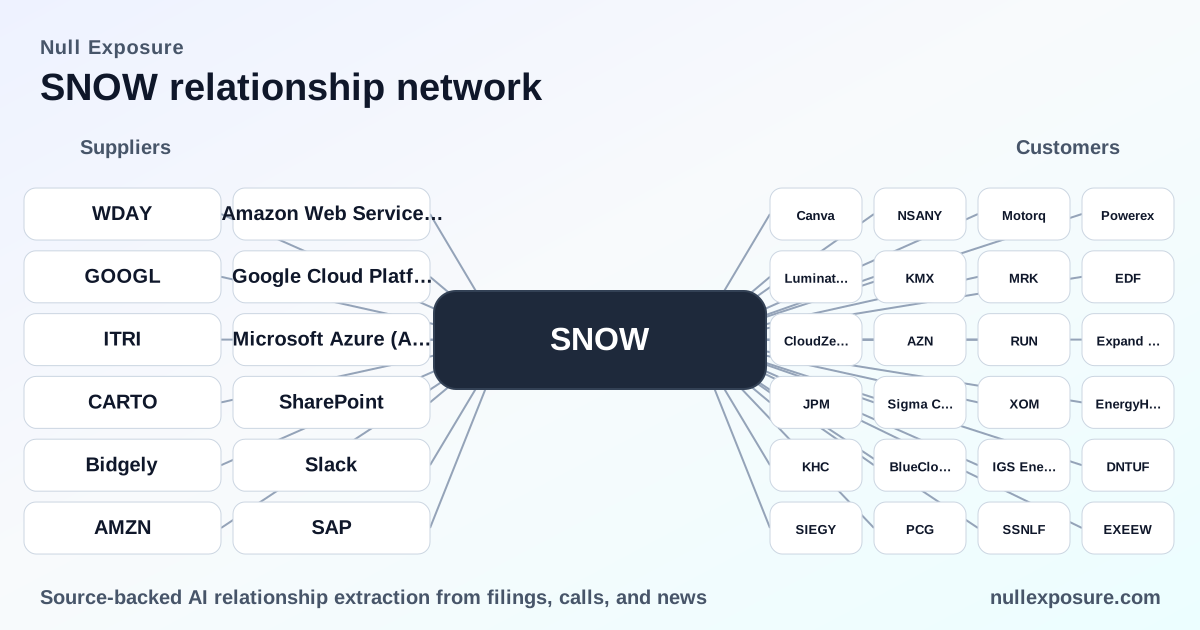
Snowflake customer map: who pays, why it matters
Snowflake sells a cloud-native consumption-based data platform to enterprises, monetizing primarily through usage fees for compute, storage and data transfer under a mix of capacity contracts (1–4 year terms) and on‑demand, monthly arrangements. Management positions the product as a single source of truth for analytics and AI, which drives deep integrations with large strategic customers and broad adoption across mid‑market and smaller firms — a mix that underpins both predictable backlog and variable revenue growth.
Learn more about how we track vendor-customer relationships at https://nullexposure.com/.
How Snowflake’s customer economics work — concise investor takeaways
- Revenue model: Snowflake charges for actual resource consumption; customers either buy multi‑year capacity commitments or consume on an on‑demand monthly basis. This creates a blend of recurring contracted revenue and usage volatility tied to workload growth.
- Contracting posture: Long‑term capacity deals (1–4 years) are common and material to revenue recognition, while short‑term on‑demand consumption supplements growth and provides expansion upside.
- Customer concentration and criticality: Snowflake sells to large enterprises and thousands of smaller customers; 745 Forbes Global 2000 customers accounted for ~42% of FY2025 revenue, signaling meaningful concentration among very large counterparties but broad overall penetration.
- Global footprint: The platform runs across three major public clouds in 47 regional deployments, supporting global enterprise adoption (Americas, EMEA, APAC).
- Operational signal: Snowflake reports active growth — 11,159 customers as of January 31, 2025 and a multi‑billion dollar RPO — demonstrating both scale and backlog convertibility.
Customer roll call — every relationship mentioned in the collected sources
-
Canva — Management cited Canva on the 2026Q1 earnings call as an example of an enterprise that “bet their business on Snowflake” for easy, connected access to data. (Snowflake 2026Q1 earnings call, Mar 2026)
-
Luminate Data — Snowflake referenced Luminate Data in the same call to illustrate how Cortex accelerates migration testing and reduces time spent during migrations. (Snowflake 2026Q1 earnings call, Mar 2026)
-
CloudZero — CloudZero is listed as a customer leveraging hundreds of active data‑sharing connections to exchange data securely across partners and customers. (Snowflake 2026Q1 earnings call, Mar 2026)
-
AstraZeneca (AZN) — Management highlighted AstraZeneca as a global pharmaceutical customer using Snowflake to analyze critical business data from SAP and Workday. (Snowflake 2026Q1 earnings call, Mar 2026)
-
Siemens (SIEGY) — Siemens is described as collaborating with Snowflake to help manufacturers unlock operational efficiency and scale. (Snowflake 2026Q1 earnings call, Mar 2026)
-
WNS — A StockstoTrade news item reported a collaboration with Snowflake to accelerate AI and data modernization across industries. (StockstoTrade report on WNS, FY2025)
-
JPM — Snowflake named JPMorgan Chase on the 2026Q1 call as a high‑profile enterprise customer that relies on the platform’s connectivity and trust. (Snowflake 2026Q1 earnings call, Mar 2026)
-
JPMorgan Chase — The earnings call explicitly referenced JPMorgan Chase alongside Canva as a core enterprise user of Snowflake’s platform. (Snowflake 2026Q1 earnings call, Mar 2026)
-
KHC (Kraft Heinz) — Snowflake disclosed that Kraft Heinz uses Snowflake Cortex to power an internal AI assistant named Lighthouse (Kraft Heinz AI). (Snowflake 2026Q1 earnings call, Mar 2026)
-
KMX (CarMax) — CarMax is named as a customer benefiting from Snowflake’s automotive solutions for manufacturing and data-driven innovation. (Snowflake 2026Q1 earnings call, Mar 2026)
-
Kraft Heinz — The company was again called out as a Cortex customer using AI tools to empower employees. (Snowflake 2026Q1 earnings call, Mar 2026)
-
AstraZeneca — AstraZeneca appears a second time in management remarks as an example of analytics on enterprise systems. (Snowflake 2026Q1 earnings call, Mar 2026)
-
Nissan (NSANY) — Nissan was highlighted among automotive customers adopting Snowflake’s AI data cloud solutions. (Snowflake 2026Q1 earnings call, Mar 2026)
-
SIEGY — Siemens appears again under its ticker, reinforcing multi‑mention enterprise relationships on the earnings call. (Snowflake 2026Q1 earnings call, Mar 2026)
-
CarMax — CarMax was reiterated as a beneficiary of the new automotive solutions suite. (Snowflake 2026Q1 earnings call, Mar 2026)
-
BlueCloud — Investing News reported BlueCloud among enterprises committing to Snowflake Postgres to reduce data silos for AI and analytics use cases. (Investing News on Snowflake Postgres, FY2026)
-
Sigma Computing — Investing News named Sigma Computing as an early adopter of Snowflake Postgres for reducing pipeline complexity. (Investing News on Snowflake Postgres, FY2026)
-
1‑800‑FLOWERS (FLWS) — A Microsoft customer story notes that 1‑800‑FLOWERS consolidates databases into Snowflake as its cloud data warehouse. (Microsoft customer story, FY2022)
-
COF‑P‑N (Capital One‑pref) — SiliconANGLE coverage referenced Capital One as one of Snowflake’s largest customers, drawing on multi‑year migrations. (SiliconANGLE, FY2022)
-
Wolfspeed (WOLF) — Media coverage connected Wolfspeed to Snowflake for accelerating AI‑driven manufacturing and operations. (FINVIZ coverage on Wolfspeed, FY2025)
-
UiPath (PATH) — UiPath announced a partnership uniting its automation platform with Snowflake Cortex AI to accelerate autonomous actions. (UiPath press release, FY2025)
-
Merck (MRK) — Investing News described Merck leveraging Snowflake Horizon Catalog for governance and AI readiness across data. (Investing News on Horizon Catalog, FY2026)
-
Motorq — Motorq was listed with Merck as a customer using Horizon Catalog for secure access to Apache Iceberg tables. (Investing News on Horizon Catalog, FY2026)
-
BlackLine (BL) — Industry coverage connected BlackLine’s Agentic Financial Operations to Snowflake and Workday connectors, indicating integration in finance automation. (Sahm Capital / FutureCFO coverage, FY2026)
-
Quad (QUAD) — Quad enhanced its Audience Builder platform with Snowflake’s natural language AI, improving audience creation speed and precision. (Quad earnings release, FY2025)
-
Merck — Merck is repeated in Investing News coverage as a Horizon Catalog customer. (Investing News, FY2026)
-
ExxonMobil (XOM) — Investing News cited ExxonMobil among industry leaders using Snowflake to modernize operations and improve financial performance. (Investing News energy solutions, FY2026)
-
COF‑P‑L (Capital One‑pref) — Additional press on Capital One’s Snowflake usage surfaced in SiliconANGLE reporting from 2022. (SiliconANGLE, FY2022)
-
PG&E / PCG — Snowflake was cited by utilities like PG&E as a platform that consolidates legacy systems and governs sensitive operational data. (Investing News energy solutions, FY2026)
-
Definitive Healthcare (DH) — Definitive Healthcare referenced Snowflake integrations as part of its open platform strategy for analytics. (The Globe and Mail transcript, FY2026)
-
Sunrun (RUN) — Investing News described Sunrun using Snowflake to support analytics for thousands of users and faster insights. (Investing News energy solutions, FY2026)
-
Domo (DOMO) — Coverage positioned Snowflake as the secure data foundation beneath Domo’s engagement layer for analytics. (StockTitan profile on Domo, FY2025)
-
Sunrun — Sunrun is reiterated in Investing News on Snowflake’s role for analytics and innovation. (Investing News, FY2026)
-
ExxonMobil (XOM) — ExxonMobil is restated in the energy solutions piece as a Snowflake customer. (Investing News, FY2026)
-
IGS Energy — IGS Energy appears on the customer list adopting Snowflake to modernize operations and forecasting. (Investing News energy solutions, FY2026)
-
Samsung Ads (SSNLF) — Snowflake named Samsung Ads on the 2026Q1 call as a connected‑TV advertising customer that used Snowflake while upholding strict privacy standards. (Snowflake 2026Q1 earnings call, Mar 2026)
-
SSNLF — The Samsung Ads mention is duplicated under its ticker in the same call. (Snowflake 2026Q1 earnings call, Mar 2026)
-
Wolfspeed (WOLF) — Wolfspeed is again associated with Snowflake in later media coverage. (FINVIZ, FY2025)
-
BlackLine (BL) — FutureCFO coverage described BlackLine’s Studio360 leveraging Snowflake connectors for finance data unification. (FutureCFO on BlackLine, FY2026)
-
EDF — Investing News quoted EDF on building an Intelligent Customer Engine on Snowflake to unify sensitive data and accelerate insights. (Investing News energy solutions, FY2026)
-
Powerex — Powerex described migration to Snowflake for AI‑driven forecasting and LLM‑based market insights. (Investing News energy solutions, FY2026)
-
Dentsu (DNTUF) — Snowflake noted on the 2026Q1 earnings call that Dentsu consolidated data into Snowflake and reduced costs by 30% via simplified architecture. (Snowflake 2026Q1 earnings call, Mar 2026)
-
DNTUF — The Dentsu mention repeats under its ticker in the same call. (Snowflake 2026Q1 earnings call, Mar 2026)
-
Expand Energy / Expand Energy Corporation (EXEEW) — Investing News and related coverage listed Expand Energy among energy sector customers using Snowflake to centralize operational views. (Investing News energy solutions, FY2026)
-
BlackLine (BL) — BlackLine also described on its 2025Q3 earnings call that Snowflake powers a layer leveraged by 90% of its customer base for reporting. (BlackLine 2025Q3 earnings call)
-
STT‑P‑G (State Street preferred) — Historical coverage referenced State Street building a data platform utilizing Snowflake and Azure for open‑architecture innovation. (eFinancialCareers coverage, FY2021)
-
Grid Dynamics (GDYN) — Grid Dynamics listed Snowflake among core cloud and analytics partners that their group includes. (InsiderMonkey transcript on Grid Dynamics, FY2025)
-
Braze (BRZE) — Braze referenced an integration with Snowflake Cortex AI enabling marketers to query campaign and analytics data using natural language. (StockTitan on Braze, FY2025)
-
Expand Energy — Expand Energy is repeated in another entry linking it to Snowflake in the industry customer list. (Investing News, FY2026)
-
EnergyHub — EnergyHub noted Snowflake as enabling low‑latency telemetry and forecasting essential for virtual power plants. (Investing News energy solutions, FY2026)
Constraints and what they imply for investors
The company‑level signals from Snowflake’s public filings and commentary show a mixed contract profile: a meaningful portion of revenue is backed by multi‑year capacity contracts (1–4 years) while on‑demand month‑to‑month usage provides variable upside. The business model is consumption‑driven and materially concentrated among very large enterprises (745 Forbes Global 2000 customers contributed 42% of FY2025 revenue), but Snowflake balances concentration with a large and growing base (11,159 customers as of Jan‑2025) and a sizable RPO ($6.9bn) that converts to revenue over time. The product is delivered as a service with near‑zero maintenance for customers, increasing stickiness for data and AI workloads.
Investment implications: risks and runway
- Growth engine: Snowflake’s mix of long‑term capacity and usage‑based expansion drives durable revenue with embedded upside from AI workloads and new products like Postgres and Horizon Catalog.
- Concentration risk: Large customers drive a disproportionate share of revenue, so churn or reduced consumption at a handful of accounts would materially affect growth.
- Competitive and execution risk: The market for cloud data and AI platforms is crowded; maintaining integrations and product differentiation is essential to preserve pricing power and expansion rates.
If you evaluate vendor relationships or need systematic tracking of customer signals for enterprise software investments, explore how we catalog these connections at https://nullexposure.com/.