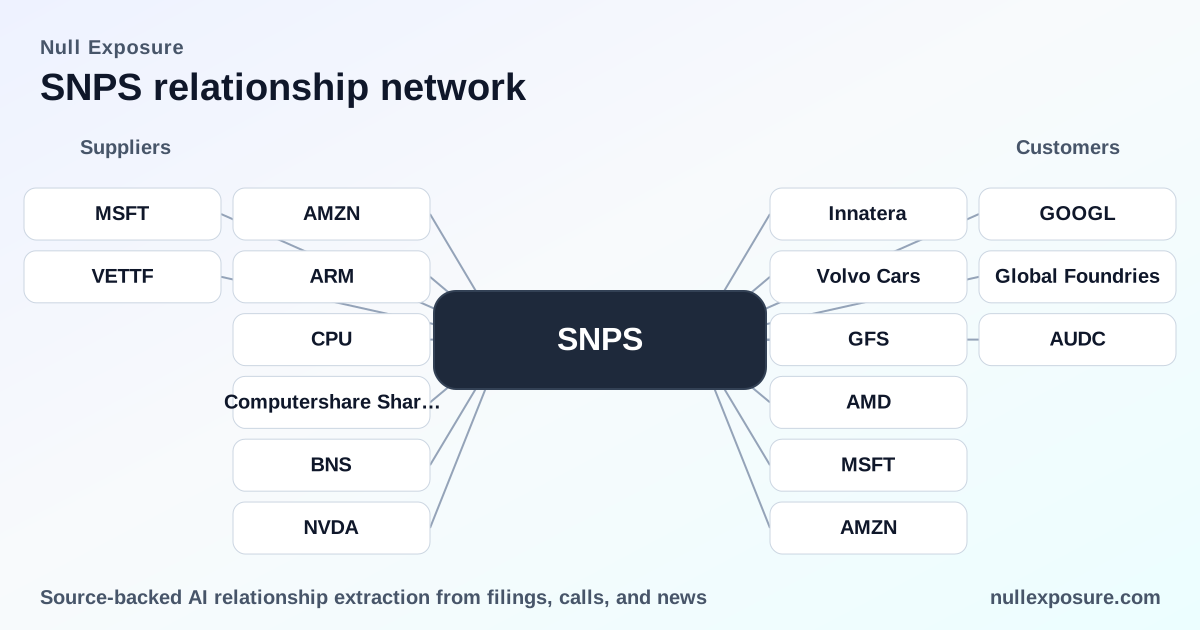
Synopsys (SNPS): customer map and what it signals for investors
Synopsys monetizes by licensing and subscribing its electronic design automation (EDA) software, silicon IP and associated services to chip designers, foundries and system companies; it mixes time‑based Technology Subscription Licenses (typically two–three year terms) with perpetual licenses plus support and an expanding hardware and services footprint. Revenue is driven by large enterprise engagements, certified IP partnerships with leading foundries and growing digital‑twin and TCAD collaborations in high‑value RF and power markets. Learn more at https://nullexposure.com/.
Why the partner list matters: one sentence thesis for shareholders
The roster of customers and collaborators — from TSMC and GlobalFoundries to NASA, Atomera and hyperscalers — demonstrates Synopsys’ role as a mission‑critical supplier across chip design, verification, IP and system‑level simulation; this creates high switching costs, concentrated enterprise exposure and recurring revenue that supports premium valuation, but also concentrates geopolitical and foundry‑cycle risk.
How Synopsys contracts, serves and risks its customers
Synopsys operates a hybrid contracting posture: software is sold under both subscription (TSL) and perpetual license models, with support/updates delivered over time, while professional services and hardware products augment stickiness. The company reports material customer concentration and a global footprint — a small number of large customers drive outsized revenue, with the United States and APAC (notably China) both material geographies and export‑control sensitivity. Hardware and services are growing complements to the core software business and the firm retains an active post‑contract support model to preserve utilization and renewal. These operating characteristics drive the following investor implications:
- Contracting maturity: TSLs (2–3 year terms) favor predictable renewal timing and revenue recognition over periods, supporting forward visibility.
- Counterparty concentration: Dependence on large enterprise and foundry customers makes revenue volatile to design cycles and regulatory actions.
- Geopolitical and export control sensitivity: China exposure and recent export restrictions are explicit headwinds to design IP and design starts.
- High criticality, high switching costs: Deep integration into customers’ flows (EDA, IP and certified flows) creates durable pricing power.
If you want a structured feed of relationship signals for modeling, review our company pages at https://nullexposure.com/.
Customer relationships — concise, source‑backed rundown
Innatera
Innatera selected Synopsys simulation tools to design and validate neuromorphic microcontrollers for ultra‑low‑power edge devices. Source: Synopsys press release, March 2, 2026 (news.synopsys.com).
Keysight Technologies (KEYS)
Keysight is completing an acquisition of Synopsys’ Optical Solutions Group, a transaction referenced on a 2025 Q3 earnings call and subsequent communications. This is an M&A outcome that reduces Synopsys’ product scope while monetizing IP and assets. Source: Keysight-related earnings call transcript (Q3 2025).
NASA
NASA selected Synopsys and EMA to verify spacesuit compatibility and develop lunar communications systems using electromagnetic simulation and digital mission engineering tools for the Artemis program. Source: Synopsys news release on support for NASA’s Artemis program, April 2026.
Atomera (ATOM)
Atomera expanded collaboration with Synopsys to use Sentaurus TCAD for GaN device modeling, develop calibrated TCAD decks and accelerate RF/power device workflows, with Atomera providing material‑level feedback and marketing support. Source: multiple industry reports and press coverage, early May 2026 (Compound Semiconductor, BriefGlance, Blockonomi).
Volvo Cars
Volvo highlighted work with Synopsys on electronics digital twins as core to its systems‑level electrification and physical AI initiatives, indicating OEM adoption of Synopsys’ system simulation stack. Source: Synopsys PR and PR Newswire coverage, March 2026.
Taiwan Semiconductor Manufacturing Company (TSMC)
Synopsys announced certified IP and EDA flows for TSMC’s leading nodes (including 3nm, 2nm and packaging families), formalizing silicon‑proven flows used by advanced AI SoC designers. Source: Synopsys press release partnering with TSMC, April 22, 2026 (news.synopsys.com).
Amazon (AMZN)
Analyst and industry commentary place hyperscalers like Amazon among the buyers of advanced Synopsys tools as they insource custom AI silicon design capability. Source: Market analysis piece, March 2026 (FinancialContent / Finterra).
Google / Alphabet (GOOGL)
Industry research identifies Google as a hyperscaler purchasing advanced EDA and IP-enabled toolchains to build custom chips, making it a strategic end customer for Synopsys’ high‑end offerings. Source: Market analysis, March 2026 (FinancialContent / Finterra).
Microsoft (MSFT)
Microsoft is cited alongside other hyperscalers leveraging Synopsys’ most advanced tools as they internalize AI ASIC and accelerator design programs. Source: Market analysis, March 2026 (FinancialContent / Finterra).
Nvidia (NVDA)
Nvidia figures in coverage as a top‑tier design ecosystem partner and potential beneficiary of Synopsys’ AI‑driven EDA acceleration work. Source: Industry commentary and market reports, May 2026 (StockTwits/industry news).
Honda (HMC)
Honda was named among end customers using Synopsys solutions — notably when combined with NVIDIA accelerators — to accelerate chip and systems development in automotive programs. Source: Earnings/industry commentary, March–May 2026 (InsiderMonkey coverage).
Samsung (SSNLF)
Samsung is listed with other large OEMs and foundries consuming Synopsys’ design and simulation flows to support advanced node and system design efforts. Source: Industry commentary and earnings summaries, March–May 2026 (InsiderMonkey / market press).
GlobalFoundries (GFS)
GlobalFoundries announced an agreement to acquire Synopsys’ ARC Processor IP Solutions business, an asset sale that refocuses Synopsys on interconnect/foundation IP while delivering proceeds and concentration effects. Source: GlobalFoundries transaction announcements and market reports, January–March 2026 (TS2.Tech / FuturumGroup).
QuickLogic (QUIK)
QuickLogic’s product announcements reference Synopsys Synplify synthesis integration, confirming Synopsys’ tool presence in FPGA RTL‑to‑bitstream flows. Source: QuickLogic PR (May 2026).
AMD
Synopsys cited honors for collaborative work with AMD to advance AI‑accelerated chip design, highlighting a strategic engineering partnership. Source: Q1 FY2026 earnings call transcript coverage (InsiderMonkey / Synopsys earnings materials).
Audi (AUDC)
Synopsys demonstrated AI‑driven simulation use cases with Audi at CES, showing automotive customers reducing physical prototyping and compressing development cycles. Source: CES coverage and earnings commentary, January–March 2026 (Futurum Group / InsiderMonkey).
Investment takeaways and risk framing
- Revenue model: A deliberate mix of subscription and perpetual licensing with bundled support creates recurring revenue and renewal leverage; TSLs (2–3 year typical) afford multi‑year visibility into large deals.
- Concentration and criticality: Large hyperscalers, foundries and OEMs dominate Synopsys demand, which supports pricing power but concentrates downside risk in design‑cycle slowdowns or contract loss.
- Geography and regulation: Significant APAC exposure — including China — and export controls are explicit constraints on growth in certain geographies, so monitor regulatory developments and design start indicators.
- Business re‑scoping: Sales of ARC IP and the Optical Solutions Group are strategic portfolio moves that change product mix and near‑term revenue composition; treat one‑off M&A receipts separately from recurring revenue when modeling margins.
For a consolidated feed of partner activity and constraints to feed valuation and scenario models, visit https://nullexposure.com/.
Bold final note: Synopsys’ customer map confirms it is an indispensable supplier to next‑generation chip and systems builders, but that indispensability comes with concentrated counterparty risk and geopolitical exposure that should be explicitly modeled in valuation and stress tests.