Senstar Technologies (SNT): Customer Footprint and Partnership Signals for Investors
Senstar Technologies sells advanced perimeter and video security systems to governments, transportation and energy operators, and industrial integrators, monetizing through product sales, system integration agreements, and ongoing software/maintenance contracts. The company’s business model blends hardware margins with higher-margin software and service revenue, while growth is driven through strategic partnerships and OEM/integration channels that extend market reach without a proportionate fixed-cost base. For a deeper look at how Senstar’s customer relationships shape revenue stability and execution risk, visit https://nullexposure.com/.
Big-picture investment thesis in one line
Senstar converts R&D-led sensor and analytics IP into recurring and project revenue by partnering with systems integrators and large infrastructure customers; this partnership-driven go-to-market lowers fixed sales costs but creates dependency on integrator execution and project cadence.
How to read Senstar’s customer posture
Senstar operates primarily as a B2B supplier to infrastructure operators and system integrators rather than as a direct-to-consumer vendor. That setup implies:
- Contracting posture: Project-based sales routed through integrators, supplemented by recurring software and maintenance agreements. This creates lumpy top-line timing but steady after-sale revenue potential.
- Concentration and criticality: Customers are mission-critical operators (transportation, energy, government), which makes systems strategically important to clients and supports stickiness; contract concentration is likely moderate given the infrastructure focus, rather than diffuse retail accounts.
- Maturity and margin structure: The company reports healthy gross profitability coupled with modest operating margins; Senstar’s margin profile reflects hardware sales together with higher-margin software/services—a profile typical of established security-equipment vendors.
- Commercial leverage: High institutional ownership (48.7%) signals market interest from professional investors, while near-zero insider ownership indicates limited internal share retention incentives.
These company-level signals explain why Senstar uses integrators and partnerships to extend reach without heavy direct-sales investment, and why revenue can be cyclical by project timing.
The customer relationships in the record
Below I cover every customer relationship mentioned in the available results.
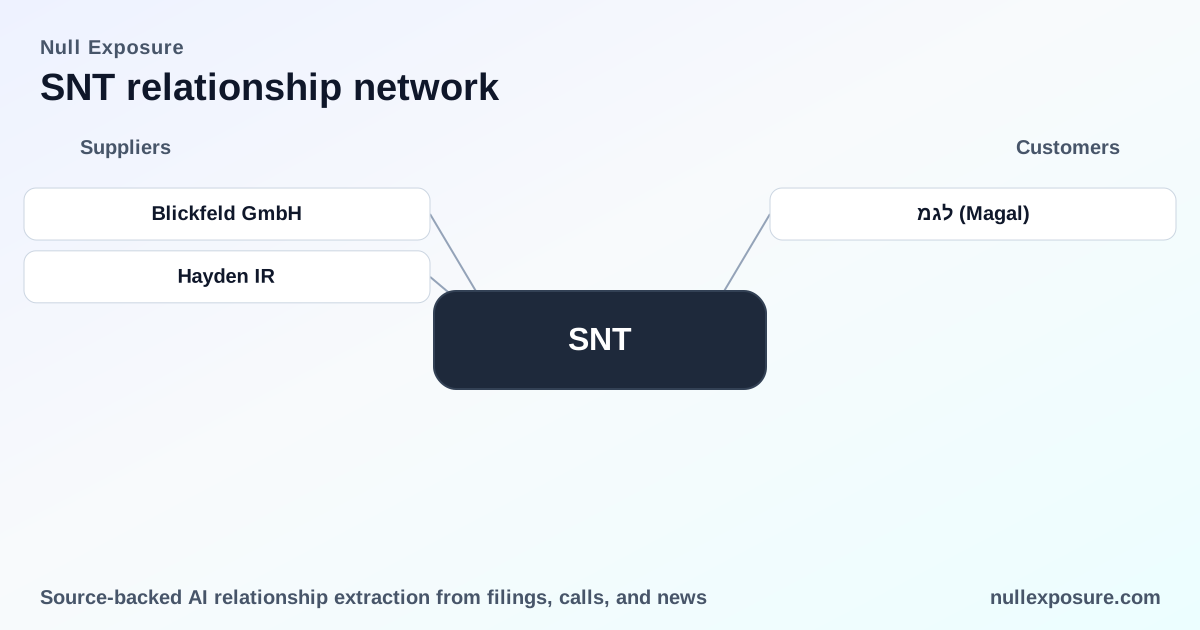
Magal (מגל) — integrator partner on select projects
Senstar has collaborated with Magal in specific projects where Magal acted as the systems integrator and Senstar supplied sensor or perimeter technologies; the relationship is described as project-based cooperation rather than an exclusive distributor arrangement. A Techtime report from September 22, 2021 documented this integrator–supplier cooperation (https://techtime.co.il/2021/09/22/senstar/).
What the relationship map implies for revenue and risk
The documented cooperation with Magal is consistent with Senstar’s broader commercial playbook: use established integrators to access large infrastructure projects and governments, then capture downstream recurring revenue from software and maintenance.
Key operational and financial implications:
- Sales cadence is project-driven. Integrator partnerships create access to large contracts but translate into timing volatility; investors should expect quarterly revenue swings tied to project award cycles, which aligns with the company’s reported quarterly revenue decline year-over-year (-14.3%) and negative quarterly earnings growth (-27.4%).
- Margin insulation through software and services. Senstar’s gross profit of $23.8m on $36.4m revenue indicates strong underlying gross margins (~66%), which supports profitability once operating leverage is realized. Operating margin TTM is slightly negative, reflecting reinvestment in R&D and go-to-market activities.
- Execution dependence on partners. Integrator relationships reduce Senstar’s direct selling expense but increase exposure to partner performance, contract terms negotiated by integrators, and payment/collection risk tied to large projects.
Financial context that matters to customers and partners
Use these concrete company metrics to calibrate partnership strength and commercial stability:
- Market capitalization: $64.2m; Revenue TTM: $36.4m; EBITDA: $3.74m.
- Valuation multiples: EV/Revenue ~1.17 and EV/EBITDA ~14.1, implying investors are pricing modest growth with operational improvement optionality.
- Profit metrics: Net profit margin ~8.8% and ROE ~7.95%, which demonstrate current profitability but limited capital return scale.
- Volatility and momentum: Beta 1.16 with 52-week range $2.64–$5.34; shares outstanding ~23.3m with institutional ownership near 49%.
Those figures reinforce that Senstar is a small-cap, growth-through-partnerships industrial vendor: investors are buying an R&D-heavy, partnership-centric security technology firm with solid gross economics but operating-level variability.
What investors and operators should watch next
- Contract awards and integrator pipeline. New large project wins through Magal or similar integrators will materially affect near-term revenue — monitor public tender outcomes and partner announcements.
- Recurring revenue conversion. Track the mix shift toward software and maintenance contracts; improving recurring revenue percentage reduces cyclicality and increases valuation multiple.
- Margin recovery and operating leverage. Management must convert strong gross margins into sustainable operating profit as R&D and sales investments stabilize.
- Counterparty concentration. While integrator partnerships accelerate penetration, concentration among a few integrators increases single-counterparty risk in major projects.
For operators evaluating procurement or partnership with Senstar, the key commercial fact is that Senstar supplies differentiated, mission-critical sensor and analytics technology but typically relies on integrators for turnkey delivery.
Final read and action
Senstar’s customer footprint—illustrated by its collaboration with Magal—confirms a deliberate, partnership-focused expansion model that trades direct sales scale for faster access to large infrastructure contracts. That structure creates upside via high gross margins and recurring service revenue, and introduces risk from project concentration and integrator execution. For a concise market intelligence overview and to explore similar customer-relationship mapping across small-cap industrials, visit https://nullexposure.com/.
Key takeaway: invest for software/recurring revenue conversion and monitor integrator-sourced contract flow; these signals drive valuation re-rating for a company with strong gross economics but project-dependent revenue.