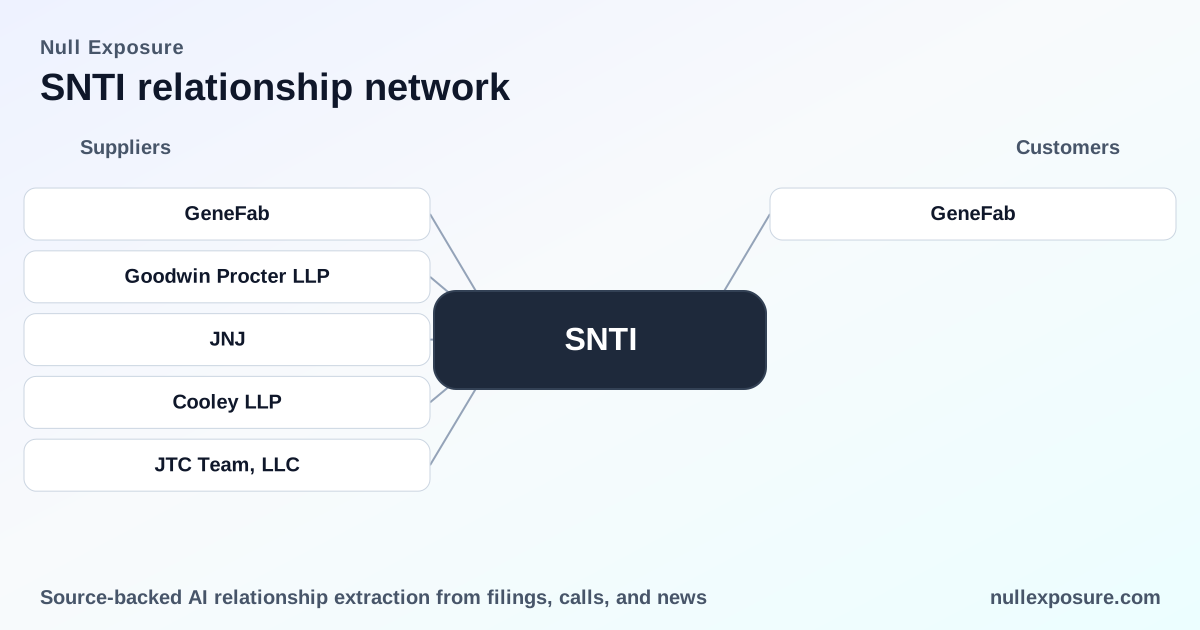
Senti Biosciences (SNTI): Customer Relationships and Commercial Signals
Senti Biosciences operates as a synthetic‑biology therapeutics developer that monetizes its platform through a mix of strategic partnerships, licensing IP, and opportunistic asset utilization such as subleasing manufacturing capacity. The company’s near‑term commercial receipts are concentrated in partner and related‑party arrangements rather than product sales, while core value remains tied to advances in its GeneCircuit platform and clinical progress. For deeper relationship mapping and transaction tracing, visit the Null Exposure coverage hub: https://nullexposure.com/
Quick read for investors: business model in one paragraph
Senti advances engineered cell and gene therapies and generates revenue primarily via collaborations, licenses, grants and facility monetization (subleases and equipment transfers) rather than commercial product revenue. Financials confirm the model: negligible revenue (Revenue TTM $22k) and sustained operating losses (Operating margin TTM -370.95), indicating reliance on partner funding and non‑operational monetization while clinical and platform development continues.
What the headline relationships look like today
Below I cover every customer/partner relationship surfaced in available reporting and filings. Each entry is a plain‑English capsule with the source noted.
GeneFab — sublease counterparty, equipment purchaser and licensee
Senti subleased significant manufacturing space and structured a transaction in which GeneFab committed to pay up to $38 million for Senti’s manufacturing equipment while occupying a portion of Senti’s cGMP facility; the sublease is treated operationally as related‑party income in Senti’s results. According to industry reporting, the GeneFab arrangement was announced in mid‑2023 and described as a transaction to sublease Senti’s facility and acquire equipment for up to $38 million (FiercePharma and GlobeNewswire, 2023). Subsequent financial disclosures record related‑party sublease income (reported line items listing amounts such as 3,691 and 1,744 in FY2026 filings/press summaries), reflecting recurring cash received under the arrangement (Bitget and GlobeNewswire/ManilaTimes press summaries, FY2026).
In addition, Senti has agreed to grant a license to GeneFab under certain intellectual property rights to enable GeneFab to perform manufacturing services and to research, develop, manufacture and commercialize products outside oncology; this licensing arrangement is referenced in Senti’s corporate disclosures as being under negotiation and positions Senti as licensor to GeneFab. Source: company regulatory disclosures cited in Senti’s public communications and press releases (license language disclosed alongside the sublease announcement).
Sources: FiercePharma report on the equipment sale and sublease (March 2026 summary of the 2023 transaction), GlobeNewswire press release announcing GeneFab deal (Aug 10, 2023), and FY2026 reporting summaries that enumerate related‑party sublease income (ManilaTimes/GlobeNewswire and Bitget coverage, FY2026).
BlueRock — collaboration revenue reported as related‑party
Senti recognized related‑party collaboration revenue from BlueRock as part of its FY2026 results, with the company disclosing continued grant support from CIRM for SENTI‑202 clinical development. This line item is recorded as collaboration revenue and indicates partner‑funded development work rather than product sales (TradingView coverage of Senti’s FY2026 filing, FY2026).
Source: TradingView summary of Senti Biosciences’ FY2026 financials noting related‑party collaboration revenue from BlueRock and CIRM grant support (FY2026).
What the constraints and disclosures tell investors about how Senti operates
The relationship evidence and supplemental disclosures paint a consistent operational posture: Senti is an early‑stage developer monetizing non‑product assets and partner funding while it advances clinical programs.
-
Contracting posture — short‑term, flexible occupancy and revenue: Senti’s public disclosures describe short‑term sublease arrangements (for example, a sublease executed Sept 23, 2024 that commenced Oct 7, 2024 and expires Apr 30, 2027). That filing demonstrates a deliberate choice to convert facility capacity into short‑dated cash flow. Source: Senti regulatory disclosure (sublease agreement language, Sept 2024).
-
Role mix — licensor and vendor to partners: Where explicitly disclosed, Senti functions as a licensor (notably to GeneFab under an IP license under negotiation) and as a vendor of facility capacity and equipment, rather than as a direct product seller. This structural posture reduces near‑term R&D funding needs while ceding some commercialization scope to partners. Source: Senti’s license language in corporate disclosures tied to the GeneFab transaction.
-
Related‑party concentration and counterparty economic importance: The repeated classification of sublease income as “related‑party” and explicit reporting of collaboration revenue indicates concentration in partner cash flows rather than diversified end‑market revenue. That concentration is a double‑edged lever: it provides predictable partner funding in the near term but increases counterparty risk and reduces revenue fungibility.
-
Commercial maturity — pre‑revenue therapeutics developer: Company financials (Revenue TTM $22k, EBITDA and EPS deeply negative, high Price/Revenue and EV/Revenue multiples) confirm an R&D‑phase company where cash flows from partnerships and asset sales are stopgap monetization, not evidence of product commercialization. Source: Senti financial snapshot (latest public metrics).
Why these relationships matter for valuation and operational risk
-
De‑risking vs. upside dilution: Licensing IP and selling or subleasing manufacturing assets de‑risk balance‑sheet cash needs but transfer commercialization value to partners; for investors this reduces short‑term dilution risk but also caps upside if platform breakthroughs are commercialized externally. GeneFab’s equipment purchase/lease is a clear monetization of tangible assets. (GeneFab press coverage, 2023–2026.)
-
Near‑term cash profile: Recorded related‑party sublease and collaboration revenue provide measurable but small near‑term inflows relative to burn. The magnitude of these line items is insufficient to offset clinical development expense given operating losses and negative EBITDA. (FY2026 financial summaries.)
-
Counterparty concentration: Reliance on a small number of partners (GeneFab, BlueRock, and grant support like CIRM) creates single‑counterparty sensitivity in Senti’s short‑term cash profile. Any renegotiation or non‑renewal of short‑term subleases would have a disproportionate impact on available operating liquidity.
Key takeaways for investors and operators
- Senti monetizes primarily through partnerships, licensing and facility monetization rather than product revenue.
- GeneFab is both a tenant and an IP license counterparty — a material related‑party that converts physical assets into cash for Senti.
- BlueRock contributes collaboration revenue, reinforcing the partner‑funded development model.
- The company is early stage and pre‑commercial; partnership receipts are supportive but modest compared with operating losses.
If you want a structured, transaction‑level view of Senti’s partner contracts and related disclosures, Null Exposure maintains centralized coverage of these relationships: https://nullexposure.com/
Final assessment
Senti’s customer and partner profile is consistent with a biopharma developer monetizing non‑core assets and securing partner funding while clinical programs progress. That positioning lowers near‑term financing pressure but constrains upside capture and concentrates counterparty risk. For investors, the distinction is clear: value hinges on platform clinical success, while reported customer relationships provide tactical liquidity and validation but not sustained commercial revenue today.