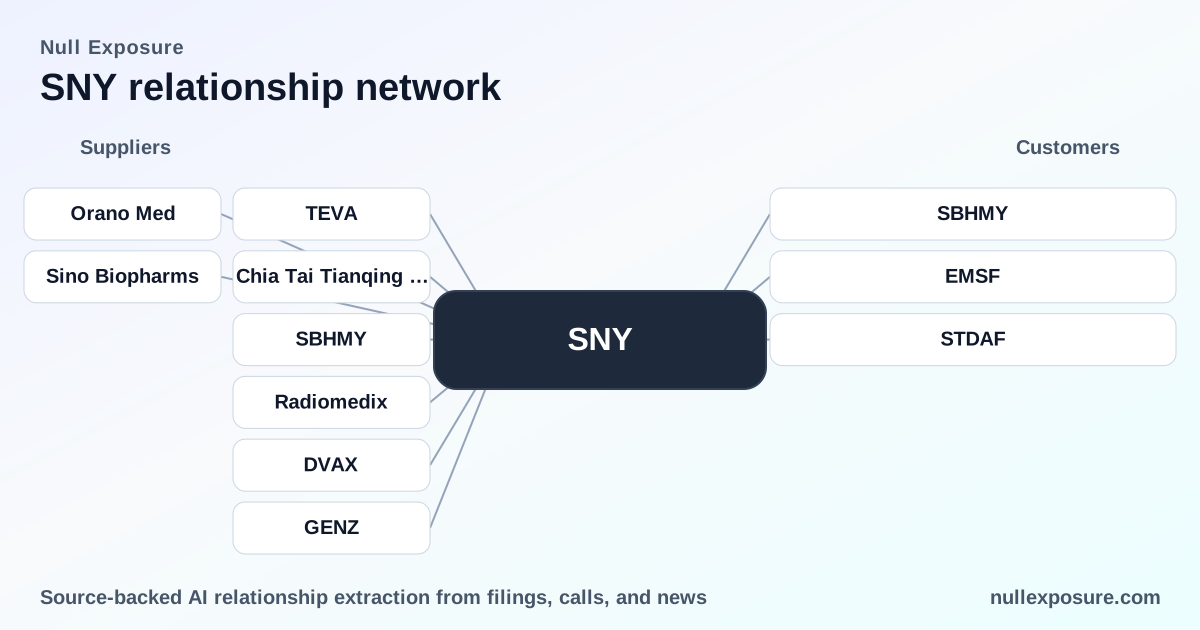
Sanofi (SNY): Customer and partner relationships that shape revenue and risk
Sanofi operates as a diversified global healthcare company that monetizes through pharmaceutical sales, royalties and milestone/licensing receipts, manufacturing and supply contracts, and selective divestitures of non-core assets. The company’s commercial model blends direct sales with a steady stream of partner-derived income — upfront payments, royalties, and long-term supply agreements — creating a mixed revenue base that is partially recurring and partially event-driven.
For a concise companion view of relationship signals and primary sources, see https://nullexposure.com/.
How Sanofi’s partner playbook drives value
Sanofi structures external relationships across three repeatable channels: licensing and upfront/milestone economics, commercialization and distribution partnerships, and manufacturing & supply agreements. Licensing generates lumpy but high-margin cash (upfronts and potential milestones); commercialization deals shift market access and distribution risk to Sanofi or partners; supply agreements secure API and finished-product continuity and often carry multi-year volume commitments. These modalities make Sanofi both a counterparty for biotech innovators and a buyer of manufacturing or licensing rights — a dual role that diversifies revenue but concentrates exposure around a handful of large collaborations.
Visit https://nullexposure.com/ for a structured inventory of these partnership signals.
Relationship inventory — the partners and what they mean for investors
Below are all customer/partner relationships captured in the referenced materials, each with a concise plain-English summary and source reference.
ANRO
ANRO exclusively in-licenses one U.S. patent and three foreign patents from Sanofi, indicating a formal IP licensing relationship rather than a simple supplier contract. According to ANRO’s FY2024 10‑K filing, the company holds these in‑license patents from Sanofi (ANRO 10‑K, FY2024).
ALXO (ALX Oncology)
ALXO is executing ongoing clinical partnerships with Sanofi across multiple studies, reflecting collaborative R&D activity rather than a pure commercial supply arrangement. Management discussed these active partnerships on ALXO’s Q4 2025 earnings call and in related press coverage (ALXO earnings call, 2025Q4; ALXO Q4 transcript, FY2026).
Novavax (NVAX)
Sanofi has taken lead commercial responsibilities for the Nuvaxovid COVID‑19 vaccine in select markets, transferring distribution duties and broadening market access for the product. News reports noted this commercial transfer and its implications for Novavax’s market positioning and Sanofi’s distribution reach (StockstoTrade news, Feb 2026; Blockonomi coverage, FY2026).
SCLX
SCLX is in discussions with Sanofi (an affiliate of Genzyme) to identify and certify new suppliers for sodium hyaluronate, suggesting Sanofi’s role as a downstream customer that drives supplier qualification activity. This is described in SCLX’s FY2024 10‑K (SCLX 10‑K, FY2024).
DBV Technologies (DBVT)
DBV secured manufacturing and supply agreements with Sanofi (and Fareva) for API and PSM to support future commercial supply, signaling Sanofi’s reliance on external manufacturing partners for specific product components. This was reported in operational partnership disclosures and filings (TradingView / Reuters summary, FY2026).
Vir Biotechnology (VIR)
Vir entered a high‑value license with Sanofi that transferred multiple T‑cell engager assets (including PRO‑XTEN and VIR‑5525) and carries potential total value up to $1.986 billion; Sanofi also received a material upfront payment ($102.8 million in 2024) and is entitled to a share of certain collaboration proceeds. Multiple news releases and filings document the structure and upfront economics of the transaction (GenEngNews, Aug 2024; Vir PR and press coverage, FY2025–FY2026).
Regeneron (REGN)
Sanofi continues a cost‑sharing and collaboration relationship with Regeneron (notably around Dupixent); payment dynamics are changing as Regeneron steps down reimbursement of development costs to zero by 2027, which alters future cash flows and cost allocation between the parties. Coverage of patent defenses and evolving cost‑sharing arrangements appears in industry reporting (BioSpace reporting; related press materials, FY2026).
Alnylam (ALNY)
Alnylam’s margin compression in recent periods was driven in part by increased royalties payable to Sanofi on Amvuttra, illustrating Sanofi’s recurring royalty income from licensed products. This effect was discussed in Alnylam’s Q4 2025 earnings commentary (InsiderMonkey coverage, FY2026).
Sino Biopharmaceutical (SBHMY / Sino Biopharmaceutical)
Sino Biopharmaceutical disclosed an exclusive license agreement with Sanofi for rovadicitinib, reflecting Sanofi’s strategy of monetizing assets through regional licensing deals. The transaction was reported via Reuters distribution and trading‑news summaries (TradingView / Reuters, FY2026).
Sionna Therapeutics (SION)
Sionna’s NBD1 research program was licensed from Sanofi, indicating Sanofi’s role as an IP originator for early‑stage assets that third parties then advance. This licensing relationship was noted in Sionna IPO and program coverage (MedCityNews, FY2025).
EMS / EMS Farma (EMSF, EMS)
Sanofi agreed to sell its Medley generics unit in Brazil to EMS, a local drugmaker, evidencing Sanofi’s continued divestiture of non‑core generics assets and the conversion of legacy product lines into cash or strategic exits. FiercePharma reported the deal and advising counsel in the transaction (FiercePharma, FY2026).
Stada (STDAF / Stada)
Sanofi has previously sold rights to established consumer‑health medicines to Stada in 2021 and 2023, reflecting a multi‑year program of divestments of legacy portfolios to external commercial partners. Industry reporting summarized Sanofi’s historical deals with Stada (FiercePharma, FY2026).
Innate Pharma (IPHA)
Innate Pharma listed partnerships with major biopharma firms including Sanofi and AstraZeneca to advance immuno‑oncology programs, positioning Sanofi as a strategic collaborator for smaller biotech innovators. This partnership profile appears in earnings/preview coverage (Intellectia preview, FY2026).
Operating constraints and business‑model signals (company level)
No explicit constraints were cataloged in the provided relationship results. As a company‑level signal, Sanofi’s relationship pattern reveals these operating model traits:
- Contracting posture: Sanofi acts both as licensor and licensee, and as a commercial partner and manufacturer/buyer, favoring negotiated multi‑year licensing and supply agreements that blend upfront, milestone, and royalty economics.
- Revenue concentration: While relationships are numerous and geographically diverse, a small number of high‑value collaborations (e.g., Vir, Regeneron, Novavax) drive disproportionate cash flow volatility through upfronts and milestone schedules.
- Criticality: Supply and manufacturing agreements (DBV, SCLX) and commercialization transfers (Novavax) indicate high operational criticality — disruptions in partner supply chains or contract terms could impact product availability and near‑term revenue.
- Maturity: The portfolio mixes mature commercialization deals and divestitures (Stada, EMS) with earlier‑stage licensing and R&D partnerships (Sionna, Innate, ANRO), producing a revenue stream with both predictable royalties and lumpy, event‑driven receipts.
Investment implications — what to watch
- Revenue composition: Expect a steady base of product sales augmented by lumpy licensing/upfront receipts and royalties; monitoring the timing and crystallization of milestone payments is essential.
- Supply‑chain exposure: Manufacturing/supply agreements introduce operational risk; contract renewals or supplier certification issues could affect production continuity and margins.
- Partner concentration risk: Large collaborators shape earnings volatility; changes in cost‑sharing (Regeneron) or commercial responsibilities (Novavax) translate directly into Sanofi’s P&L profile.
- Strategic simplification: Divestitures of generics and consumer health assets reduce legacy exposure and shift focus to higher‑margin specialty biologics and partnered innovation.
For a deeper, transaction‑level index of Sanofi’s partner signals and source tracing, visit https://nullexposure.com/.
Bold takeaways: Sanofi’s earnings are a hybrid of stable product sales plus partnership economics; investors should model both recurring royalty streams and timing risk from upfronts/milestones when forecasting free cash flow.