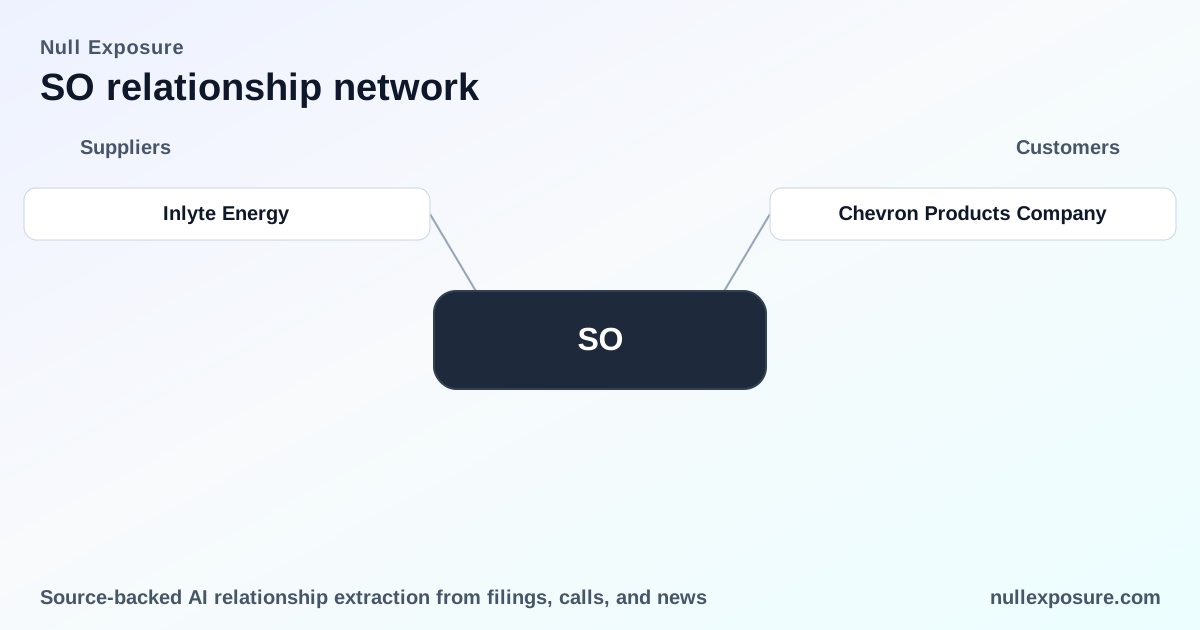
Southern Company (SO): Customer Relationships and What They Mean for Investors
Southern Company is a vertically integrated utilities holding company that monetizes a mix of regulated retail distribution and competitive wholesale generation. The company generates stable cash flow from long-term power purchase agreements (PPAs) and regulated cost-recovery mechanisms while capturing upside through targeted short-term wholesale sales and distributed-energy services delivered by affiliates. For investors, the customer book is a hybrid: anchored by long-duration industrial and retail contracts, supplemented by opportunistic short-term market exposure and growth in distributed energy solutions.
Explore the customer signals and relationship implications at https://nullexposure.com/ for a concise data view and ongoing updates.
What the relationship evidence says — quick read for portfolio managers
Southern Company operates at the intersection of regulated utilities and competitive generation. The balance of contract tenors and counterparty types drives capital allocation, counterparty concentration risk, and margin volatility: long-term PPAs anchor revenue stability, while short-term market sales and distributed energy projects enable margin capture and growth. Geographic concentration in North America and a mix of roles—seller, distributor, service provider—define regulatory, operational, and credit risk profiles for counterparties.
Operating constraints and business-model signals investors should log
- Contracting posture: Southern Company is materially structured around long-term PPAs (15–20 years) for most generation output, giving predictable cash flows and credit support for capital-intensive projects. Short-term sales exist to exploit market margins and manage system dispatch.
- Counterparty mix: Evidence includes industrial retail customers, cooperatives, municipalities, and government contracts, indicating diversified counterparty categories but concentrated regional exposure.
- Geographic concentration: The company’s activity is primarily North America (Southeastern U.S.), which centralizes regulatory and weather exposure.
- Role diversity: Southern Company functions as seller (wholesale generation), distributor (gas utilities), buyer under tolling/hedging arrangements, and a service provider through system services.
- Segment balance: Core earnings derive from generation sales and regulated distribution, while infrastructure and services (renewables, microgrids, resilience) represent strategic growth lines.
These are company-level signals drawn from Southern Company disclosures and public reporting; they describe operating constraints and strategic levers rather than any single customer contract.
Customer relationships: the recorded counterparties and what they mean
Mississippi Power — Chevron Products Company (Chevron)
Mississippi Power provides retail electric service to the Chevron refinery in Pascagoula under agreements that extend through at least 2038, creating a multiyear, large-industrial retail customer relationship that supports predictable volumetric demand for the local utility. According to Southern Company’s 2024 Form 10‑K (FY2024), the Chevron refinery is Mississippi Power’s largest retail customer and is contracted through at least 2038. (Source: Southern Company 10‑K FY2024)
Powder River Energy Corporation (via PowerSecure / distributed energy project)
Southern Company’s distributed-energy affiliate deployed a 5 MW battery paired with ground-mount solar to address peak demand, backup capacity, and cost management for cooperative customers; the project illustrates the company’s ability to sell behind-the-meter and distributed infrastructure solutions to regional cooperatives. A SimplyWallSt report on Southern’s battery/storage and solar project (FY2026) highlights PowerSecure’s role bringing behind-the-meter experience to a cooperative like Powder River Energy. (Source: SimplyWallSt, May 2026)
GPJA / Georgia Power construction for data-center load
Georgia Power’s project to serve data-center customers is material for workforce and operations: the construction phase will bring about 1,200 temporary workers and roughly 60 permanent Southern Company employees on site, underscoring Southern’s role as both developer/operator and on-the-ground operator for large commercial load projects. WRDW reported on May 1, 2026, that Georgia Power broke ground on a plant to serve data centers and documented the expected Southern Company staffing levels for the project. (Source: WRDW, May 1, 2026)
How these relationships knit into Southern Company’s economic model
Southern Company’s customer list reflects a dual business model: regulated retail and long-term contracted generation provide base revenue and capital-recovery frameworks, while competitive wholesale sales and third‑party distributed-energy projects deliver margin variability and growth. The recorded relationships exemplify that split:
- The Chevron–Mississippi Power contract typifies the long-duration industrial retail counterparties that provide demand stability and support utility rate bases.
- The Powder River/PowerSecure example shows the company leveraging its engineering and project capabilities to sell resilience and cost-management solutions to cooperatives and commercial customers.
- The Georgia Power/GPJA project demonstrates Southern’s role as integrator for large commercial loads (data centers), combining construction, operations, and long-term service commitments.
These combinations justify Southern’s capital allocation to renewables, storage, and grid modernization while preserving regulated earnings.
Investment implications — what to watch in the next 12–24 months
- Revenue stability vs. growth trade-off: Long-term PPAs and regulated retail contracts support dividend coverage and low beta, while the company’s push into storage, renewables, and behind-the-meter projects drives growth but requires capital and execution. Track the mix of long-term contracted revenues versus merchant or short-term sales reported in quarterly filings.
- Counterparty and regional risk: Heavy North American (Southeast) concentration concentrates regulatory and weather exposure; monitor state-level regulatory orders and major industrial customer renewals or terminations.
- Execution on distributed energy: Projects like the 5 MW battery/solar bundle for cooperative customers scale the services segment. Operational delivery and contract structures for these projects will determine margin realization and capital intensity.
- Workforce and construction risk: Large projects (e.g., data-center serving plants) create near-term construction hiring and operational ramp considerations; successful commissioning translates into long-term contracted load and cash flows.
Bottom line
Southern Company runs a capital-intensive, contract-driven utility platform where long-term PPAs and regulated rate mechanisms anchor cash flow and credit quality, while distributed-energy solutions and short-term market activity offer avenues for growth and margin enhancement. Investors should prioritize contract tenor, counterparty composition, and the pace of distributed-energy deployments when modeling risk-adjusted returns.
For a consolidated view of Southern Company customer signals and ongoing updates, visit https://nullexposure.com/.