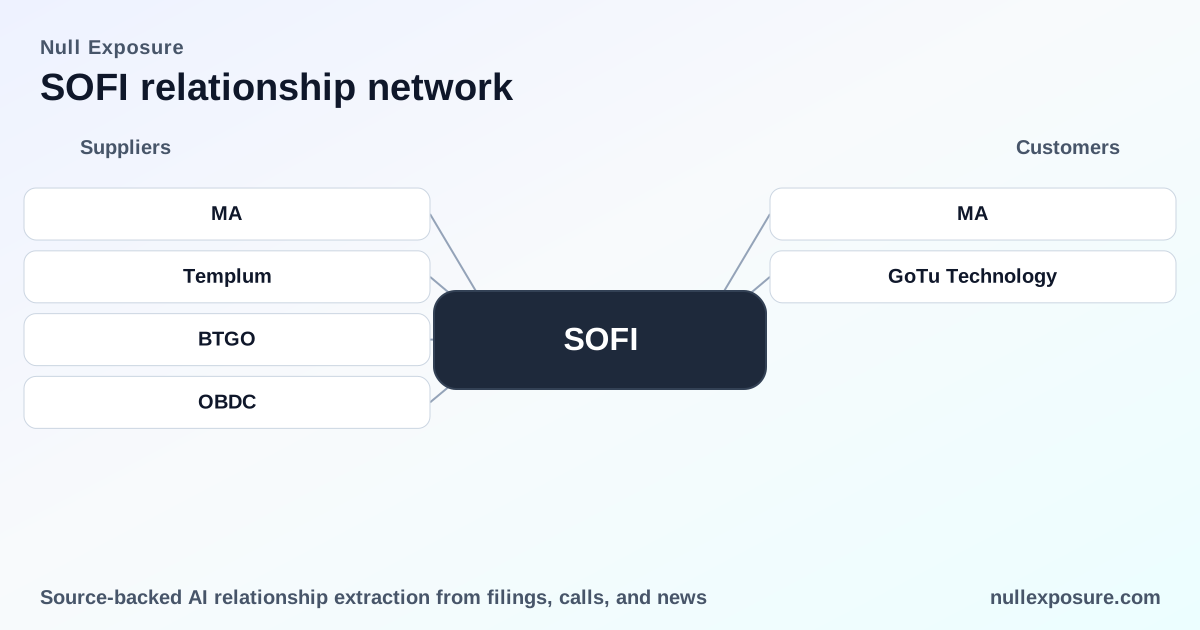
SoFi’s customer map: platform clients, underwriting partners and strategic rails that drive growth
SoFi operates as a vertically integrated digital financial services platform that monetizes through consumer lending margins, subscription and transaction fees, investment management, and increasingly through technology licensing and payments rails. The company sells financial products directly to members while also licensing its Galileo/technology platform and underwriting or co-managing capital markets transactions—creating a mixed revenue mix of yield, fees and platform licensing. For investors, the most relevant signal is that SoFi’s customer relationships span fintech counterparties, broker-dealers, payments networks and distribution partners, giving the company both retail distribution breadth and B2B revenue optionality. Learn more about how we track these partner relationships at https://nullexposure.com/.
Why SoFi’s customer roster matters to equity investors
SoFi’s relationships reflect a hybrid business model: retail-originated credit and deposits subsidize a software-as-a-service pathway that licenses Galileo and other rails to financial and non-financial institutions. The company’s disclosures and the relationship evidence together imply the following operating characteristics:
- Contracting posture: A mix of recurring licensing arrangements and multi-year platform integrations alongside short-hold loan origination for sale; that structure produces steady recurring revenue from platform customers while preserving balance sheet flexibility from loan sales.
- Concentration and materiality: No single third-party buyer accounts for 10% of revenue, signaling diversified counterparty exposure even as strategic partners (e.g., payments networks) are individually important.
- Criticality and role mix: SoFi often acts as a service provider and technology vendor, while also operating as a lender/seller and occasional arranger; those multiple roles raise both upsell opportunities and operational complexity.
- Geographic reach and maturity: Customer footprints are primarily North America and Latin America with selective APAC initiatives, indicating a regional leader with growing cross-border platform ambitions rather than a fully global payments incumbent.
These company-level constraints (contract types, geographies, segment mix and materiality) explain why SoFi’s partnership set includes payment networks, crypto infrastructure firms, broker-dealers and real-estate distribution partners—each relationship supports a different revenue vector.
If you want a consolidated view of SoFi’s counterparty exposure and how it affects valuation drivers, see our coverage at https://nullexposure.com/.
Relationship roll call — every partner cited in recent coverage
Below I list each partner referenced in the tracking results with a concise business description and the source.
Bullish
SoFi named Bullish among the initial participants in its new Big Business Banking initiative, positioning Bullish as a market-making/stablecoin counterparty for regulated crypto-to-fiat settlement. Source: FXNewsGroup (May 4, 2026).
BitGo / BTGO
BitGo (BTGO) shows up twice—SoFi participated as a co-manager on BitGo’s public filing and BitGo is also listed among early Big Business Banking participants. SoFi’s underwriting and platform ties to BitGo reinforce its strategic push into regulated crypto custody and settlement. Source: 01net (BitGo S‑1 filing, 2026) and FXNewsGroup (May 4, 2026).
SOFA (leveraged ETF on SoFi shares)
A newly issued ETF ticker, SOFA, was launched to deliver 200% of the daily returns of SoFi shares, effectively creating a leveraged product tied directly to SoFi’s equity performance. Source: ETF Trends (March 10, 2026).
Chime
Chime disclosed plans to transition off SoFi’s platform early last year, a high-profile example of a challenger bank moving away from Galileo/SoFi infrastructure and illustrating competitive churn among platform clients. Source: Yahoo Finance reporting on S‑1 disclosures (May 2026).
AGIQ (SoFi Agentic AI ETF)
SoFi launched the SoFi Agentic AI ETF (AGIQ) and will host the fund on SoFi Invest, generating product-level fees and distribution lift for its Invest business while leveraging third-party advisors. Source: SoFi press release and GlobeNewswire / trade press (September 2025; March 2026 reports).
Mastercard (MA)
Mastercard expanded a commercial partnership to allow SoFiUSD, SoFi’s fully reserved U.S. dollar stablecoin, to be used for settlement on Mastercard’s global payments network—an axis of distribution and utility for SoFi’s payments strategy. Source: SahmCapital and Benzinga coverage (March 2026).
GoTu Technology
GoTu Technology entered a partnership to make SoFi at Work financial-wellness resources available to dental professionals on GoTu’s marketplace, illustrating SoFi’s strategy to distribute products through vertical employment platforms. Source: MarketScreener (March 2026).
B2C2
B2C2 is named among initial participants in SoFi’s Big Business Banking program, positioning the firm as a trading/custody participant in SoFi’s institutional crypto settlement flow. Source: FXNewsGroup (May 4, 2026).
Fireblocks
Fireblocks appears on SoFi’s list of initial Big Business Banking firms, aligning Fireblocks’ custody and transfer infrastructure with SoFi’s regulated rails. Source: FXNewsGroup (May 4, 2026).
Mesh Payments
Mesh Payments is listed as an initial client in SoFi’s Big Business Banking launch, indicating SoFi’s intention to support expense and corporate payment flows for fintech market participants. Source: FXNewsGroup (May 4, 2026).
Wintermute
Wintermute, a digital-asset market maker, is included among launch partners for SoFi’s business banking initiative, tying algorithmic market liquidity providers into SoFi’s regulated settlement offering. Source: FXNewsGroup (May 4, 2026).
Galaxy
Galaxy is named as an initial participant in the Big Business Banking rollout, reflecting SoFi’s outreach to institutional crypto firms for stablecoin and settlement capabilities. Source: FXNewsGroup (May 4, 2026).
Jupiter
Jupiter is listed among the inaugural firms for Big Business Banking, part of SoFi’s strategy to onboard specialized liquidity and infrastructure providers. Source: FXNewsGroup (May 4, 2026).
Cumberland
Cumberland is cited as an initial participant in Big Business Banking, representing the inclusion of large market-making desks in SoFi’s settlement ecosystem. Source: FXNewsGroup (May 4, 2026).
Real Broker
SoFi convened a Real Estate Advisory Council as part of its home-lending expansion; Real Broker representatives are members of that council, underlining SoFi’s distribution push into mortgage origination and real-estate services. Source: SoFi investor relations release (May 2026).
Sotheby’s
An agent from Sotheby’s is listed on SoFi’s Real Estate Advisory Council, signaling partnerships with premium brokerages to source higher-touch mortgage and wealth clients. Source: SoFi investor relations release (May 2026).
Compass
SoFi’s Real Estate Advisory Council includes Compass-affiliated agents, supporting SoFi’s expanded home-lending and referral strategies through leading broker networks. Source: SoFi investor relations release (May 2026).
CFND
SoFi Securities served as a co-manager on a CFND offering, demonstrating the company’s role as an investment-banking counterparty and distribution channel for equity and structured-product underwriting. Source: StockTitan news coverage (March 2026).
Investor takeaways: what this partner set implies for the thesis
- Revenue optionality: Partners span payments, crypto custody and broker networks, supporting multiple monetization levers—lending yield, platform licensing, transaction and product fees.
- Operational complexity: The mix of active platform clients, underwriting roles and retail product distribution increases operational risk but also raises upsell potential to enterprise customers.
- Risk profile: Geographic expansion into Latin America and selective APAC initiatives diversify growth but require continued investment in compliance and integration. Concentration risk is low at the revenue line, yet individual partners (e.g., Mastercard) are strategically critical to SoFi’s payments roadmap.
For investors evaluating SoFi’s franchise, the partner roster is a clear signal that the company is both a consumer finance originator and a B2B fintech rails provider—a hybrid model that supports faster top-line diversification but requires execution on integration and regulation.
If you want a consolidated counterparty impact analysis for SoFi’s valuation and risk, visit our research hub at https://nullexposure.com/.