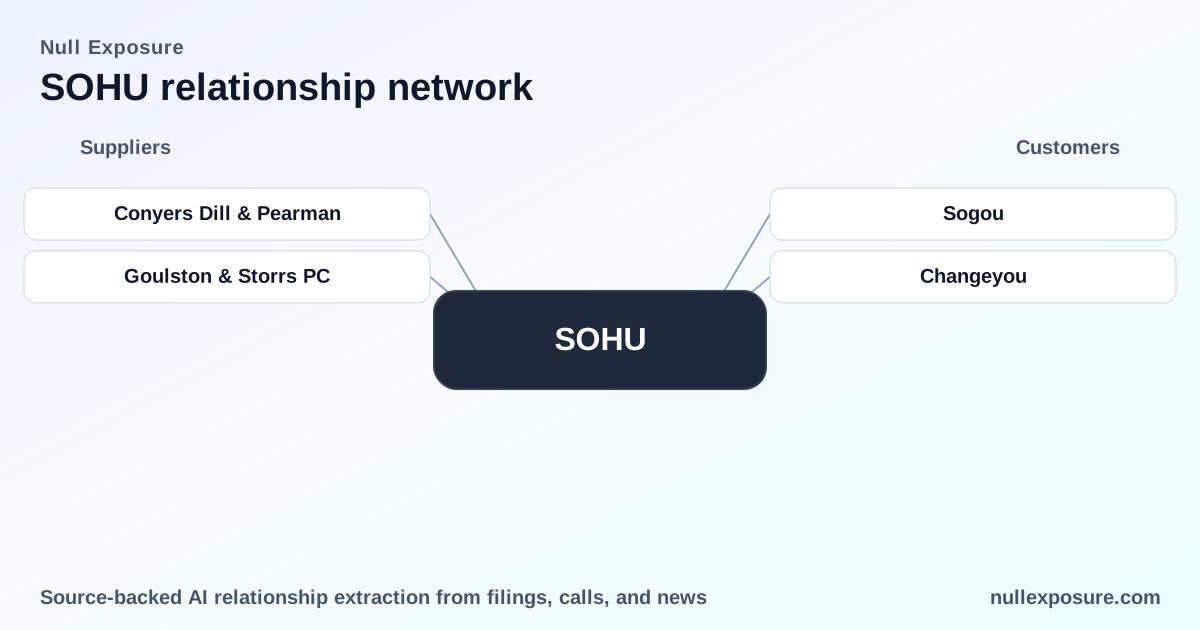
Sohu.Com (SOHU) — Revenue relationships and what they mean for investors
Sohu.Com operates as an online media, gaming and search platform in China, monetizing primarily through advertising (search and display), online games, and content services. The company's revenue profile is concentrated around a small set of product relationships that feed advertising and gaming sales, and these relationships determine both near-term cash flow and long-term strategic optionality. For a concise, sortable view of these relationships and original sources, visit https://nullexposure.com/.
How Sohu makes money and how its supplier/customer posture works
Sohu is an ad-and-games publisher: it aggregates user attention across PC and mobile, sells advertising inventory (including sponsored search) and operates online game titles either directly or through partners. Advertising—especially sponsored search—and online gaming are the primary monetization engines, while content and video services provide engagement and inventory scale. The company historically held equity stakes in search assets and has also transacted those stakes for cash consideration, while continuing commercial relationships that deliver advertising revenue.
From an operating-model standpoint, the company-level signals are:
- Concentration: Revenue data shows heavy reliance on a single branded search source, which implies sales concentration risk and sensitivity to that partner’s pricing and traffic volumes.
- Contracting posture: Sohu combines platform/operator relationships (commercial ad buys and game distribution) and, historically, equity positions, so contractual exposure can be a mix of standard vendor agreements and occasional strategic disposals.
- Criticality: Search and game revenues are core to operating cash flow; loss or repricing of these channels would have immediate financial impact.
- Maturity: The business mixes mature advertising products and established game franchises, suggesting predictable but potentially low-growth ad economics unless new products scale.
No explicit contractual constraints were returned for the customer-scope review; the above characteristics are company-level signals derived from reported relationships and revenue attribution.
The relationships that matter — a concise rundown
Below I cover every named relationship surfaced in the review, each with a short, plain-English summary and the source.
Tencent Holdings Ltd — a strategic acquirer in the search landscape
Sohu received roughly $1.18 billion in cash from Tencent’s acquisition of Sogou because Sohu previously held a 33.8% stake in Sogou, and the transaction eliminated Sohu’s equity interest in that search asset. A China Daily report covering the September 2021 transaction noted the consideration and the fact Sohu no longer held ownership in Sogou after the merger (China Daily, Sept 24, 2021).
Sogou — a dominant contributor to Sohu's sponsored-search revenue line
Corporate financial reporting for FY2026 identifies Sogou (Sponsored Search) as the largest single contributor, accounting for 54.6% of total sales, approximately $248.4 million, indicating that sponsored search branded as Sogou remains a material source of ad revenue for Sohu despite prior equity transactions (Intellectia.ai FY2026 financial summary).
Changeyou — online gaming as a material revenue stream
Changeyou is listed among other significant revenue streams, representing Sohu’s exposure to online-game revenues and related distribution monetization (Intellectia.ai FY2026 financial summary). Game publishing and distribution through Changeyou contributes to the company’s product mix outside of search advertising.
Why these relationships form a strategic risk profile
Sohu’s revenue is concentrated and product-driven: one branded ad source represents a majority share of sales in FY2026, while online games supply a secondary but meaningful revenue stream. That structure produces three investment-relevant implications:
- Revenue concentration risk: With more than half of sales attributed to a single sponsored-search source, any traffic loss, re-pricing, or contract re-negotiation affecting that source will exert outsized pressure on reported top-line and margins.
- Cash realization from asset sales versus recurring revenue: The Tencent/Sogou transaction demonstrates the company’s ability to realize one-time cash from equity stakes, but realized cash is a different economic lever than recurring ad or game revenue.
- Operational leverage to content and games: Games (e.g., via Changeyou) provide product diversification, but game revenues are often hit-driven and cyclically volatile versus search ad flows.
Key takeaways for investors
-
Sogou-sponsored search is the largest single revenue driver for FY2026 and represents a primary concentration risk.
-
Tencent’s 2021 acquisition of Sogou turned an equity exposure into cash, removing an ownership stake while the commercial relationship delivering sponsored-search revenue persisted as a top-line driver.
-
Games (Changeyou) are material but secondary, offering diversification that does not eliminate concentration in search advertising.
-
For original relationship sources and a structured view, visit https://nullexposure.com/.
Near-term monitoring and action points
Investors should monitor three inputs quarterly:
- Revenue attribution by product (search vs. games vs. content) to confirm whether the Sogou share of sales trends up or down.
- Commercial agreements and traffic/pricing metrics tied to sponsored search — any disclosure of renegotiation, traffic diversion or CPM changes will be a direct earnings lever.
- Game monetization trends and title pipeline from Changeyou to assess diversification effectiveness.
If you are evaluating a position, prioritize quarters where the company discloses product-level revenue splits and contract changes, because those items move valuation more than one-off asset realizations.
Bottom line
Sohu’s cash flows are driven by a concentrated sponsored-search relationship and a material online-games business; the 2021 Tencent Sogou deal converted equity into liquidity but did not remove the company’s commercial exposure to Sogou-branded search revenue. Investors should treat Sohu as a concentrated-content-and-ad operator whose valuation will track sponsored-search economics and game monetization cycles.
For additional relationship maps, source links, and structured evidence for due diligence, see https://nullexposure.com/.