SOJC: Customer Map and What It Means for Investors
Thesis — SOJC represents a claim on The Southern Company’s preferred capital structure and the underlying business monetizes through electricity generation, transmission and distribution, with the company collecting regulated retail tariffs and long-term wholesale contract payments (PPAs) as primary cash flows; capacity revenues and contracted energy sales drive earnings stability and support the preferred dividend profile. For investors and operators evaluating SOJC counterparty exposure, the headline is simple: Southern’s customer base mixes large industrial off-takers and institutional retail partners under predominantly long-term contracts across North America, creating predictable revenue streams but concentrating exposure to a handful of large counterparties and regulated jurisdictions. For further context and tools, see https://nullexposure.com/.
How Southern actually sells power — a commercial snapshot
Southern operates across multiple business lines: traditional regulated utilities that collect retail rates, Southern Power that builds and sells generation under wholesale contracts, and Southern Company Gas for distribution and marketing. The company sells capacity and energy under long-term PPAs and retail tariffs, supplements with short-term opportunity sales, and monetizes renewable builds via contracted off-take arrangements. That blended model explains why capacity revenues are a major earnings driver and why preferred securities like SOJC receive support from stable contractual cash flow. Visit https://nullexposure.com/ for more coverage.
Counterparty roll call: every named customer in the filings and commentary
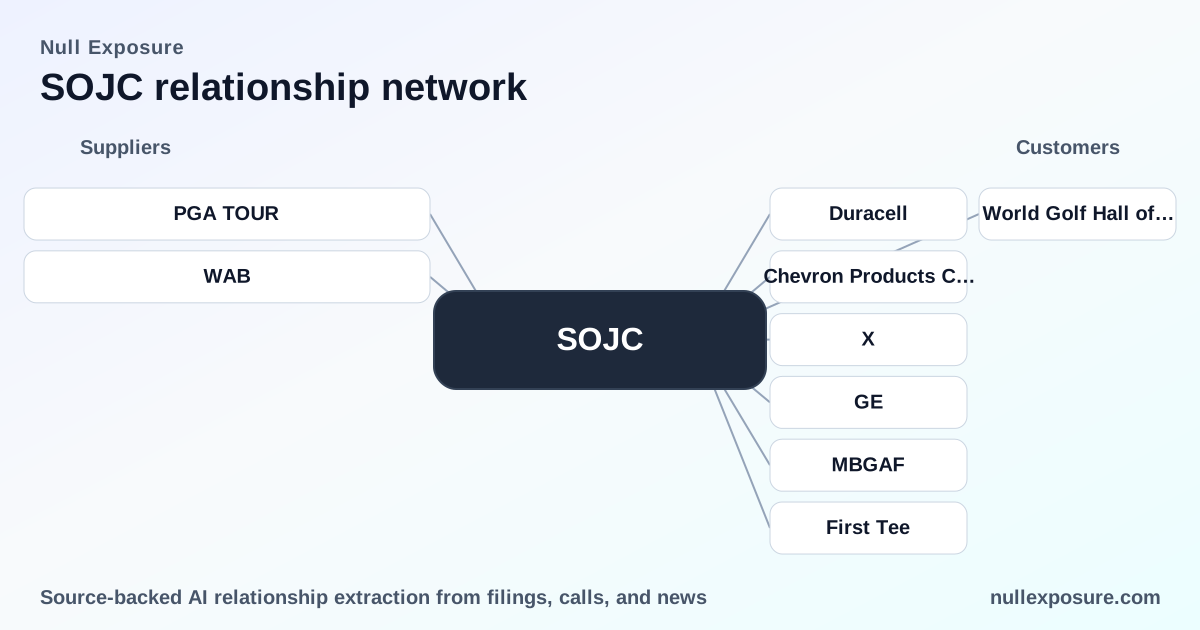
Below are all relationships returned in the SOJC customer search, each with a concise plain-English summary and a source reference.
Duracell
Duracell was cited by management when listing large industrial and manufacturing customers served over the prior year, indicating Southern’s footprint in high-demand manufacturing loads. According to the 2025 Q4 earnings call transcript, Duracell was named alongside other industrial customers (2025 Q4 earnings call, March 2026).
US Steel
US Steel was listed as a prominent metals-sector customer in the company’s public remarks about large industrial announcements, highlighting exposure to energy-intensive metal producers. Management referenced US Steel during the 2025 Q4 earnings call when describing major manufacturing and metals relationships (2025 Q4 earnings call, March 2026).
GE (General Electric)
General Electric was identified among large customers in the same earnings commentary, underscoring Southern’s engagement with aerospace and heavy-industrial clients. Management included General Electric in the list of notable relationships during the 2025 Q4 earnings call (2025 Q4 earnings call, March 2026).
General Electric (separate entry)
A second listing for General Electric mirrors the prior mention and reflects multiple references to the company across the same earnings discussion; it reinforces that GE is part of Southern’s manufacturing/industrial customer set. The duplicate is documented in the 2025 Q4 earnings call (2025 Q4 earnings call, March 2026).
Mercedes‑Benz
Mercedes‑Benz was called out among automotive-industry counterparts, signaling Southern’s penetration into automotive manufacturing loads that typically require large, reliable power contracts. Management named Mercedes‑Benz in the 2025 Q4 earnings call when discussing industry wins (2025 Q4 earnings call, March 2026).
Chevron Products Company
Chevron is an explicitly documented retail customer of Mississippi Power with a contractual retail service arrangement that extends through at least 2038 for the Pascagoula refinery, making Chevron a long-dated revenue source for that utility. This relationship is described in Southern’s FY2024 Form 10‑K where Mississippi Power and Chevron Products Company are named directly (FY2024 10‑K).
First Tee
Southern’s relationship with First Tee is a sponsorship/education patron arrangement rather than an energy off-take: Southern has been the Education Patron of First Tee since 2012, reflecting corporate community and brand partnerships. This is reported in a PGA Tour company article covering Southern Company’s sponsorship activities (PGA Tour article, August 2022).
World Golf Hall of Fame
Southern partnered with the World Golf Hall of Fame to create the Charles Sifford Award presented by Southern Company, a philanthropic and branding relationship rather than a commercial energy contract. The partnership is described in the same 2022 PGA Tour article noting Southern’s community and philanthropic initiatives (PGA Tour article, August 2022).
What the constraints tell investors about SOJC’s operating model
The relationship-level data is only part of the story; the company-level constraints provide crisp signals about contract posture, concentration, criticality and maturity:
- Contracting posture: predominantly long-term. Southern’s power sales — particularly through Southern Power and many renewable projects — are structured through long-term PPAs (15–20 years common), which insulate cash flows from near-term commodity volatility and support preferred dividend coverage.
- Short-term activity exists but is limited. Management supplements long-duration contracts with short-term opportunity sales; these are incremental rather than core to earnings stability.
- Counterparty mix: institutional and regulated counterparties. The firm sells primarily to investor‑owned utilities, municipalities, cooperatives, and large commercial & industrial customers — a counterparty set that combines regulated, creditworthy entities and large corporate off-takers.
- Geographic concentration in North America. Contractual and operational footprints are focused on U.S. jurisdictions (notably Alabama, Georgia, Mississippi), which governs regulatory risk and jurisdictional rate design.
- Materiality dynamics: capacity revenues are critical. Capacity payments are a principal contributor to net income and are designed to recover fixed costs and return on investment, reinforcing cash flow certainty.
- Role orientation: Southern primarily functions as the seller of electricity and developer/operator of generation assets. The business model emphasizes selling capacity and energy under contract rather than merchant risk-taking.
- Relationship lifecycle: active and renewing. The company actively renews and remarkets PPAs ahead of expirations, which reduces renewal risk but leaves exposure if replacement PPAs are not secured.
These are company-level signals that explain why preferred holders can look to relatively predictable distributions, while still recognizing counterparty and regulatory dependencies.
Risks and what investors should watch
- Counterparty concentration risk: Long-term PPAs concentrate revenue with a smaller set of large counterparties; a non-renewal or counterparty stress event could be earnings‑negative.
- Regulatory and jurisdictional sensitivity: Much of the revenue comes from regulated utilities and FERC-approved arrangements, so rate cases, fuel-recovery mechanisms and policy changes will move cash flow profiles.
- Industrial demand exposure: Dependence on large industrial off-takers (steel, refining, automotive) ties Southern’s fortunes to cyclical demand in those sectors.
Bottom line — what SOJC investors should take away
SOJC benefits from a revenue model rooted in long-term contracts and regulated tariffs, producing stable, contract-backed cash flows that underpin preferred dividends. The counterparty list demonstrates a deliberate focus on large industrial and institutional relationships plus community partnerships; the commercial profile is seller‑centric and contract-driven, concentrated geographically in the U.S. For active investors and operators evaluating credit risk, the key is monitoring PPA renewal activity, the financial health of large off-takers, and regulatory developments in core states.
For a detailed view of counterparties and exposure analytics, explore the issuer page at https://nullexposure.com/.