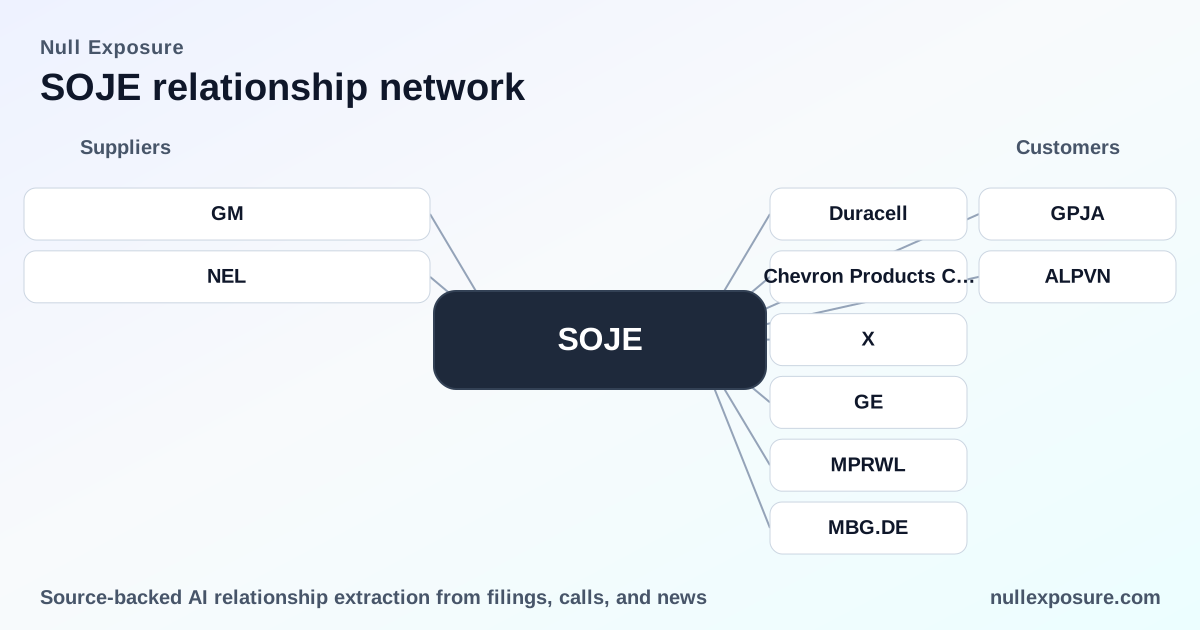
SOJE Customer Map: Industrial offtake and regulated utility anchors
Southern Company Series 2 (SOJE) operates as part of the Southern Company system, monetizing through regulated retail tariffs and wholesale electricity sales—primarily via long‑term power purchase agreements (PPAs) and service contracts across the Southeastern United States. For investors, the revenue profile is a mix of regulated distribution economics and contract‑backed wholesale generation, creating predictable cash flows while concentrating counterparty exposure in large industrial and utility counterparties. For a concise view of counterparties and implications, see https://nullexposure.com/.
Why the customer list matters to investors
SOJE’s customer relationships reveal two structural facts that drive valuation: durable, contracted cash flows from long‑term PPAs and regulated retail rates, and concentration risk among large industrial and wholesale buyers. The balance between long‑term contracts and opportunistic short‑term sales underpins near‑term stability while creating remarketing risk when PPAs expire. Investors should value earnings visibility from contracted revenue while pricing potential earnings volatility tied to contract renewals and large industrial load contracts.
How SOJE contracts and counterparty packaging shape risk
- Contracting posture: Southern Company’s filings describe that a large share of wholesale output is sold under long‑term PPAs (15–20 years common), with a smaller role for short‑term opportunity sales. This creates predictable revenue and shifts fuel‑price exposure to counterparties.
- Concentration and criticality: Several customers are major industrial players and affiliated utilities, so the expiration or nonrenewal of a few contracts can be materially meaningful for a generation asset, even if not company‑level catastrophic.
- Geographic focus: Operations and customers are concentrated in the Southeastern U.S., anchoring regulatory stability but raising regional economic and weather risk.
- Role profile: SOJE acts predominantly as a seller of electricity (core product) and a regulated distribution operator through traditional operating companies; noncore activities (distributed energy, microgrids) exist but are secondary.
- Spend and scale signals: Disclosures show working capital and fuel‑recovery balances in the $10m–$100m band for some items, consistent with large industrial contracts and utility fuel clauses.
For further context on counterparties and exposure, visit https://nullexposure.com/.
Relationship readout — every counterparty mentioned in SOJE source material
Below are the relationships extracted from SOJE’s FY2024 10‑K and the 2025 Q4 earnings call, each listed with a one‑line commercial summary and source.
-
Duracell — SOJE lists Duracell among large manufacturing and industrial announcements receiving service or project attention, indicating engagement with battery or manufacturing customers in SOJE’s industrial sales channel. This was referenced during SOJE’s 2025 Q4 earnings call discussion of large industrial wins.
Source: SOJE 2025 Q4 earnings call (2025Q4). -
Chevron Products Company — Mississippi Power provides retail electric service to Chevron’s Pascagoula refinery under agreements that extend through at least 2038, representing a long‑dated industrial retail contract. This is disclosed in SOJE’s FY2024 10‑K filings describing Mississippi Power’s largest retail customer.
Source: SOJE FY2024 10‑K (FY2024). -
US Steel (X) — US Steel is identified among major metals‑industry customers tied to recent large announcements, showing SOJE’s exposure to heavy industry electricity demand. This mention appears in the 2025 Q4 earnings call when management summarized large industrial engagements.
Source: SOJE 2025 Q4 earnings call (2025Q4). -
General Electric (GE) — General Electric is cited alongside other large manufacturing customers in the earnings call narrative, signaling commercial activity or project relationships with capital‑intensive industrial OEMs. Management referenced GE during the 2025 Q4 earnings call.
Source: SOJE 2025 Q4 earnings call (2025Q4). -
GE — The tickered duplicate entry for GE in the same earnings call reinforces that General Electric was explicitly called out among manufacturing and aerospace engagements discussed in the 2025 Q4 call.
Source: SOJE 2025 Q4 earnings call (2025Q4). -
MPRWL — SOJE’s FY2024 10‑K notes that, as of December 31, 2024, Mississippi Power had a cogeneration agreement in effect with one of its industrial customers; the MPRWL entry reflects that cogeneration counterparty activity. This indicates active distributed generation or customer‑sited generation arrangements.
Source: SOJE FY2024 10‑K (FY2024). -
Mississippi Power — The company’s filings confirm Mississippi Power maintains at least one cogeneration agreement with an industrial customer and operates retail fuel‑recovery mechanisms and long‑term service arrangements in southeastern Mississippi. These items are reported in the FY2024 10‑K.
Source: SOJE FY2024 10‑K (FY2024). -
Mercedes‑Benz — Mentioned in the 2025 Q4 earnings call among large automotive‑sector announcements, Mercedes‑Benz represents SOJE’s penetration into automotive manufacturing demand. Management included Mercedes‑Benz in its list of large industry customers.
Source: SOJE 2025 Q4 earnings call (2025Q4). -
Alabama Power — SOJE’s FY2024 10‑K states Alabama Power had cogeneration contracts in effect with seven industrial customers as of December 31, 2024, indicating multiple industrial bilateral arrangements in the Alabama footprint.
Source: SOJE FY2024 10‑K (FY2024). -
GPJA — The GPJA entry corresponds to Georgia Power; SOJE discloses that Georgia Power has contracts to purchase alternative energy from 40 independent power producers (IPPs) in Georgia, reflecting extensive wholesale contracting activity. This is described in the FY2024 10‑K.
Source: SOJE FY2024 10‑K (FY2024). -
Georgia Power — Georgia Power is expressly listed as having contracts in effect to buy alternative generation from 40 IPPs within Georgia, highlighting a sizable market for PPAs and renewables procurement in the state. This is included in the FY2024 10‑K.
Source: SOJE FY2024 10‑K (FY2024). -
ALPVN — The ALPVN duplicate corresponds to the Alabama Power disclosure that seven cogeneration contracts were active as of year‑end 2024; ALPVN repeats that contractual scope in the FY2024 10‑K.
Source: SOJE FY2024 10‑K (FY2024).
What investors should take away
- Contract‑backed revenue is the dominant cash‑flow driver. SOJE’s public disclosures emphasize long‑term PPAs and regulated retail tariffs as the primary monetization mechanisms, which supports predictable near‑term cash generation.
- Counterparty concentration is real and industry‑focused. The customer list skews to large industrials (refining, steel, automotive, aerospace) and to affiliated/regional utilities — a structure that boosts revenue size but concentrates remarketing and counterparty credit risk.
- Regional regulatory context matters. Southeastern regulation and fuel‑recovery mechanisms lower short‑term commodity exposure but create geographic concentration that investors must underwrite.
- Earnings sensitivity on PPA expirations. SOJE discloses that expiration of PPAs without successful remarketing could have a material negative impact on Southern Power’s earnings, a direct red flag for scenarios analysis when modeling long‑run cash flows.
Investment implications and next steps
For portfolio managers evaluating SOJE exposure, stress PPA renewal scenarios and model the impact of losing a small number of large industrial contracts — the filings peg that risk to the wholesale generation segment rather than company‑level insolvency, but it compresses asset‑level returns. For more structured counterparty mapping and to benchmark counterparties against other issuers, explore the platform at https://nullexposure.com/.
Bold, contract‑anchored cash flows and concentrated industrial relationships define SOJE’s risk/return profile: predictable today, conditional on successful PPA remarketing and sustained regional demand tomorrow.