SOLO customer relationships: who’s buying the single-seat EV and what it means for investors
ElectraMeccanica sells and monetizes the SOLO as a low-cost, single-occupant electric vehicle to consumers, fleets, and brick-and-mortar retailers through direct sales and limited retail partnerships. Revenue flows from vehicle sales, targeted fleet orders and display/retail placements that drive local awareness; ancillary revenue sources include cargo conversions and partnership pilots for delivery services. For investors, the relevant tests are order concentration, retail distribution economics, and the pace at which pilot partnerships scale into recurring fleet contracts. Learn more at https://nullexposure.com/.
What the customer list tells you in one line
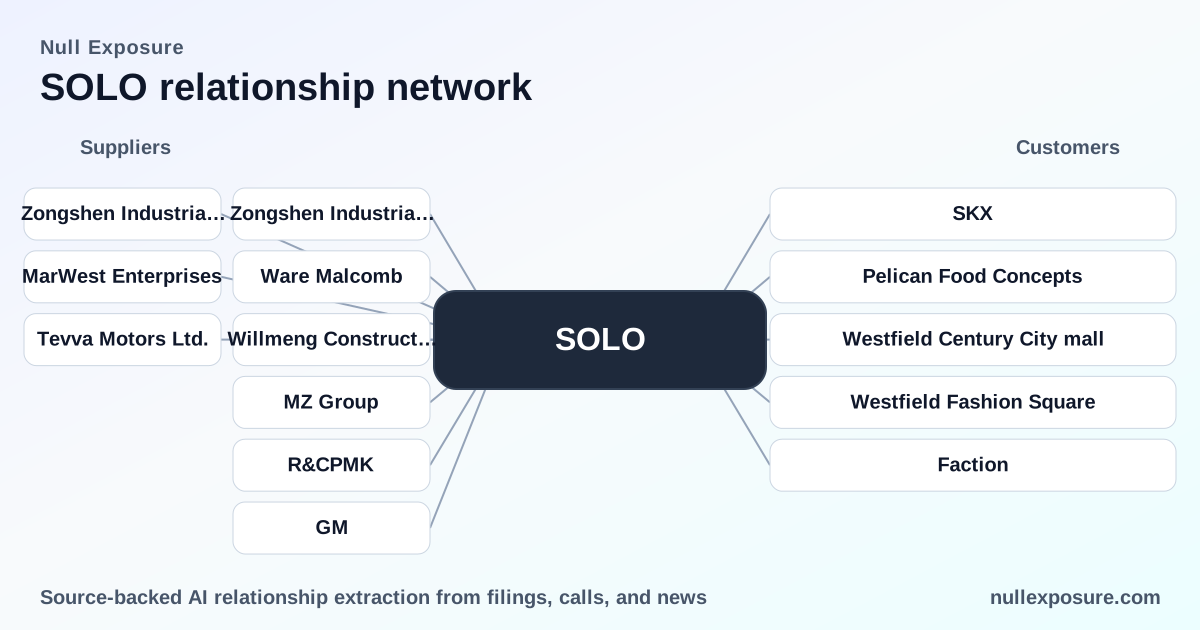
The reported customers and pilots represent a mix of early-adopter retail placements, a marquee fleet name, franchise-level discussions for cargo conversions, and targeted tech pilots—collectively consistent with a company still in commercialization and customer-proving mode rather than large-scale fleet rollouts.
Relationship-by-relationship readout (each entry in the source results)
SKX — Electrek report (FY2021)
ElectraMeccanica delivered SOLO vehicles to a select group of early reservation holders and fleet customers, and Skechers USA was explicitly named among early fleet recipients at an invite-only Los Angeles delivery event. This placement communicates an early corporate-fleet endorsement and was reported by Electrek in October 2021.
Skechers USA — Automotive News (FY2021)
Automotive News confirmed Skechers USA as one of the first U.S. customers to take delivery of a commercial SOLO EV, reinforcing the commercial deployment beyond private buyers to branded fleets. The coverage (Autonews, FY2021) gives the delivery public visibility and validation in a mainstream auto trades outlet.
SKX — Electrek duplicate entry (FY2021)
A second Electrek entry duplicates the earlier note that Skechers USA received SOLO deliveries as a fleet customer at the Los Angeles launch, underscoring the same early fleet relationship reported in October 2021. Electrek’s repeated coverage highlights media emphasis on early corporate customers.
Pelican Food Concepts — Proactive Investors (FY2022)
ElectraMeccanica entered advanced discussions with Pelican Food Concepts, a franchisee of Mountain Mike’s Pizza, for a potential order of SOLO Cargo vehicles, representing a route into restaurant delivery/cargo use cases. Proactive Investors reported the commercial negotiation phase during FY2022, signaling targeted vertical interest from franchise operators.
Westfield Century City mall — Spectrum News1 (FY2020)
ElectraMeccanica established retail visibility by selling SOLO online and operating a retail kiosk at Westfield Century City, providing direct-to-consumer exposure in a high-traffic mall setting. Spectrum News1 covered the FY2020 retail launch and the Century City display that supported early public test drives and walk-in interest.
Westfield Fashion Square — Spectrum News1 (FY2020)
The SOLO was showcased at Westfield Fashion Square in the San Fernando Valley shortly after Century City, extending mall-based retail placement to another Los Angeles market. Spectrum News1’s FY2020 notice emphasizes a retail display strategy to convert showroom interest into early sales.
Faction — Electrek feature (FY2022)
ElectraMeccanica tested autonomous food delivery integrations in a pilot with startup Faction, positioning the SOLO as a platform for last-mile robotics and delivery experiments. Electrek’s March 2022 feature described the testing of autonomous food deliveries with Faction, indicating product adaptability to novel delivery architectures.
What these relationships imply about SOLO’s operating model and commercialization constraints
Because the dataset provides no explicit contractual constraints, draw conclusions at the company level: ElectraMeccanica operates with a commercialization-first posture focused on awareness and proof-of-concept customers rather than large, long-term OEM or logistics contracts. The relationships show:
- Low concentration of scale today — customers are mostly pilot, retail-display, and small fleet placements rather than multi-thousand-unit fleet orders.
- Commercial criticality is limited but strategic — marquee names such as Skechers provide credibility; franchise talks and delivery pilots demonstrate pathways to practical, recurring use cases.
- Contracting posture is opportunistic and flexible — the company pursues retail kiosks, one-off fleet deliveries, and negotiation-stage franchise orders rather than fixed, high-volume supply contracts.
- Maturity is early-stage commercialization — activity is concentrated in FY2020–FY2022 media coverage and pilot deployments rather than sustained, large-scale programs.
These signals frame investor expectations: growth is dependent on converting pilots into volume orders and expanding retail-to-fleet conversion economics.
Investment implications — upside and risk
ElectraMeccanica’s customer footprint delivers valuable proof points: headline-catching deliveries to a national apparel company, multiple mall retail placements for direct consumer conversion, and active pilots for delivery and cargo conversions. These points support a narrative of product-market fit in niche urban, last-mile, and promotional fleet roles.
Key risks to monitor:
- Scale risk: Current relationships are small and pilot-focused; commercial scaling requires multi-unit fleet commitments or widespread retail conversion.
- Concentration risk: If a handful of pilot customers drive a disproportionate share of early revenue, financial metrics will show volatility.
- Distribution economics: Mall kiosks and single-location retail displays are useful for awareness but impose high customer acquisition costs unless sales per location scale.
- Execution on conversions: The company’s ability to turn advanced discussions (e.g., franchisees) and pilots (e.g., Faction) into recurring purchase contracts determines near-term revenue trajectory.
Bottom line and next steps for research
ElectraMeccanica’s customer map is coherent with a company finishing product development and validating use cases through retail displays, small fleet deliveries, and targeted pilots. The critical investor question is conversion: will these early relationships scale into repeatable revenue streams and larger fleet commitments?
For deeper diligence, review recent company filings and order announcements, and track any expansion of franchise orders or multi-unit fleet contracts that shift the model from pilot-driven to scale-driven. For more analysis and continual updates on industrial customer relationships, visit https://nullexposure.com/.
Bold takeaway: SOLO’s revenue growth depends on converting pilot placements and marquee deliveries into predictable, high-volume fleet or franchise orders; current relationships validate the product but do not yet constitute scale.