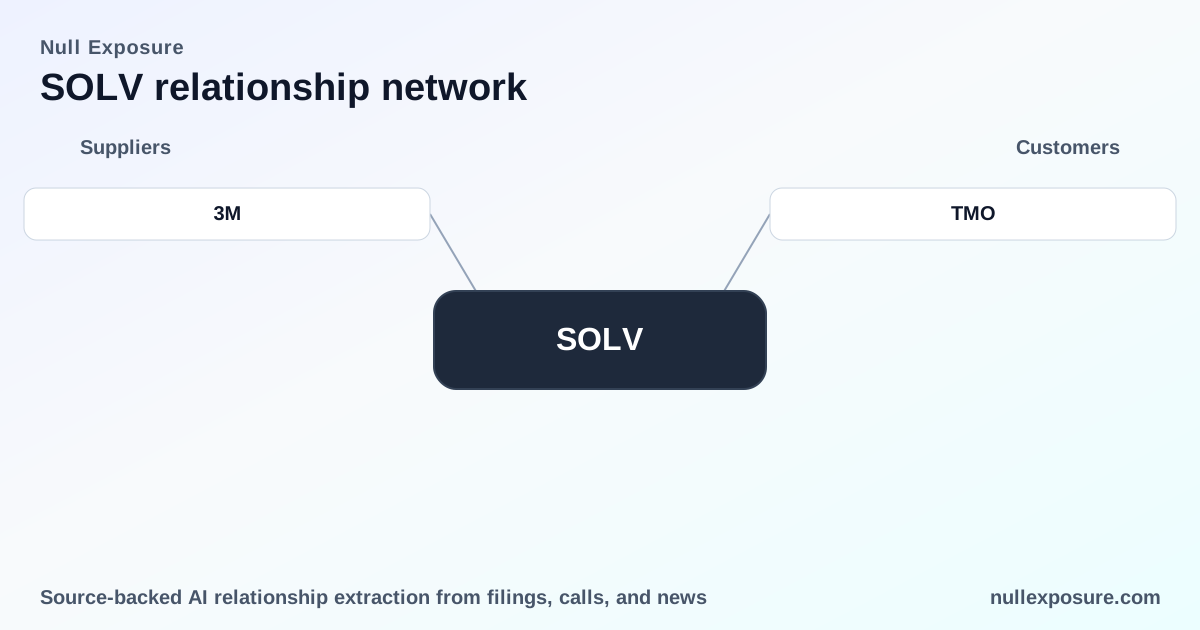
Solventum (SOLV) — customer relationships that shape revenue and risk
Solventum monetizes by selling medical instruments, purification and filtration systems, and healthcare software to a broad set of commercial and government buyers worldwide, complemented by recurring consumables and service contracts; revenue derives from product hardware sales, software subscriptions and aftermarket consumables. Investors should view Solventum as a capital-light medical products company that extracts margins from both one-time equipment sales and high-margin recurring consumables, while selectively monetizing non-core assets through strategic divestitures. For further signals and relationship intelligence, visit https://nullexposure.com/.
The short list that matters: who Solventum does business with
Below I catalog each relationship surfaced in recent public reporting and explain why each matters for investors. Each entry is a plain-English, one-to-two sentence summary with a concise source note.
Thermo Fisher Scientific (TMO) — divestiture counterparty and strategic buyer
Thermo Fisher acquired Solventum’s purification and filtration business in early 2025 for roughly $4.1 billion, transferring a meaningful portion of Solventum’s bioproduction-related hardware revenue to a single strategic buyer and signaling that Solventum will now lean more on other segments. According to Thermo Fisher’s public results and analyst coverage in early 2026, the buyer frames the acquisition as a complement to its bioproduction capabilities and reports progress integrating the assets into its portfolio (FinancialContent, BioSpace, Yahoo Finance; FY2026 commentary). Insider commentary from an earnings transcript noted Thermo Fisher’s continued satisfaction with the acquired filtration and separation business (InsiderMonkey, May 2026).
Ningbo Semiconductor International Corp. — identified recipient in export-control enforcement
U.S. enforcement reporting tied Solventum shipments described as “contactors” used in semiconductor manufacturing to Ningbo Semiconductor International Corp., indicating Solventum equipment or components were sold or routed to Chinese semiconductor firms that drew regulatory scrutiny. The enforcement order and local reporting cited Ningbo as an identified recipient in connection with a penalty for China sales (Hoodline, April 2026).
Semiconductor Manufacturing South China Corp. — another identified recipient in the enforcement action
The same enforcement materials identify Semiconductor Manufacturing South China Corp. as a recipient of equipment described as “contactors” used in semiconductor manufacturing, showing Solventum’s sales footprint extends into specialized industrial end-markets in China that can attract legal and political risk. Local press coverage summarized the order and named Semiconductor Manufacturing South China Corp. alongside Ningbo (Hoodline, April 2026).
What these relationships tell investors about Solventum’s operating model
The relationship map and corporate disclosures create a consistent set of operating signals that affect valuation and risk appetite.
-
Contracting posture: Solventum operates as both a vendor of capital equipment and a seller of recurring consumables and services, which creates mixed contracting dynamics — large, often one-time sale contracts for hardware and long-tailed service or consumables contracts that stabilize revenue. The firm’s recent divestiture of purification and filtration to Thermo Fisher reduced exposure to one large hardware subsegment while crystallizing cash value.
-
Concentration and counterparty mix: The Thermo Fisher transaction demonstrates Solventum can crystallize high-value assets via strategic buyers, but it also concentrates certain product lines under third parties; investors should note a shift of revenue mix away from the sold filtration assets. At the same time, constraints evidence indicates Solventum sells to government entities and maintains sales in over 90 countries, producing a diversified but politically exposed counterparty base.
-
Criticality and end-market sensitivity: Hardware sold into semiconductor manufacturing and into global healthcare providers exposes Solventum to cyclical capital spending and to regulatory intervention in high-sensitivity industries. The April 2026 enforcement action tied to China sales underscores operational sensitivity to export controls and geopolitical policy.
-
Maturity and segment mix: Solventum’s portfolio spans mature hardware (MedSurg, Dental, Purification & Filtration) and higher-growth software (Health Information Systems), reflecting a hybrid maturity profile — stable cash flows from consumables and hardware plus faster-growth but smaller software revenue streams. This mix supports moderate operating leverage while keeping exposure to product obsolescence and reimbursement policy.
Risks that come from the relationship footprint
-
Regulatory and geopolitical exposure: Identified shipments to Chinese semiconductor producers and the associated enforcement action create an explicit legal risk vector that can lead to fines, restricted market access, and supply-chain disruption. The Hoodline coverage of the April 2026 enforcement action is a concrete illustration.
-
Concentration of strategic buyers after divestiture: The sale of filtration and purification to Thermo Fisher monetized an asset but also reduces Solventum’s direct exposure to a historically meaningful revenue segment, altering comparables and growth prospects. Thermo Fisher’s FY2026 commentary and multiple market write-ups from early 2026 confirm the size and strategic nature of that transaction.
-
Government reimbursement and procurement: Company disclosures indicate Solventum sells to government entities globally, which exposes pricing, reimbursement and contracting to policy cycles and public procurement rules; this is a structural constraint on pricing power.
Opportunities and mitigants
-
Reallocation of capital: The $4.1 billion realized from the filtration divestiture gives management optionality to invest in higher-margin software, M&A in adjacent niches, or repurchase shares — a catalyst set investors can watch through capital allocation announcements (FinancialContent, BioSpace; early 2026 reporting).
-
Aftermarket and consumables upside: Even as filtration hardware transfers to Thermo Fisher, consumables and service revenues tied to remaining equipment lines remain sticky and are a durable margin source; this makes Solventum resilient to single-transaction shocks.
For investors seeking ongoing monitoring and deeper relationship signals, check additional coverage at https://nullexposure.com/.
Bottom line for investors
Solventum presents a hybrid risk-return profile: the company continues to operate global hardware and software businesses with recurring aftermarket economics, but recent strategic asset sales and enforcement-related disclosures increase both clarity and geopolitical/legal risk. Thermo Fisher’s purchase materially reshaped Solventum’s revenue map, while the April 2026 enforcement matter underscores the importance of export-control diligence and geographic risk management. Monitor management’s capital allocation decisions, the pace of software monetization, and any follow-on regulatory developments as the primary drivers of valuation upside or downside.