Southern Company (SOMN): How customer contracts drive cash flow and where Chevron fits in
Southern Company operates a hybrid utility model that combines regulated retail franchises in the Southeast with a competitive wholesale generation business (Southern Power) and natural gas distribution operations. The company monetizes through regulated retail rates, long‑term power purchase agreements (PPAs) and capacity contracts, and wholesale energy sales, while natural gas operations generate recurring fee and volumetric revenues. For investors, the key thesis is simple: long-dated contractual cash flows underpin earnings stability, but customer concentration and regional regulatory dynamics remain the principal exposure.
Explore full relationship detail and structured customer risk profiling at https://nullexposure.com/.
The headline relationship: Chevron and Mississippi Power — a long-term retail supply link
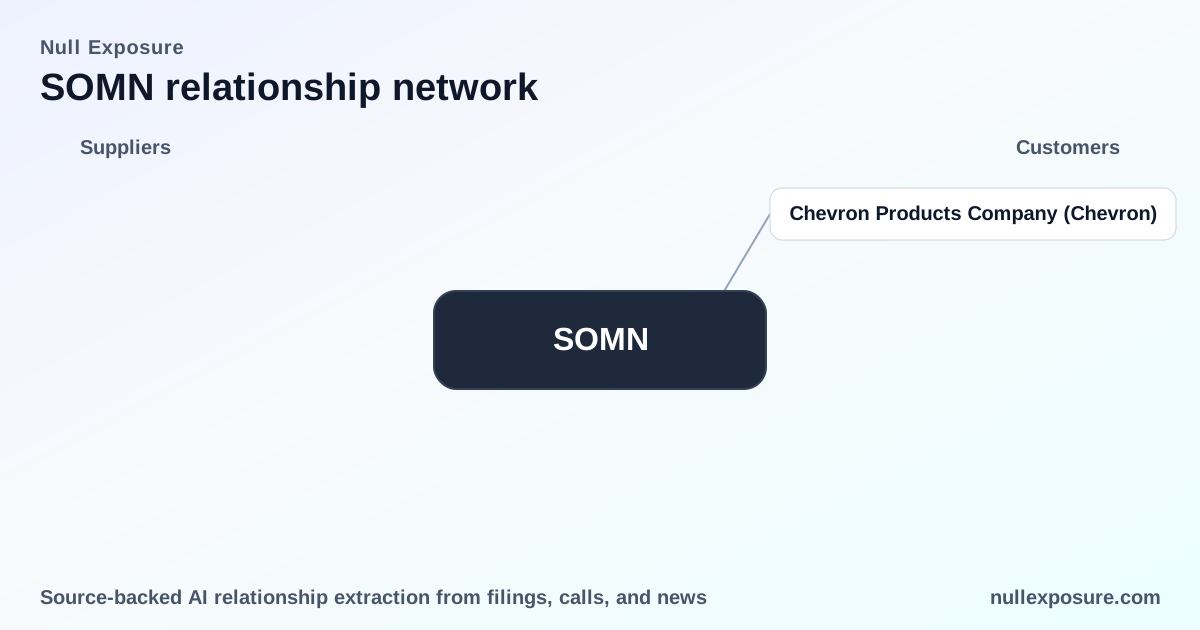
Mississippi Power supplies retail electricity to the Chevron refinery in Pascagoula under an agreement that extends through at least 2038; Chevron is described as Mississippi Power’s largest retail customer. This is a direct retail customer arrangement documented in Southern Company’s public filing. According to Southern Company’s 2024 Form 10‑K, Mississippi Power and Chevron Products Company have agreements that provide retail service to the Pascagoula refinery through at least 2038 (FY2024).
Why this single relationship matters to holders of SOMN
The Chevron contract is a multi‑decade retail supply agreement for a large industrial load in Mississippi, delivering predictable volumetric demand for Mississippi Power and underpinning local cash flow and plant utilization. The contract’s duration through 2038 implies an extended revenue runway for Mississippi Power tied to a single large industrial counterparty (Southern Company 2024 Form 10‑K).
All customer relationships cited in the filings — concise inventory
Chevron Products Company (Chevron) — Mississippi Power retail customer through at least 2038. According to the company’s FY2024 10‑K, Mississippi Power provides retail service to the Chevron refinery in Pascagoula under agreements that run through at least 2038 (Southern Company 2024 Form 10‑K).
Contracting posture and what it reveals about business durability
Southern Company’s operating model is contract‑driven and intentionally concentrated around long‑dated commitments in its competitive generation business and fee‑based regulation in its delivery utilities. The 10‑K frames the dominant revenue mechanics as long‑term PPAs (15–20 years typical for renewables), tolling arrangements that shift fuel cost exposure to counterparties, and regulated rate schedules set by state commissions for retail gas and electric service. Those features translate into stable, predictable cash flows and limited direct commodity risk for the parent.
- Long‑term contracting dominates Southern Power’s wholesale sales, which reduces merchant exposure and supports project finance metrics for renewables and gas capacity (Southern Company 2024 Form 10‑K).
- The company also conducts short‑term and spot sales opportunistically, but these are described as secondary to the PPA backbone.
These signals are company‑level characteristics drawn from Southern Company’s disclosures rather than attributes tied to a single counterparty.
Concentration and materiality — where risk is concentrated
Southern Company discloses that a relatively small group of customers accounts for a meaningful share of wholesale revenues: Southern Power’s top three customers accounted for roughly 24% of Southern Power revenue in 2024, and certain wholesale contracts represented 13.9% of Mississippi Power’s operating revenues in 2024. Those figures indicate material customer concentration at the segment level, even as the corporate footprint remains diversified across regulated and competitive businesses (Southern Company 2024 Form 10‑K).
Investors should treat concentration as a central risk factor: long contracts reduce volatility but concentrate countersignatory and remarketing risk should contracts expire or be renegotiated.
Criticality and maturity of contracts — renewal dynamics investors must track
The company’s filing emphasizes proactive contract management: Southern Power pursues replacement PPAs ahead of expirations and expects that some revenue streams will be remarketed to new counterparties. Long PPA tenors (often 15–20 years for renewable projects) create multi‑year visibility into cash flow, while the existence of short‑term and market‑based sales leaves a modest but real pathway to revenue variability. Contract maturity profiles therefore balance stability with periodic renewal risk; the company explicitly warns that failed remarketing could materially affect Southern Power earnings, though not necessarily consolidated Southern Company earnings (Southern Company 2024 Form 10‑K).
Counterparty mix and geographic footprint
Southern Company sells into a mix of investor‑owned utilities, independent power producers, municipalities, cooperatives, and commercial/industrial customers. The operational footprint is concentrated in the U.S. Southeast, with gas distribution businesses like Atlanta Gas Light and Nicor in specific states. Geographic concentration in the Southeast combined with a mixed counterparty base creates regulatory and operational idiosyncrasies that investors should monitor, particularly as state commissions set retail rates and approve recovery mechanisms (Southern Company 2024 Form 10‑K).
Risk read and investor action points
- Key strength: Long‑dated PPAs and regulated rate bases provide durable cash flow and limit commodity exposure. The Chevron retail agreement through 2038 is a concrete example of that durability at the retail level (Southern Company 2024 Form 10‑K).
- Key risk: Customer concentration at the segment level—top customers representing material shares of Southern Power and Mississippi Power revenue—creates exposure to remarketing and counterparty credit risk.
- Operational watchlist: Monitor PPA expirations, remarketing outcomes, large industrial customer contract renewals (like Chevron), and state regulatory proceedings that affect rate recovery of capital projects.
- Balance sheet and liquidity: Long contracts support financing for new capacity, but investors should track near‑term maturities and the company’s success in replacing expiring PPAs to sustain EBITDA and cash flow margins.
For a structured view of these customer ties and a quick way to screen concentration across Southern Company’s counterparty universe, visit our platform: https://nullexposure.com/.
Final read
Southern Company’s commercial architecture is firmly contract‑centric: regulated retail tariffs provide baseline stability while long PPAs furnish the competitive segment with predictable earnings. The Chevron–Mississippi Power relationship is emblematic of that model—a large retail industrial contract with multi‑decade tenure that supports local cash flow. Investors should value the stability inherent in these contracts but price in concentration and renewal risk at the segment level when modeling downside scenarios or assessing financing flexibility.