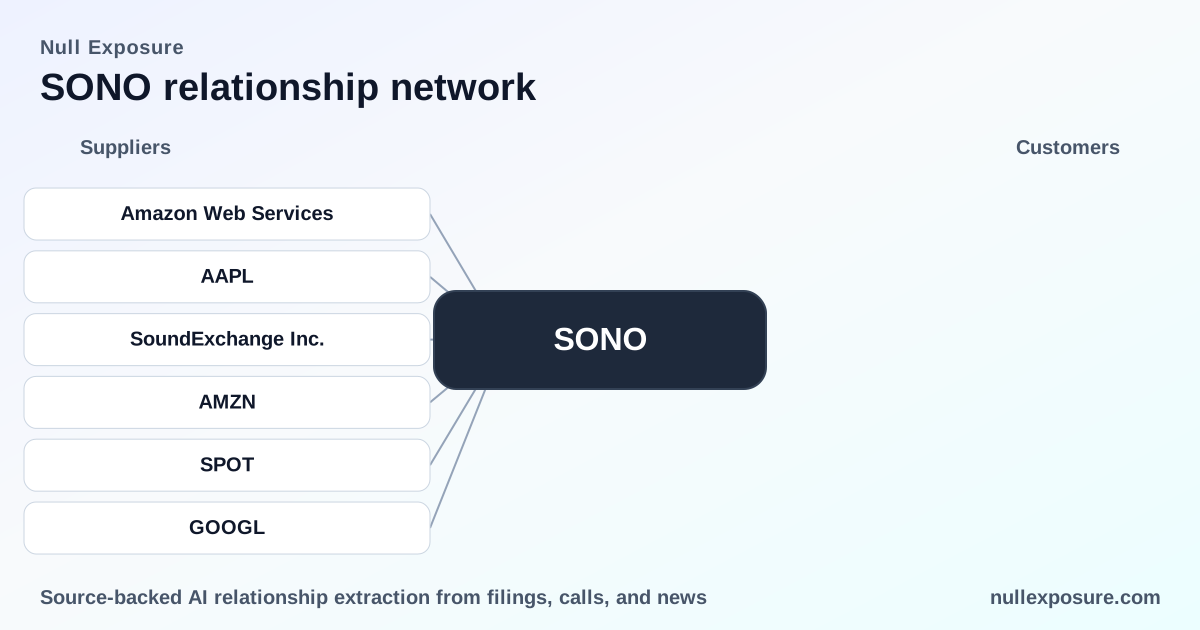
Sonos (SONO) — How partner channels, products and subscriptions shape customer economics
Sonos sells premium multi‑room audio hardware and links that hardware to software and cloud services. The company monetizes primarily through device sales (hardware), supplemented by services and software access and a small but growing subscription/partner revenue line. With trailing revenue of roughly $1.44 billion and gross profit near $646 million, Sonos is a hardware-first business whose incremental margin and customer lifetime value depend on software engagement and repeat device purchases.
For a concise map of customer-facing dynamics and partner performance, see https://nullexposure.com/ — the source collection that informed this note.
Why investors should treat Sonos as a hardware-led consumer franchise with a services overlay
Sonos’ core model is simple and capitalizes on brand and ecosystem lock‑in: sell high‑margin speakers and platforms, keep users in the Sonos app and then capture ancillary revenue from cloud services, licensing, accessories and partner programs. The company reports a major portion of revenue from product sales while describing partner products and subscription receipts as a “small portion” of revenue, which aligns with the reported revenue mix and negative EPS signal in the latest TTM figures (diluted EPS of -$0.16).
Operationally, Sonos is a retail and direct-to-consumer seller with global distribution: its installed base exceeds 17 million households across 60+ countries, giving it scale in EMEA and APAC as well as North America. The installed base underpins repeat purchases — Sonos reports that existing customers accounted for approximately 45% of new product registrations in fiscal 2025 — but recurring revenue remains limited, so the business is sensitive to product cycle execution and retail/partner channel outcomes.
What the IKEA partnership reveals about partner-channel risk
The most visible partner experiment for Sonos was the collaboration to embed audio products into IKEA offerings. Press coverage in May 2026 characterized the IKEA venture as underperforming: Strata‑Gee noted the IKEA collaboration “does not appear to have been successful” and classified these arrangements under a catch‑all ‘partner products’ category. That phrasing is consistent with Sonos’ own disclosure that partner products and subscription receipts constitute only a modest share of total revenue, indicating that retail experiments have limited near‑term revenue impact.
This outcome highlights two investment implications: (1) partner channels are useful for distribution expansion but are not yet a core growth driver, and (2) Sonos’ economics remain dependent on its branded hardware portfolio and software engagement rather than on big partnership wins.
Constraints and company-level operating signals investors should internalize
- Contracting posture and revenue durability: Sonos operates largely through one‑off device sales and retail transactions, with subscription and cloud revenues explicitly described as a small component of total revenue. This implies lower predictable recurring revenue compared to SaaS peers and greater sensitivity to product refresh cadence.
- Counterparty type and customer concentration: The company’s business targets individual consumers (more than 17 million households), which creates revenue diversification across a large number of low‑value contracts rather than dependence on a few enterprise buyers.
- Geographic footprint and scale: Sonos reports substantive revenue and customer counts across EMEA and APAC and describes its installed base as global, indicating broad geographic exposure that reduces single‑market concentration but increases exposure to currency and regional retail dynamics.
- Business segments and criticality: Hardware is the dominant segment, with services and embedded software complementing it. Software is largely distributed at no charge (the Sonos app and firmware), limiting direct monetization but improving product stickiness.
- Relationship posture and maturity: The company shows active relationships with a mature consumer installed base, as evidenced by repeat purchase behavior (45% of new registrations from existing customers), but the services stack is in an earlier monetization stage relative to the hardware business.
Together these signals describe a company with retail contracting, low counterparty concentration, global reach, hardware maturity and nascent services monetization — a profile that demands strong product cycles and durable brand preference to drive valuation upside.
Identified customer/partner relationship: IKEA
IKEA — Sonos co‑developed in‑home speaker products sold through IKEA as part of a partner products category; press coverage in May 2026 described the IKEA venture as unsuccessful and positioned it alongside other partner and accessories sales that are a modest share of revenue. This characterization comes from industry reporting summarizing Sonos’ FY2026 commentary on partner products (Strata‑Gee, May 4, 2026).
Financial and strategic takeaways for investors
- Revenue sensitivity to hardware cycles: With roughly $1.44 billion in trailing revenue and software/services playing a limited monetization role, Sonos’ near‑term top‑line is driven by product launches and retail distribution effectiveness.
- Margin leverage but limited recurring cash flow: Gross profit is substantial (about $646 million TTM), but the business lacks the high‑visibility recurring revenue of subscription-first companies; operating margins will track product mix and software adoption.
- Partnerships are experimental distribution, not core revenue engines: The IKEA example demonstrates that retailer co‑development can fail to scale and should be viewed as tactical expansion rather than a guaranteed multiplier for revenue.
- Diversification across regions reduces country risk but magnifies execution complexity: EMEA and APAC footprints offer growth runway, yet execution across retail partners, logistics and regional preferences will determine conversion of global awareness into sales.
- Installed base provides a runway for upsell if software monetization accelerates: The 17 million household installed base and high repeat registration rate establish a platform for incremental services, but investing thesis requires evidence of successful scale of those revenue streams.
What to monitor next quarter
- Product refresh cadence and retail sell‑through in EMEA and APAC.
- Commentary on subscription or cloud revenue growth in company filings and whether Sonos upgrades its services monetization targets.
- Any strategic reassessment of partner channels following the IKEA outcome and whether Sonos repositions partner products as a strategic line or cost‑controlled experiment.
For a more detailed customer and partner map, and to explore how customer relationships affect counterparty risk scores, visit https://nullexposure.com/.
Bold conclusion: Sonos is a hardware‑centric consumer electronics company with meaningful brand and installed‑base advantages; converting that installed base into predictable, high‑margin recurring revenue is the critical execution milestone that will determine valuation upside.