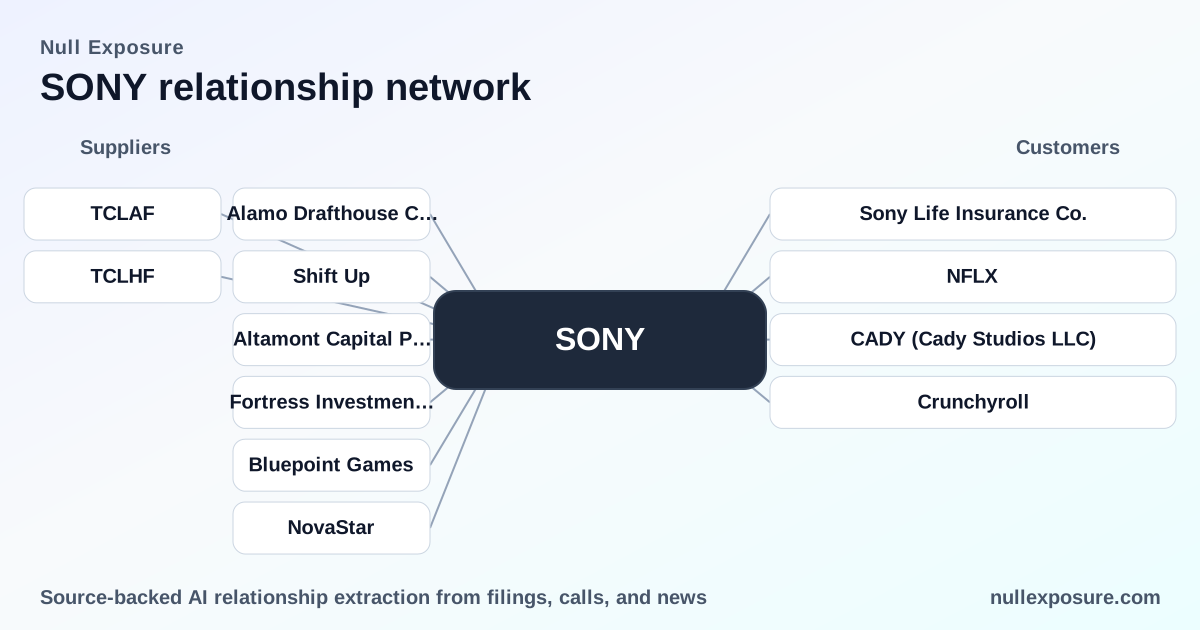
Sony Group: The customer relationships that underwrite content, devices and margin
Sony Group monetizes a vertically integrated mix of hardware, software, content licensing and services. The company sells consumer electronics and semiconductors, produces and licenses film and TV through Sony Pictures and Aniplex, operates streaming and distribution channels, and realizes non-operating gains through strategic asset transfers and corporate realignments. Investors should view Sony’s customer relationships as a blend of long-term licensing partnerships, platform distribution agreements, and transactional device OEM deals that collectively drive recurring content margins and episodic hardware revenue. For a deeper relationship risk map, visit https://nullexposure.com/.
What those relationships reveal about Sony’s operating model
Sony’s customer map shows a mixed contracting posture: long-term content and distribution agreements (Pay-1 film windows, IMAX/DTS:X licensing) coexist with transactional OEM and component supply relationships (displays, batteries). The portfolio reduces concentration risk at the aggregate level, but specific pockets—streaming pay-1 deals and physical distribution agreements—are high‑value and high‑criticality for Sony Pictures’ margin profile. Maturity varies: many entertainment partnerships are multi-year and stable; several device and component links are tactical and subject to competitive pricing. The relationship feed did not include explicit contractual constraints; treat that absence as a company-level signal that no feed-level red flags were reported in this data pull.
Relationship-by-relationship investor guide
Below are each of the relationships surfaced in the reporting, with a concise commercial read and the cited source.
Sony Life Insurance Co.
Sony Group transferred land to Sony Life Insurance Co., generating a JPY43.9 billion realized gain tied to the insurer’s spin-off in FY2026; that transaction is a material non-operating income event. Reported by Variety and referenced in industry news coverage in March 2026.
Sources: Variety (Q3 FY2025 / FY2026 reporting) and IMDB news summary (March 2026).
Netflix (NFLX)
Sony Pictures Entertainment signed a new Pay‑1 licensing agreement with Netflix in January FY2026, establishing Netflix as a primary first-window streaming partner for theatrical content following theatrical runs. Source: Sony Q3 FY2026 earnings transcript coverage on InsiderMonkey and corroborated in press reporting on Pay‑1 placement (Page Six, March 2026).
Roku (ROKU)
Roku expanded a strategic content partnership with Sony Pictures to strengthen its catalogue and FAST/AVOD distribution, reflecting Sony’s distribution reach into connected-TV platforms. Source: Yahoo Finance coverage of Roku’s strategic deals (May 2026).
CADY (Cady Studios LLC)
Cady Studios selected Sony Electronics’ imaging technologies to power its school‑photography expansion, demonstrating Sony’s upstream position in imaging hardware for enterprise customers. Source: PR Newswire press release (March 2026).
Lionsgate (LGF‑B)
Sony Pictures Home Entertainment signed a multi‑year agreement to handle physical home entertainment distribution for Lionsgate in the U.S. and Canada, reinforcing Sony’s role as a distribution services provider in physical media. Source: PR Newswire announcement (FY2021 referenced in PR).
Triller (ILLR)
Triller has faced litigation from Sony Music for unpaid licensing fees, highlighting exposure to enforcement actions and the downstream risks of content licensing nonpayment. Source: Music Business Worldwide reporting on litigation (2026).
Immersion (IMMR)
Immersion’s relationship centers on haptics technology used in PlayStation controllers; Sony’s continued focus on haptics is a strategic input for future console cycles and controller differentiation. Source: Wccftech coverage and CEO commentary (FY2020 context referenced in 2026 reporting).
TCL Electronics Holdings
TCL agreed to acquire Sony’s home entertainment business assets for an agreed equity value that implies roughly JPY75.4 billion (USD475 million) before closing adjustments, evidencing Sony’s selective asset divestiture to focus core operations. Source: Yicai Global reporting on the transaction (May 2026).
TCL (TCLAF)
As part of the realignment with TCL, Sony sold 100% of its Malaysian manufacturing subsidiary (Sony EMCS Malaysia) to TCL, reflecting consolidation of manufacturing footprint and outsourcing of certain LCD/TV operations. Source: Invidis news on the TCL joint-venture and asset sale (May 2026).
NIU (NIU)
Early production of EV and battery products referenced the use of Sony and Sanyo 18650 battery cells, indicating Sony’s historical role as a battery technology supplier for scaled mobility products. Source: 36Kr coverage of NIU’s supply history (May 2026).
Vuzix (VUZI)
Vuzix’s LX1 smart glasses deploy a Sony OLED HD display and camera modules, showing Sony’s component-level penetration into AR/enterprise wearable devices. Source: Vuzix FCC/CE certification and product press coverage on Yahoo Finance and PR Newswire (March 2026).
RDI
Sony film titles such as Gran Turismo have been part of theatrical lineups at independent cinemas like the Angelika in Brisbane, underlining Sony Pictures’ theatrical distribution footprint and content reach. Source: Man of Many cinema programming coverage (2026).
Xperi (XPER)
Xperi expanded partnership with Sony Pictures to release hundreds of additional titles in IMAX Enhanced with DTS:X immersive audio for FAST/AVOD distribution to smart TVs, illustrating Sony’s leverage in premium-format licensing. Source: Xperi Q3 FY2025 results announcement (FinancialContent, Nov 2025).
VinFast (VFS)
VinFast’s VF‑9 and other models include Sony RIDEVU entertainment as an in‑car feature, showing Sony’s expansion of entertainment IP into automotive customer experiences and service bundles. Source: SimplyWallSt reporting on VinFast product features and ownership services (2026).
Apple (AAPL)
Press coverage links Sony’s AI‑enhanced imaging sensors with partners like Apple, confirming Sony’s tech leadership in image sensors that drive both supplier leverage and product differentiation for OEMs. Source: Ad‑Hoc News industry note on imaging sensor progress (May 2026).
Crunchyroll
Sony’s ownership of Crunchyroll positions the company as a major anime distributor and streamer in the West, channeling Aniplex releases and adding subscription distribution muscle to Sony’s content stack. Source: Polygon reporting on Crunchyroll and Aniplex operations (2026).
Snail, Inc. (SNAL)
Snail’s title launches on platforms including PlayStation indicate Sony’s role as a primary platform partner for third‑party game releases and promotional discounts, reinforcing PlayStation as a distribution anchor. Source: Quiver Quant press release summarizing release strategies (FY2025).
Anghami (ANGH)
Anghami’s partnerships with regional platforms and PlayStation distribution deals show how Sony-linked content can extend into non‑traditional digital music and regional streaming arrangements. Source: Yahoo Finance coverage of Anghami H1 2025 results and partnerships (2025).
Honda Motor Co. (HMC)
Collaborations between Honda and Sony show joint work on vehicle software and entertainment systems; commentary frames these projects as halo collaborations that validate capability rather than large volume drivers. Source: FinancialContent industry analysis of Honda/Sony initiatives (March 2026).
Conn’s (CONN)
Retail coverage cited Sony portable speakers among Conn’s HomePlus featured gifts, illustrating Sony’s placement in U.S. retail promotional channels and seasonal SKU merchandising. Source: ABC13 coverage of Conn’s retail features (holiday season, FY2025).
Avidia Bank Cards (AVBC)
Card rewards programs have explicitly offered Sony-branded bonus points structures, pointing to Sony’s brand licensing and rewards tie‑ins with financial partners. Source: CardRates coverage of Avidia Bank card rewards (FY2020 context in reporting).
What to watch — risks and strategic levers
- Content distribution concentration: Pay‑1 windows with Netflix and large FAST/AVOD deals are revenue-critical; loss or repricing would pressure SPE margins.
- Asset realignment: The TCL divestiture and Malaysian factory sale indicate a strategic shift away from lower‑margin manufacturing to higher‑margin content and sensors.
- Legal and licensing exposure: Litigation with platforms (Triller) highlights collection risk in music licensing.
- Component leverage: Strong placement of Sony displays, sensors and batteries across wearables, automotive and OEMs supports durable hardware revenue and cross‑selling.
Key investor actions: track Sony’s Pay‑1 renewal cadence and the cadence of large distribution contracts, monitor proceeds and recurring impact from divestitures, and watch legal outcomes that could affect licensing cash flows. For ongoing relationship intelligence and breach/constraint monitoring, visit https://nullexposure.com/.
Bottom line
Sony’s commercial map reflects a deliberate tilt toward content monetization, premium component supply, and selective asset sales to sharpen returns. The company’s relationships are strategically diverse: some are long-duration, high-margin licensing arrangements; others are tactical supply or retail placements. For investors, the structural value rests in Sony’s control of premium IP and its ability to push that IP across streaming, theatrical, physical distribution and platform partnerships while monetizing hardware and sensor leadership.