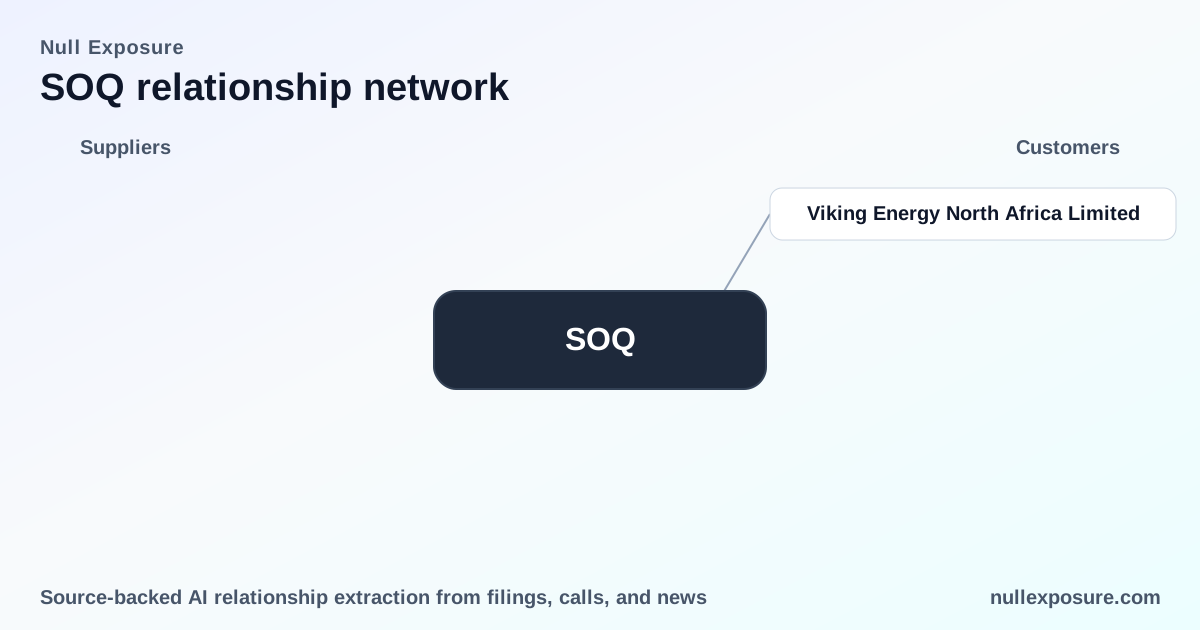
SOQ Customer Relationships: what Marquee, 1771538 Alberta Ltd. and Viking reveal to investors
SOQ operates as an oil and gas exploration and production company that monetizes through a combination of direct production, farm-out arrangements, and strategic asset transactions; historical filings show the company uses structured disposals and partner-funded carries to reallocate capital and derisk exploration portfolios. For investors, the company’s customer and counterparty footprint is characterized by discrete, transactional counterparties rather than broad commercial distribution channels — this creates concentrated counterparty risk but also a clear pathway to near-term liquidity through asset sales and farm-outs. Learn more about how we track counterparties at https://nullexposure.com/.
What the headline relationships imply about how SOQ runs the business
SOQ’s visible commercial activity in the record set centers on two levers: asset transfers (arrangements/purchase-and-sale) and farm-out extensions. Those levers show a contracting posture that favors closed, legally documented transactions over long-term, volume-based customer contracts. The SEC filing and contemporary press coverage are dated FY2013, which means these relationships are legacy strategic actions that materially reshaped the company’s asset base at that time.
- Contracting posture: Formal, transaction-driven (arrangement agreements and purchase-and-sale agreements dominate). These are enforceable, one-off commercial transfers rather than open-ended supply contracts.
- Concentration: The counterparty list is small and concentrated; a handful of counterparties account for the material commercial interactions visible in public records. Concentration elevates counterparty and execution risk.
- Criticality: The Marquee transaction is large in nominal value for the scope of the disclosures (approximately $30.7 million in aggregate consideration), indicating asset sales are a structural, not incidental, source of value realization.
- Maturity: All cited records point to FY2013 activity, which positions these items as historical strategic moves rather than ongoing customer relationships; investors should treat them as evidence of prior capital strategy rather than current revenue streams.
No explicit contract constraints or vendor-relationship constraints are present in the available records; this absence is itself a company-level signal that public disclosures on ongoing commercial constraints were limited in the retrieved set.
Relationship-by-relationship notes investors need
Marquee Energy Ltd. — asset acquirer
Marquee agreed to acquire Sonde’s Western Canadian business unit in an arrangement valuing the consideration at approximately $30.7 million, composed of $15 million cash and 21,182,491 common shares of Marquee, indicating a mix of cash and equity consideration that spreads counterparty credit exposure into equity upside. According to an SEC filing (Exhibit 99.1, FY2013) hosted on EDGAR, the arrangement structured either an amalgamation or an acquisition route to effect the transfer.
Source: SEC filing, Exhibit 99.1 (Arrangement Agreement), FY2013 — https://www.sec.gov/Archives/edgar/data/1177470/000117747013000032/exhibit991-informationcirc.htm
1771538 ALBERTA LTD. — purchaser vehicle (NumberCo)
1771538 Alberta Ltd. is documented as the purchaser entity in a purchase-and-sale execution page dated November 4, 2013; the company functioned as the immediate buyer for assets being transferred out of Sonde prior to the broader arrangement with Marquee. This reflects a classic transactional structure where a special-purpose purchaser takes title ahead of a parent-company merger or amalgamation.
Source: Purchase and Sale Agreement execution page, SEC filing (FY2013) — https://www.sec.gov/Archives/edgar/data/1177470/000117747013000032/exhibit991-informationcirc.htm
Marquee (ticker MQL) — listed counterparty with disclosed consideration
A separate entry labels the acquirer succinctly as Marquee (MQL) and repeats that the Western Canadian Business Unit transfer was valued at approximately $30.7 million, reinforcing the materiality of the disposition relative to Sonde’s portfolio management in that period. The use of cash plus equity consideration signals negotiation flexibility and potential alignment of interests post-transaction.
Source: SEC filing, arrangement summary (Exhibit 99.1), FY2013 — https://www.sec.gov/Archives/edgar/data/1177470/000117747013000032/exhibit991-informationcirc.htm
Viking Energy North Africa Limited — farm-out partner
Sonde extended its original farm-out agreement with Viking Energy North Africa Limited by mutual agreement until July 31, 2013, reflecting an operational cadence that relies on third-party partners to carry exploration risk or fund development phases. The extension was publicly announced in a June 2013 industry release that identified Sonde under the tickers TSX:SOQ and NYSE MKT:SOQ.
Source: Industry press, Boereport (June 7, 2013) — https://boereport.com/2013/06/07/sonde-resources-corp-announces-further-extension-of-farm-out-of-joint-oil-block/
What these relationships mean for portfolio risk and value realization
- Asset sales are a clear liquidity lever. The Marquee arrangements demonstrate SOQ’s willingness to convert acreage and producing units into immediate cash plus equity, which is useful for balance-sheet management or redeploying capital.
- Counterparty concentration is material. A small number of counterparties are visible in the record, which increases execution risk: a single failed counterparty transaction can have outsized impacts on cash flow and strategic flexibility.
- Deal structure mixes cash and equity. The combined cash-and-share consideration is an important structural feature: it reduces immediate cash exposure for the buyer while giving the seller post-closing upside, but it also introduces market-price risk into the effective proceeds.
- Farm-outs indicate capital-light exploration strategy. Use of farm-out extensions shows a pragmatic approach to exploration exposure: SOQ transfers drilling/development risk to partners while retaining potential upside or re-entry rights.
Investor action checklist
- Assess counterparty credit and operational track record for counterparties involved in any ongoing or future transactions; concentration makes diligence essential.
- Require clarity on whether historical patterns (asset sales and farm-outs) remain the primary monetization route, or whether production/marketing contracts have been developed since FY2013.
- For valuation models, treat equity consideration received in past deals as partially realized value contingent on the acquirer’s share-performance; do not treat share consideration as equivalent to cash until liquidated.
If you want a consolidated view of SOQ’s counterparties and historic transaction documents, start at our research hub: https://nullexposure.com/.
Conclusion
The disclosed customer and counterparty activity for SOQ in FY2013 shows a company that monetizes by selling assets and using partner-funded farm-outs — a transaction-first commercial posture with concentrated counterparty exposure. For investors, this profile demands rigorous counterparty diligence, conservative treatment of equity consideration received in deals, and a focus on whether similar transactional strategies continue to drive value today.