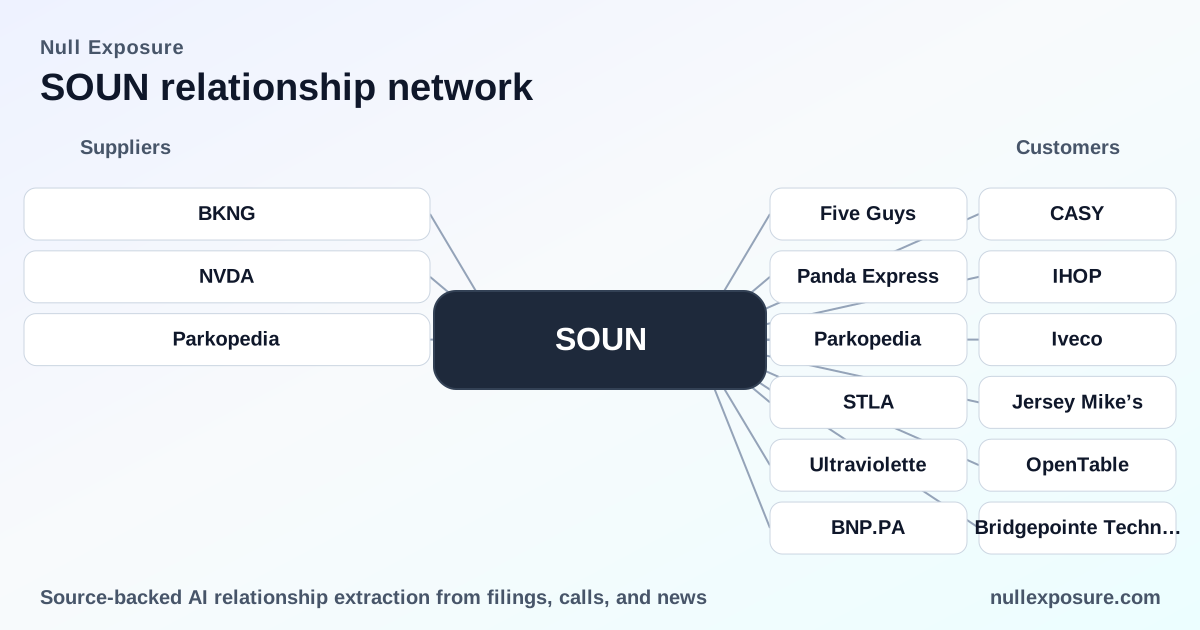
SoundHound AI (SOUN): Enterprise voice AI wins, recurring bets, and concentration risk
SoundHound AI builds and licenses voice-first conversational intelligence — a mix of licensed software, hosted services and usage-based subscriptions — and monetizes via multi-year subscriptions, usage fees/royalties and platform monetization. The company sells voice agents and “Employee Assist” tools into restaurants, automotive OEMs and enterprises, often under long-term commercial arrangements that convert product trials into recurring revenue. For investors evaluating customer relationships, the headline is broad commercial traction across restaurants, autos and enterprise partners combined with concentrated revenue and continued investment that keeps profitability elusive. Learn more at https://nullexposure.com/.
How SoundHound’s commercial model actually works
SoundHound operates at the intersection of software licensing and cloud-delivered services. The company sells:
- Service subscriptions (fixed fees or per-query/per-user usage billing) for hosted voice agents and employee assist tools,
- Royalties/licensing for voice-enabled products embedded by OEMs or device makers, and
- Professional services and monetization (ads/partner integrations) layered on top of deployments.
The company’s public disclosures and recent press indicate revenue mixes that include both recurring subscription cashflows and volume-driven royalties, with contract terms often structured over multiple years and a sizable portion of recognized revenue already contracted and scheduled to be recognized over the next five years. These characteristics create a revenue profile that is predictable when deployments scale, but sensitive to client execution and adoption.
A roll call of every active customer relationship
Below I summarize every partner mentioned in the collected sources. Each entry is one or two sentences with the reporting source.
Stellantis (STLA)
SoundHound expanded integration with Stellantis’ brands across Europe, Asia and Latin America to add live generative AI capabilities for real-time responses, signaling deeper OEM adoption in vehicles. This expansion was reported in a Sahm Capital recap of SoundHound’s FY2026 update (Feb 27, 2026).
Ultraviolette
SoundHound signed Ultraviolette, an Indian electric two-wheeler maker, marking entry into EV two-wheelers and regional OEM partnerships. The development was included in the Sahm Capital FY2026 summary (Feb 27, 2026).
Casey’s / Casey’s General Stores (CASY)
Casey’s renewed and expanded a multi-year agreement, pushing SoundHound’s voice ordering to roughly 90% of stores to process phone food orders and reduce missed orders and hold times. This expansion was covered by Business Insider (May 2026) and CStoreDive reporting on Casey’s rollout.
Five Guys
Five Guys extended its partnership to roll out SoundHound’s voice ordering more broadly, with the company claiming the solution handles incoming orders even at peak times to reduce missed orders. Multiple Sahm Capital briefs and a CSNews recap document the expansion (Jan–Feb 2026).
BNP Paribas
BNP Paribas is listed among referenced enterprise customers in FY2026 reporting, positioning SoundHound’s reach into financial services for conversational use cases. Sahm Capital noted BNP Paribas in its FY2026 review (Feb 27, 2026).
IHOP
SoundHound signed additional IHOP franchise locations to deploy voice ordering or in-store assistants across the chain’s large footprint. The IHOP expansion was noted in Sahm Capital’s FY2026 coverage (Feb 27, 2026).
Iveco
SoundHound expanded with Iveco to offer its voice assistant across a range of commercial vehicles, reinforcing the company’s automotive channel momentum. This was reported in the Sahm Capital FY2026 article (Feb 27, 2026).
Jersey Mike’s
Additional Jersey Mike’s franchise locations were added to SoundHound’s voice-enabled merchant network, supporting quick-service ordering use cases. Sahm Capital’s FY2026 summary records this expansion (Feb 27, 2026).
OpenTable
OpenTable joined SoundHound’s voice commerce ecosystem, adding reservation and booking capabilities to the growing merchant network. Sahm Capital referenced OpenTable in its FY2026 notes (Feb 27, 2026).
Panda Express
SoundHound expanded deployments with Panda Express to more drive-thru locations, reinforcing quick-service restaurant (QSR) momentum. The Panda Express expansion appears in the FY2026 recap by Sahm Capital (Feb 27, 2026).
Parkopedia
Parkopedia joined SoundHound’s voice commerce ecosystem, broadening merchant integrations that support location-based services and transactions. Sahm Capital included Parkopedia in its FY2026 overview (Feb 27, 2026).
Peet’s Coffee
Peet’s selected SoundHound’s Employee Assist across its nationwide store footprint to provide hands-free, real-time information to in-store teams, a retail use case for employee productivity. Sahm Capital covered the Peet’s rollout and associated investor commentary (Mar 2026).
Quálitas
Quálitas, a leading Mexican auto insurer, deployed SoundHound’s agentic AI to scale end-to-end claims resolution and customer service operations. This partnership was announced in a Quálitas-SoundHound press release covered by Sahm Capital (Apr 2, 2026).
Experis / ManpowerGroup (MAN)
Experis announced a strategic partnership naming SoundHound as its exclusive conversational AI technology partner for Experis’ EXCELERATE AI suite; ManpowerGroup cited this breakthrough in its earnings commentary. Sahm Capital and a Benzinga transcript of ManpowerGroup’s Q1 2026 call reference the deal (Mar–Apr 2026).
Bridgepointe Technologies
SoundHound partnered with Bridgepointe to make its AI agents and automation platforms available to Bridgepointe’s enterprise clients, a channel play to accelerate enterprise adoption. Sahm Capital and related investor pieces described the Bridgepointe deal (Jan 2026).
Dunkin’
Dunkin’ is listed among brands targeted in collaborative rollouts tied to enterprise partnerships that aim to broaden voice-driven tools across hospitality and retail chains. Sahm Capital referenced Dunkin’ in its Bridgepointe/enterprise rollout coverage (Jan 2026).
Marriott
Marriott was named as a target in the enterprise expansion narrative tied to Bridgepointe and other channel partners, indicating potential hospitality deployments. Sahm Capital’s Bridgepointe coverage references Marriott (Jan 2026).
Toyota
Toyota was flagged as a brand targeted in enterprise and automotive collaboration commentary, underscoring SoundHound’s automotive addressable market. Sahm Capital mentioned Toyota in the Bridgepointe context (Jan 2026).
Associated Carrier Group
SoundHound became the first agentic AI provider available to Associated Carrier Group members to modernize telecom customer support and employee experience. Markets Business Insider covered this partnership announcement (Apr 2026).
Red Lobster
Investor discussion and trading commentary cited elevated interest after positive news related to a Red Lobster partnership, suggesting restaurant channel spillover in market sentiment. TradingView user commentary captured the market reaction (May 2026).
Jeep
Jeep/Jeep-branded integrations were referenced in trader discourse as part of SoundHound’s commercial activity in the automotive sector and Chinese EV market partnerships. TradingView commentary included Jeep mentions (May 2026).
What the relationship signals tell investors about operating constraints
SoundHound’s customer evidence aligns with several company-level operating characteristics:
- Contracting posture: The company sells a mix of subscription and usage-based contracts plus licensing/royalties, creating hybrid and multi-year commercial arrangements rather than one-off hardware sales.
- Revenue concentration: One customer accounted for 14% of revenues in the latest fiscal year, a material concentration signal that increases downside if large accounts churn.
- Geographic footprint: Revenue is global but shows meaningful splits — strong Americas contribution, meaningful APAC exposure, and EMEA receipts — indicating diversified markets but regional execution variability.
- Criticality and maturity: Deployments at QSR chains and OEMs are operationally critical (voice ordering, drive-thru, in-car assistants) and many partnerships are active and expanding, yet the company remains in a growth-investment phase and is not yet consistently profitable (negative operating and EBITDA margins in latest filings).
- Service orientation: SoundHound functions as licensor, seller and hosted service provider, which increases dependency on long-term service delivery, integration and professional services capacity.
Investment implications and near-term watchlist
- Upside catalyst: Converting pilots into recurring subscription/usage revenue at scale (restaurants and OEMs) drives revenue visibility and margin leverage.
- Execution risk: Large-account concentration and the need for flawless deployment across thousands of retail locations or OEM vehicle fleets create operational execution as the primary downside.
- Profitability pathway: Monitor quarterly trends in service subscription growth, product royalties and the schedule of remaining performance obligations; SoundHound reported $83.3 million of contracted but unrecognized revenue as of Dec 31, 2024 (company disclosures summarized across FY2026 reporting).
For investors researching partner dynamics and customer risk, SoundHound’s mix of marquee customers and channel partnerships is compelling but requires proof that deployments convert to high-margin recurring revenue at scale. For a deeper look at the relationships and a comparative view across other enterprise voice plays, visit https://nullexposure.com/.