SoundHound AI (SOUNW) — Customer Relationships and Commercial Signals Investors Should Track
SoundHound AI sells a voice-first conversational platform to enterprises and product manufacturers and monetizes through a mix of subscription fees, usage-based charges (revenue-per-query or per-user), licensing/royalties for embedded products, and targeted monetization services. The company operates as both a licensor of software and a hosted service provider, which produces a revenue base composed of recurring service subscriptions and variable usage revenue tied to customer volume and product rollouts. For investors focused on customer-level exposures, the business model combines scalable upside via enterprise rollouts with concentration and geographic variability that materially influence near-term cash flow. Learn more about coverage and signals at https://nullexposure.com/.
How SoundHound actually contracts and gets paid
SoundHound’s commercial architecture blends three revenue vectors that determine predictability and upside:
- Subscription contracts underpin recurring service revenue for voice-enabled customer service and phone ordering; these are typically fixed monthly fees or service subscriptions sold to businesses. Company filings describe subscription revenues for service providers that are charged fixed fees or fees based on usage.
- Usage-based and royalty economics capture volume growth: royalties apply when SoundHound’s technology is embedded in hardware or products (for example, automotive or IoT), and variable fees apply to hosted query volumes. Filings characterize these as “variable consideration” payable per query, per user, or per device.
- Licensing provides point-in-time revenue when non-customized software is transferred and control is passed to a customer, typically for embedded solutions.
These contracting structures produce a profile with mixed predictability: subscription components create a baseline, while usage and royalty streams amplify revenue when customers scale. SoundHound’s disclosures also show the company serves both product manufacturers and service providers, so the revenue mix shifts with new deployments and embedded integrations.
Geographic footprint and revenue concentration — what drives growth and risk
SoundHound reports a global customer base with meaningfully uneven regional performance. Company filings for the year ended December 31, 2024 show total reported revenues of roughly $84.7 million, with Americas leading at about $51.1 million, Asia around $17.7 million, and EMEA about $15.9 million, signaling a North America–heavy revenue mix. The company also disclosed that one customer accounted for 14% of total revenue during 2024, which is a material concentration signal for investors evaluating counterparty risk.
The filings point to a recent decline in product royalties in Asia due to the timing of minimum guarantee licensing and Houndify Edge recognition, while Americas posted strong growth year-over-year. Those dynamics indicate geographic rebalancing risk: revenue volatility in Asia can offset gains elsewhere when royalties or one-time licensing events do not recur.
Restaurant rollouts in the public record — what was announced
SoundHound’s most visible customer wins in recent filings and press releases are restaurant chains where the company powers phone ordering with its voice AI.
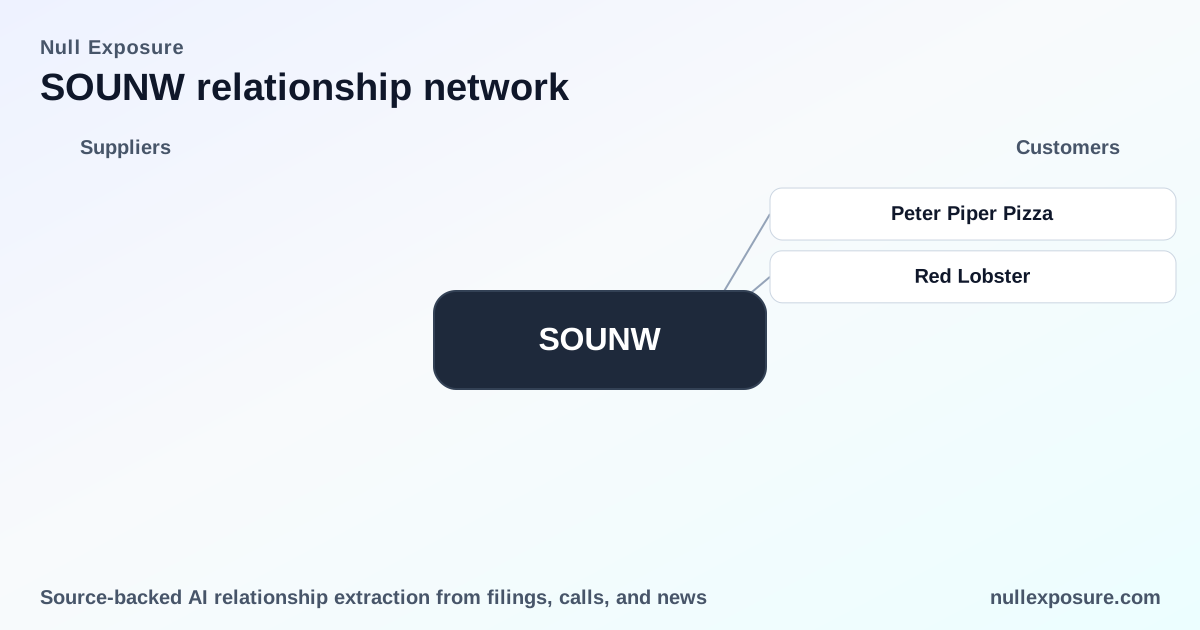
- Peter Piper Pizza rolled out SoundHound-powered voice phone ordering to its locations, moving call flows to AI-enabled ordering and likely shifting ordering volume from human attendants to an automated voice assistant. This was announced in a company press release posted to FT Markets/BizWire. (Source: FT Markets/BizWire company announcement, 2025–2026 period — see markets.ft.com link.)
- Red Lobster entered a partnership to use SoundHound AI to power phone ordering across all locations, which positions SoundHound as a service provider for a national restaurant chain and ties potential recurring revenue to ordering volume. This was disclosed in a company announcement on FT Markets/BizWire. (Source: FT Markets/BizWire company announcement, 2025–2026 period — see markets.ft.com link.)
Both announcements are public company communications distributed through the FT Markets/BizWire channels; they confirm SoundHound’s active penetration into the restaurant vertical with phone-ordering use cases that align with the company’s subscription and usage-based revenue model.
What these relationships imply for revenue mechanics and runway
The restaurant deals illustrate how SoundHound converts platform capability into monetizable contracts:
- Service posture: These are service-provider relationships where SoundHound hosts and operates voice ordering capabilities on behalf of the restaurant, which fits the company’s “Houndified Services” model that provides platform access over contractual periods.
- Revenue sensitivity to volume: Phone-ordering deployments create direct ties between ordering volume and usage fees or upsells to subscription tiers, so investor returns scale with actual customer transaction growth.
- Commercial maturity: Rolling out to national chains tests operational scale and product stability; successful multi-location deployments accelerate adoption in adjacent restaurant accounts and increase the predictability of recurring revenue if contracts include fixed subscription floors plus variable per-order fees.
Company-level constraints and what investors should monitor
SoundHound’s public disclosures reveal several operating constraints and signals investors should monitor as leading indicators of customer momentum or risk:
- Contract mix: The company explicitly states it earns revenue from subscription, usage-based (variable), and licensing arrangements. This creates a revenue profile where baseline subscription revenue coexists with high-leverage variable streams.
- Counterparty scale: Filings reference very large enterprises and Fortune 500 customers across the combined product set, indicating that SoundHound targets marquee clients while also serving smaller service providers — a strategy that increases both runway potential and concentration risk.
- Geographic variability: Revenue distribution is North America–heavy, with Asia showing declines in product royalty recognition and EMEA gaining share year-over-year; regional shifts change profitability and cash timing.
- Material concentration: One customer equal to 14% of revenue in 2024 is a clear concentration risk that amplifies contract renewal and retention importance.
- Dual role: SoundHound acts as both licensor (embedded software and one-time recognition) and service provider (hosted platform and recurring service fees); investors should track the mix as it determines revenue stability and margin profile.
- Active deployments: The company reports processing billions of interactions for customers and powering millions of products, indicating operational scale but also exposing service delivery and reliability as critical risk vectors.
Practical takeaways for investors and operators
- Growth lever: National restaurant rollouts such as Peter Piper Pizza and Red Lobster convert product capability to repeatable revenue via subscription + usage economics; scale in this vertical can quickly lift quarterly top line if variable charges trigger.
- Key risks: Customer concentration (14% from one customer), regional royalties timing, and the variability inherent in usage-based contracts require monitoring of churn, per-customer throughput, and licensing milestone timing.
- What to watch next: Contract renewal announcements, reported usage metrics or orders processed for major partners, regional royalty recognition, and any disclosures that move a customer from pilot to enterprise-wide deployment.
For a deeper commercial signal map and to track future customer disclosures and concentration dynamics, see our coverage at https://nullexposure.com/.
Conclusion — SoundHound’s mix of subscription and usage economics gives it a commercially attractive scaling model when deployments cross from pilot to enterprise-wide, but investors must weigh high-leverage upside against material counterparty concentration and geographic recognition timing when valuing near-term cash flow.