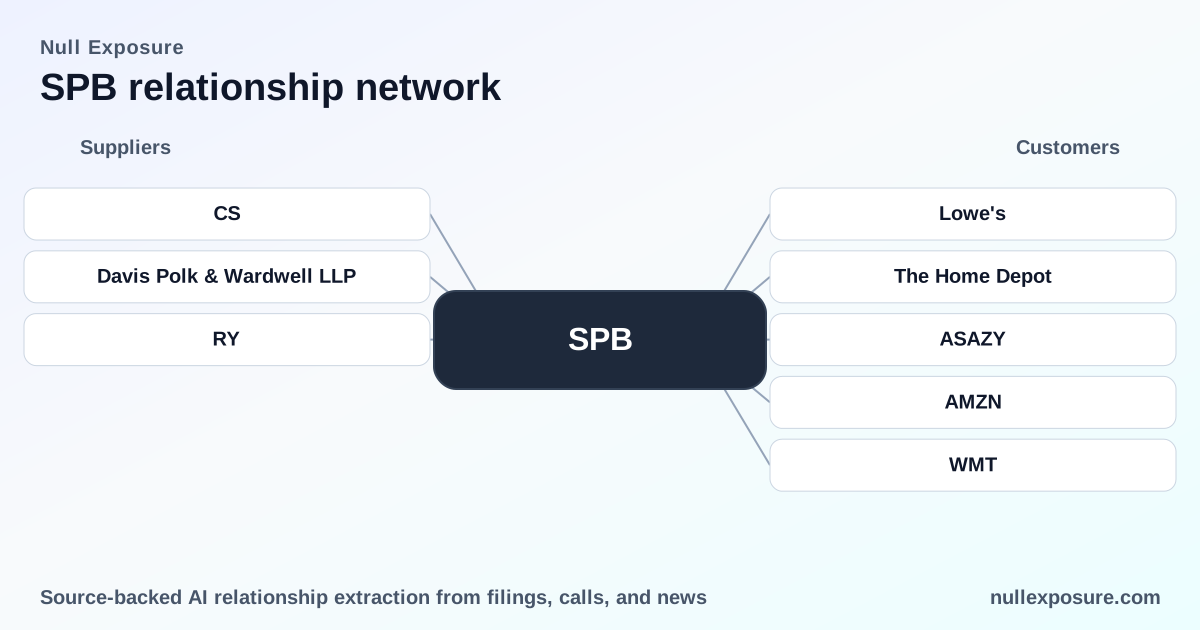
Spectrum Brands (SPB): Customer Relationships, Concentration and Operational Constraints
Spectrum Brands is a global branded consumer-products company that monetizes through direct product sales to large retail partners and licensing of established brands. The business operates as a seller to major brick-and-mortar and e-commerce retailers while also acting as a licensor for certain brands; revenue is recognized on shipment for product sales and on-time-elapsed measures for licensing agreements. Investors should focus on retail concentration, short-term contracting posture, and geographic diversification when assessing revenue durability and counterparty risk. For further company-level research and linkage analysis see https://nullexposure.com/.
How Spectrum actually sells and where the risk lives
Spectrum products are distributed through a mix of direct sales, brokers, distributors and license agreements. The company explicitly reports significant sales concentration to a handful of large retailers and confirms that customer purchases are typically executed via individual purchase orders rather than long-term contracts. The FY2025 Form 10‑K states that transfers of control on product sales occur at shipment in most cases, which aligns with a short-term and spot-oriented procurement model for many customers.
Company-level operating signals drawn from public filings and disclosures:
- Contracting posture: short-term / spot — SPB states it "generally does not have long-term agreements" with retail customers and recognizes product revenue on transfer of control at shipment.
- Licensing role — SPB also licenses brands to third parties and recognizes licensing revenue over time under an as-invoiced practical expedient.
- High counterparty concentration — the company flags that significant customers regularly exceed 10% of consolidated net sales and that significant customers comprised 36% of net sales in 2025.
- Large-enterprise counterparties dominate channel mix — sales flow primarily to major retailers, e-commerce platforms, warehouse clubs and specialty chains.
- Global footprint — revenues are materially international with meaningful contributions from NA, EMEA, APAC and LATAM; over 60% of the HPC (home & personal care) segment is international.
- Material spend scale — the magnitude of significant customers suggests >$100m exposure bands for top retail relationships.
These characteristics produce a revenue profile that is concentrated but diversified by channel and geography, and sensitive to ordering patterns of a small number of very large retail customers.
For desk-level subscription access and to explore SPB relationships in a single view, go to https://nullexposure.com/.
The retail and partner roster investors should track
Lowe’s
According to Spectrum Brands’ FY2025 Form 10‑K, Lowe’s is identified among a limited group of retailer customers that each exceed 10% of segment sales; Lowe’s is named explicitly in the company’s concentration disclosure for the year ended September 30, 2025. (Source: SPB 2025 Form 10‑K)
The Home Depot
Spectrum Brands’ FY2025 disclosure lists The Home Depot as another retailer that individually exceeds the 10% threshold for segment sales, making it a material distribution partner for core product lines. (Source: SPB 2025 Form 10‑K)
FEBO (Fenbo Holdings Limited)
Fenbo Holdings is reported in market news as an OEM supplier for Spectrum Brands producing electrical hair‑styling products under the Remington brand; a QuiverQuant news item noted Fenbo received Nasdaq non‑compliance notice in September 2025 related to its bid price. (Source: QuiverQuant news, Sept 12, 2025; reported Mar 9, 2026)
ASAZY
An industry report covering the close of corporate transactions referenced ASAZY in connection with Spectrum Brands’ home and hardware divestiture; Assa Abloy (ASAZY) completed an acquisition connected to Spectrum’s HHI business and related divestitures. (Source: SecurityInfoWatch report on Assa Abloy closing Spectrum deal, reported Mar 10, 2026)
Assa Abloy
Security industry coverage separately confirms Assa Abloy completed its $4.3 billion acquisition of Spectrum’s home and hardware business and that certain assets were further divested to other buyers such as Fortune Brands. This transaction reconfigured parts of Spectrum’s customer/partner ecosystem. (Source: SecurityInfoWatch report, Mar 10, 2026)
Amazon (AMZN)
Amazon is explicitly cited in the FY2025 Form 10‑K as a retailer that contributes materially to segment sales; the filing lists Amazon among customers that together with Walmart represented approximately 34% and in another disclosure approximately 42% of segment sales in the year ended September 30, 2025. (Source: SPB 2025 Form 10‑K)
AMZN (duplicate listing)
The filing includes repeated disclosures naming Amazon in the concentration table and narrative, underscoring Amazon’s recurring and material role in SPB’s distribution mix for FY2025. (Source: SPB 2025 Form 10‑K)
Walmart (WMT)
Walmart is named in multiple FY2025 10‑K passages as a significant customer; the filing pairs Walmart with Amazon in representing a large share of segment sales and also lists Walmart alongside Home Depot and Lowe’s in a broader retail concentration statistic representing approximately 64% of segment sales for a named segment. (Source: SPB 2025 Form 10‑K)
WMT (duplicate listing)
A second reference to Walmart in the FY2025 filing reiterates Walmart’s materiality and frequency in the company’s concentration disclosures. (Source: SPB 2025 Form 10‑K)
Why these relationships matter to valuation and operations
- Concentration is a valuation lever. With >30% of net sales tied to a handful of retailers, changes in ordering cadence, shelving decisions, or promotional terms at any one partner can translate directly to quarter‑to‑quarter revenue volatility.
- Contracting flexibility cuts both ways. The predominance of purchase‑order based, short‑term deals reduces fixed downside but increases exposure to demand shifts and seasonal reorder behavior.
- Licensing provides margin and optionality. Licensing arrangements generate recurring, lower‑capex revenue streams that are recognized over time and protect brand economics when SPB elects to hand off manufacturing or distribution.
- Geographic diversification moderates single‑market shocks. International sales — especially in EMEA and APAC — are meaningful, but they also add FX, logistics and regional retail dynamics to the operational risk set.
- Super‑supplier dynamics matter. News of OEM partners (Fenbo) and strategic transactions (Assa Abloy) can affect product continuity and go‑to‑market arrangements; investors should monitor supplier health and post‑deal integration.
Key takeaways for investors
- Top-line is concentrated: Significant customers comprised 36% of net sales in FY2025.
- Contracts are short and order-driven: The company relies primarily on purchase orders and shipment-based revenue recognition.
- Dual monetization model: SPB functions as both a high-volume seller and a licensor, diversifying revenue types.
- Global exposure with regional concentration: NA, EMEA and APAC are all material to revenue.
- Corporate transactions and supplier health are relevant catalysts: Acquisitions/divestitures and OEM notices (e.g., Fenbo) warrant active monitoring.
Spectrum Brands’ customer map is clean to read: a small number of very large retailers drive a large share of sales, supported by licensing and international channels. That concentration is a structural risk that also concentrates potential operating upside when product cycles and retail promotions align. For a consolidated view of SPB relationships and comparative counterparty analytics visit https://nullexposure.com/.