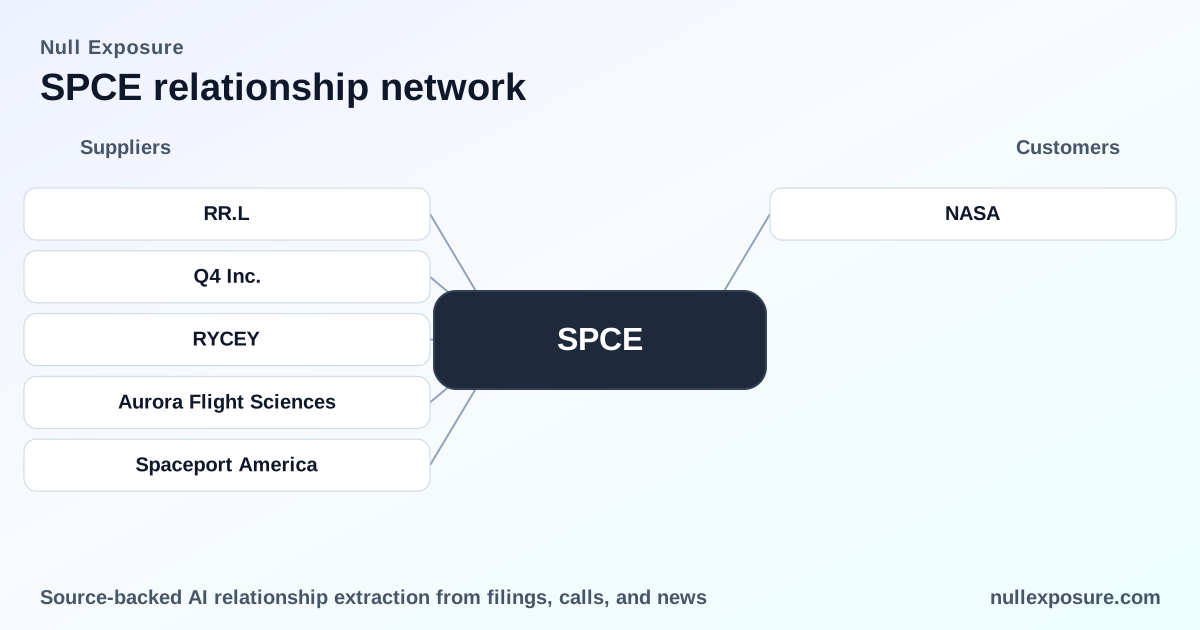
Virgin Galactic (SPCE) — who pays to ride and why it matters to investors
Virgin Galactic sells seat reservations and scientific access to suborbital spaceflights and supplements those revenues with selective engineering services. The company monetizes through advance customer deposits and ticket sales to individuals, researchers and government-funded programs while occasionally performing manufacturing and R&D work for third parties; as of December 31, 2024 the company reported roughly 700 reservations representing about $190 million of expected future spaceflight revenue, a structural revenue backlog that underpins near‑term monetization while core operations scale. For deeper relationship signals and curated intelligence, visit the Null Exposure homepage: https://nullexposure.com/
What customer relationships the public record shows
The public record for SPCE’s customer-facing activity emphasizes a mix of individual customers, university researchers and government-funded research programs. Below are the relationships found in our review of news coverage and summaries:
NASA — Flight Opportunities payload support (FY2024)
Virgin Galactic’s Galactic 07 mission carried two autonomous rack‑mounted payloads supported by NASA’s Flight Opportunities program, demonstrating the carrier’s role as a launch platform for funded microgravity experiments. A SATNEWS report covering the flight (June 2024) documented the two NASA-supported payloads on Galactic 07: https://news.satnews.com/2024/06/10/virgin-galactic-completes12th-spaceflight/
NASA — Flight seat funded through Flight Opportunities (FY2025)
NASA funded a researcher’s seat on a Virgin Galactic flight under the Flight Opportunities program, showing direct government funding of passenger access for research purposes. Parameter.io reported that NASA paid for Collicott’s seat under Flight Opportunities (March 2026): https://parameter.io/why-is-virgin-galactic-stock-soaring-today/
Purdue University — propellant slosh experiment (FY2024)
Purdue University flew an experiment on Galactic 07 to study propellant slosh for spacecraft propulsion applications, illustrating academic researchers’ use of suborbital flights for applied spacecraft engineering tests. This was described in the SATNEWS coverage of the mission (June 2024): https://news.satnews.com/2024/06/10/virgin-galactic-completes12th-spaceflight/
University of California, Berkeley — in‑microgravity 3D printing test (FY2024)
UC Berkeley flew a publicized experiment on Galactic 07 to test new 3D printing technology in microgravity, underlining the platform’s suitability for hardware validation and materials research in short-duration microgravity conditions. SATNEWS reported on the Berkeley experiment as part of the Galactic 07 payload suite (June 2024): https://news.satnews.com/2024/06/10/virgin-galactic-completes12th-spaceflight/
Italian Air Force — researchers on private tourist flight (FY2023)
A commercial Virgin Galactic flight included a trio of researchers representing the Italian Air Force, who tended to scientific payloads while flying as private customers, evidencing cross‑over between military research interests and commercial passenger operations. Hindustan Times covered the flight and the Italian Air Force researchers (FY2023): https://www.hindustantimes.com/lifestyle/travel/virgin-galactic-launches-first-flight-of-private-tourists-to-the-edge-of-space-101691726126304.html
How these relationships map to Virgin Galactic’s operating model
The relationship evidence lines up with a hybrid commercial/research business model that combines consumer-facing seat sales with funded scientific rides and occasional engineering services. Key operating characteristics and business-model constraints investors should weigh:
- Contracting posture: Virgin Galactic sells directly to individuals (reservations for future astronauts) while also executing funded flights for research programs and government-backed initiatives such as NASA’s Flight Opportunities, indicating a dual contracting posture of consumer retail and institutional contracts.
- Customer concentration and criticality: The company’s 700 reservations (~$190m expected revenue) represent concentrated booked revenue coming largely from individual customers; simultaneously, relationships with NASA and research universities provide high‑signal, high‑credibility institutional engagements that are strategically valuable even if not large in nominal revenue today.
- Geographic reach and market access: The customer base is global — the company highlights reservations from more than 60 countries — creating a diversified demand pool for seat sales but exposing operations to international regulatory and compliance complexity.
- Revenue maturity and cash dynamics: Financials show early‑stage revenue (Revenue TTM ~$1.54m) against deep operating losses (negative EBITDA and negative EPS), which means customer deposits and reserved backlog are critical to near-term monetization while operations scale.
- Service orientation: The company positions itself primarily as a services provider—transporting passengers and scientific payloads—while occasional manufacturing or engineering work indicates a secondary, project‑based buyer role.
None of these structural signals assigns a risk or advantage to any single customer beyond what the source excerpts directly report; they reflect company‑level characteristics derived from the relationship evidence.
Investment implications and risk considerations
Virgin Galactic’s customer relationships deliver both credible validation and commercial execution risk:
- Validation: Engagements with NASA, Purdue and Berkeley provide scientific validation of the platform and brand cachet with institutional customers—an important reputational asset that supports future government and research bookings.
- Revenue runway: The $190 million of reservation revenue (as of Dec 31, 2024) offers a demonstrable forward revenue stream, but actual cash realization depends on flight cadence, regulatory approvals and operational reliability.
- Financial fragility: Operating metrics show very low current revenue and substantial negative margins, meaning the company remains dependent on capital markets or additional contractual revenue to sustain growth investments.
- Customer mix risk: Heavy reliance on individual pre‑paid customers concentrates execution risk: a small number of flight cancellations or program delays can materially affect near-term cash flow and public sentiment.
Key takeaways for investors:
- Institutional research contracts (NASA, universities) boost credibility but do not yet substitute for scalable ticket revenue.
- Prepaid reservations represent visible near‑term monetization, but execution risk is operational (flight cadence, safety, regulation).
- Balance the reputational upside of high‑profile research flights against the company’s current negative profitability and capital needs.
If you evaluate relationship-driven investment hypotheses, Null Exposure provides focused intelligence and tracking for particle-level customer signals; learn more at https://nullexposure.com/
Final read — what to watch next
Monitor three things that will determine whether Virgin Galactic converts relationships into durable value:
- Flight cadence and safety record — increased, reliable flights convert reservations into revenue and reduce churn risk.
- Institutional pipeline — additional funded seats or research contracts with NASA, defense customers, and universities would diversify revenue and validate pricing power.
- Cash and margin trajectory — improvements in operating margin, or access to capital that extends runway, are necessary for scaling operations.
Bold validation events — repeat NASA-funded flights, multi‑institution payload manifests, and steady conversion of the 700‑reservation backlog — will materially reduce investment downside. Conversely, continued negative cash flow with uneven flight execution will keep the company in the high‑risk, high‑beta startup zone.