SPE-P-C: Institutional Holders, Investor Relationships, and What They Mean for Preferred Equity Exposure
SPE-P-C operates as an issuer of preferred equity securities that generate steady income for institutional investors and yield-focused allocators. The security’s monetization model is straightforward: SPE-P-C distributes preferred dividends to holders while leveraging capital markets channels and intermediary distribution networks to place and reprice shares. For investors and operators assessing counterparty exposure, the relevant signal set is concentrated in institutional ownership patterns and intermediary distribution — neither of which show single-party dominance. For more context on ownership signals and relationship mapping, visit https://nullexposure.com/.
Executive takeaway: what the ownership list implies for credit and market risk
SPE-P-C’s top institutional holders are small relative to a typical controlling shareholder block, so the preferred’s investor base is diversified across intermediaries and specialist allocators rather than concentrated in one custodial counterparty. That distribution has several operational implications: liquidity dependence on market makers and broker-dealers, stable coupon servicing requirements, and low counterparty concentration risk at the institutional-holder level. The absence of constraint disclosures in the relationship payload further signals there are no flagged contractual encumbrances or named-service dependencies in the data provided.
How the issuer’s operating model presents in practice
SPE-P-C’s operating posture reflects a capital-markets issuer that focuses on sustainable yield distribution rather than operating-scale revenue generation. This results in a contracting profile that is:
- Market-driven and liquidity-dependent — ongoing access to buyers (intermediaries and institutional accounts) determines repricing and aftermarket liquidity.
- Low single-client concentration — the ownership percentages provided show no dominant institutional holder.
- Operationally critical in settlement and dividend servicing — standard for preferred equity but not indicative of bespoke vendor relationships in the available data.
- Mature investor relationships — allocations to established broker-dealers and advisory firms align with a conventional preferred-stock investor base rather than early-stage strategic partners.
Institutional relationships: who holds SPE-P-C and why it matters
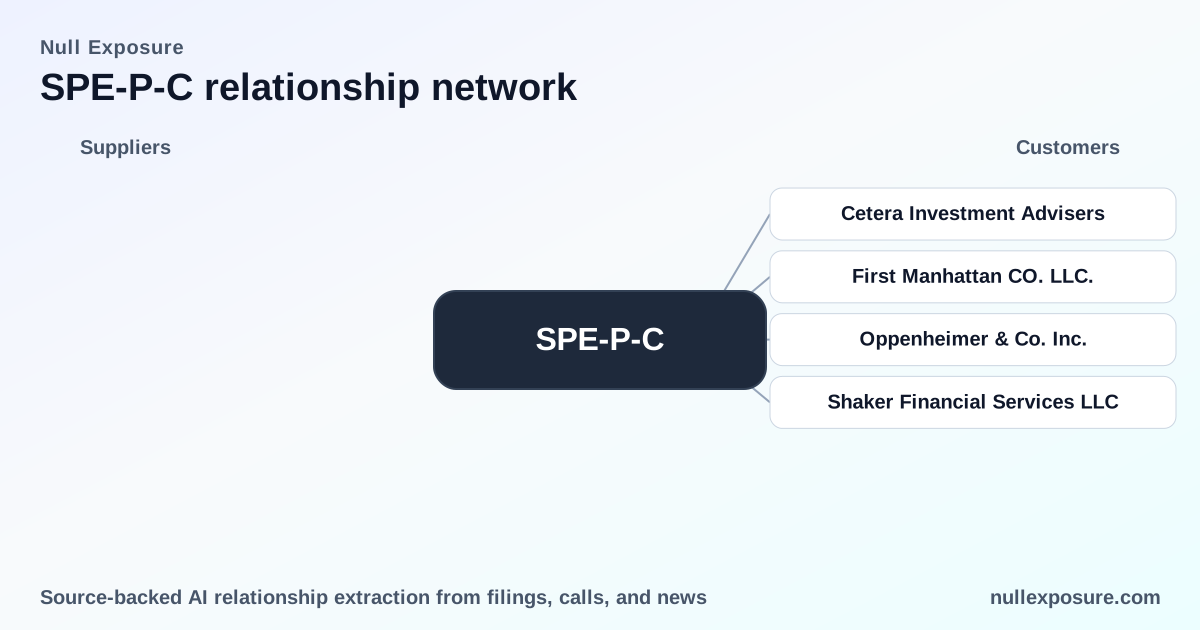
Below I walk through every institutional relationship reported in the dataset. Each entry contains a concise, plain-English summary with the source cited.
Shaker Financial Services LLC — the largest reported holder
Shaker Financial Services is listed as holding 2.36% of SPE-P-C, making it the largest reported institutional position in the data. This stake size implies active allocation from a specialist or boutique allocator rather than a controlling interest, and contributes to diversified institutional demand. According to a MarketBeat instant alert covering FY2026 ownership trends, Shaker Financial Services is the top institutional investor at 2.36% (MarketBeat, Jan 21, 2026).
First Manhattan Co. LLC. — a modest advisory allocation
First Manhattan Co. LLC. is recorded with 0.38% ownership. The position points to First Manhattan playing a modest advisory or allocation role within client portfolios, reinforcing the security’s placement among wealth managers and boutique advisory channels. This holding is noted in the same MarketBeat FY2026 report detailing top institutional investors (MarketBeat, Jan 21, 2026).
Cetera Investment Advisers — intermediary distribution presence
Cetera Investment Advisers holds 0.36%, showing participation by a national advisory network. Cetera’s position indicates distribution through retail and registered-advisor channels, which supports aftermarket liquidity and wider investor reach. This is recorded in the MarketBeat instant alert on FY2026 institutional ownership (MarketBeat, Jan 21, 2026).
Oppenheimer & Co. Inc. — broker-dealer allocation
Oppenheimer & Co. Inc. holds 0.20%, reflecting a classic broker-dealer or wealth-management channel allocation. Oppenheimer’s holding suggests marketplace placement through traditional broker networks and further diffusion of shares across retail and institutional accounts. This is documented in the MarketBeat FY2026 ownership summary (MarketBeat, Jan 21, 2026).
What the ownership mix means for investors and operators
- Concentration risk is low at the institutional-holder level. The largest holder at 2.36% does not create a controlling block; instead, ownership is dispersed across intermediaries and specialist firms, limiting single-point counterparty risk for dividend or voting outcomes.
- Liquidity is supported by established distribution channels. Presence of Cetera and Oppenheimer points to retail and advisor distribution, which helps with secondary-market liquidity for preferred holders.
- Operational criticality centers on market plumbing, not bespoke vendor relationships. The business model relies on market-making and custodial infrastructure rather than a small set of mission-critical suppliers; no constraints were returned in the dataset to suggest otherwise.
Company-level signals from the constraints payload
The relationship constraints array returned no entries. At the company level this manifests as two practical signals:
- No reported contractual encumbrances or named third-party constraints in the available data — the dataset did not flag vendor lock-in, exclusivity obligations, or other named dependencies.
- Public-facing ownership and distribution are the primary governance signals to monitor. With constraints absent, governance and liquidity exposures are better inferred from ownership concentration and intermediary participation.
Risk considerations and monitoring priorities
Investors should prioritize ongoing monitoring of:
- Changes in top-holder percentages — any movement that consolidates a larger block into one intermediary could alter governance dynamics or secondary-market liquidity.
- Broker-dealer and advisor flows — shifts in retail/RA distribution channels (e.g., Cetera or Oppenheimer materially increasing/decreasing allocations) will affect trading liquidity and bid/ask spreads.
- Dividend servicing and market-maker depth — preferred-equity instruments are sensitive to market-making capacity and coupon expectations; maintain focus on market liquidity metrics and dealer inventories.
Final read and practical next steps
SPE-P-C’s institutional holder list shows small, diversified positions across advisory and broker-dealer channels — a setup that supports steady market access and low single-counterparty risk. Operators should treat distribution networks and market-making partners as the operational focus rather than searching for named infrastructure constraints in vendor contracts. For investors wanting a systematic map of relationships and up-to-date ownership tracking, visit https://nullexposure.com/ for deeper exposure analytics and relationship intelligence.
Key sources cited in this review: a MarketBeat instant alert on institutional ownership of the Special Opportunities Fund, which documents top institutional investors and their reported stakes in FY2026 (MarketBeat, Jan 21, 2026).