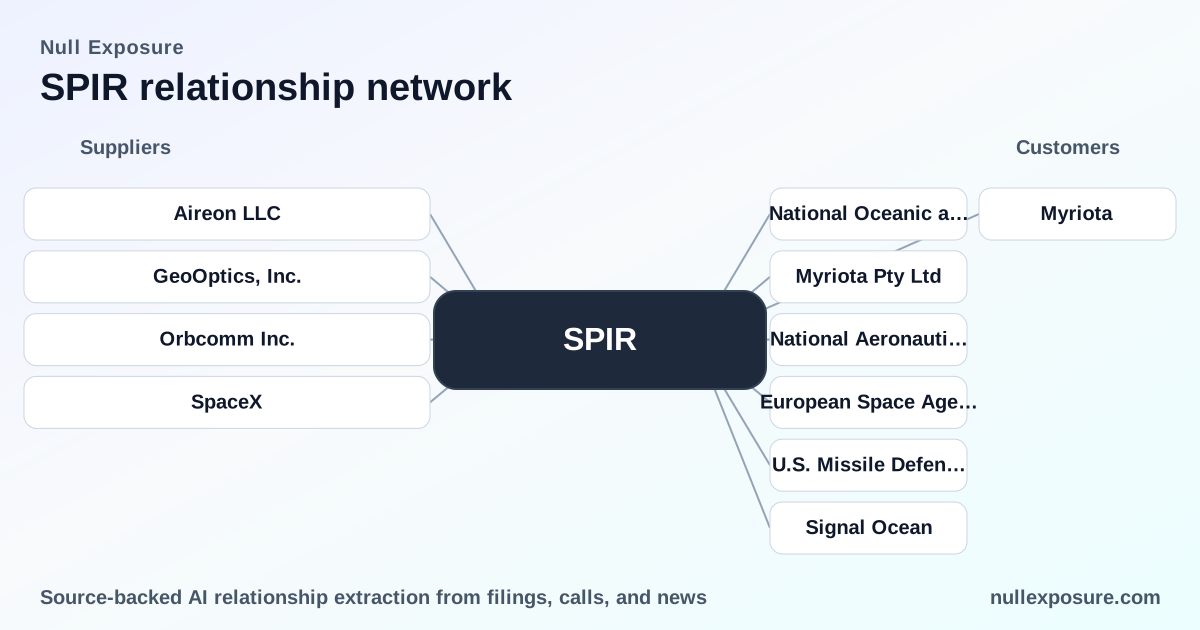
Spire Global (SPIR) — Customer relationships, commercial posture, and operational constraints
Spire Global sells space-enabled data, analytics and "space-as-a-service" solutions to commercial and government customers, monetizing primarily through recurring subscriptions and contract-based project services, plus launch and spacecraft services when acting as a service provider. The company converts upfront capital needs for customers into predictable operating spend and retains an active backlog of multi-period customer commitments, while also carrying meaningful revenue concentration with U.S. government agencies. For a concise view of Spire’s coverage and signals, visit https://nullexposure.com/.
The commercial logic: subscriptions, projects, and space services
Spire’s revenue model is subscription-first with project work layered on top. The company states it recognizes subscription revenue ratably over contract terms, which supports predictable top-line streams and higher lifetime customer value. At the same time, Spire operates as both a seller of data and analytics services and a service provider for space missions, giving it multiple monetization levers — subscription fees, project contracts, and space services engagements.
- Concentration and counterparty risk are material: Spire discloses that government customers accounted for roughly 36% of 2024 revenue, and one consolidated government customer grouping represented 24% of revenue in 2024 (28% in 2023). That structure increases revenue visibility for contracted work but concentrates risk on a relatively small set of large public agencies.
- Contract mix and duration matter: The company has short-term transition agreements alongside multi-year subscriptions and project awards, and it reported $216,436 of performance obligations not yet earned as of 12/31/2024 — evidence of active multi-period commitments.
- Geography is mixed but North America–heavy: Spire reports the Americas delivered 57% of 2024 revenue, while it also describes itself as a global provider of space-based services.
For deeper platform analytics and relationship mapping, check the firm profile at https://nullexposure.com/.
Key commercial constraints shaping investor risk and upside
Spire’s public filings and market reports reveal a set of operating constraints that drive both downside sensitivity and embedded optionality:
- Subscription-led billing: Spire emphasizes converting upfront capital expenditures into recurring operating expenses for customers, with subscriptions recognized ratably — a structural driver of recurring revenue strength.
- Government counterparty concentration (material): Government agencies represent a meaningful share of revenue (~36% in 2024) and a single consolidated government customer grouping accounted for roughly a quarter of revenue — this is a strategic revenue dependency.
- Short-term transactional elements exist: The company disclosed a twelve‑month transition service and data provision agreement for $7,500, underscoring that some engagements are transactional and short-horizon.
- Active backlog and service commitments: The firm reported performance obligations not yet recognized totaling $216,436 as of year-end 2024, indicating ongoing contracted work.
- Geographic split: While Spire operates globally, North America is the largest single region (57% of 2024 revenue) — a concentration relevant to political and procurement cycles.
- Typical contract sizes: The firm reports contracts to government agencies in the $1M–$10M range (for example, NOAA awards described below), signaling mid-sized program economics rather than only small transactions or massive single awards.
- Role flexibility: Spire operates as both seller (data/analytics subscriptions) and service provider (space services and mission execution), which offers revenue diversification but also exposes the company to execution risk on launches and mission delivery.
Because the NOAA award language appears by name in filings, investors should treat NOAA contract details as relationship-specific signals (see relationship entries below).
Customer roll-call — who contracts with Spire, and what it means
Below is a concise, relationship-by-relationship readout drawn from Spire’s filings and market reports. Each entry is one to two sentences with the source called out.
European Space Agency (ESA)
Spire engages in co‑funded R&D arrangements with ESA under customer-funded research and development contracts, indicating collaboration on technology and science initiatives rather than pure commercial subscriptions. This is disclosed in Spire’s FY2024 Form 10‑K (FY2024).
Source: Spire FY2024 Form 10‑K disclosure (FY2024).
Myriota Pty Ltd
Myriota purchased small but recurring launch and/or data services from Spire — Spire reported revenue of $642 (2024) and $897 (2023) from Myriota and $52 receivable as of 12/31/2024, reflecting a modest commercial relationship. This detail comes from the FY2024 Form 10‑K revenue disclosures.
Source: Spire FY2024 Form 10‑K (revenue and receivable figures, FY2024).
National Aeronautics and Space Administration (NASA)
Spire participates in customer-funded or co-funded R&D agreements with NASA, reflecting research collaborations and government program work as part of its public‑sector footprint. This is documented in the FY2024 Form 10‑K.
Source: Spire FY2024 Form 10‑K (FY2024).
National Oceanic and Atmospheric Administration (NOAA)
Spire reported that NOAA did not fully renew one sales order covering Sept 2024–Sept 2025, and separately disclosed NOAA contract awards totaling $9.4M (Jan 2024) and $3.8M (Sept 2024) for satellite weather and climate data — a mix of material awards and revenue timing risk. These references appear in Spire’s FY2024 Form 10‑K and related disclosures (FY2024).
Source: Spire FY2024 Form 10‑K (NOAA contract awards and renewal commentary, FY2024).
U.S. Missile Defense Agency
Spire was selected to participate in the Missile Defense Agency’s SHIELD contract vehicle, an IDIQ pool with a large aggregate ceiling that places Spire eligible to compete for future defense task orders and expands its addressable government market. This selection was reported in press coverage on December 18, 2025.
Source: Sahm Capital press report (Dec 18, 2025).
GHGSat
Spire signed a space services agreement to launch satellites for GHGSat’s greenhouse gas monitoring missions, demonstrating Spire’s role as a launch and mission provider for environmental monitoring customers; the arrangement was announced in a Spire press release originally dated Sept 15, 2022.
Source: Spire press release reported via Business Wire / FinancialContent (Sept 15, 2022).
Kpler Holding SA
Kpler completed the acquisition of Spire’s Maritime business for approximately $240 million (announced April 27, 2026), which materially reshapes Spire’s customer-facing maritime product line and reduces direct maritime customer exposure on Spire’s balance sheet.
Source: Market press report (Apr 27, 2026).
I Squared
Spire agreed to sell certain natural gas storage assets to I Squared for approximately $650 million, a transaction disclosed in market filings and press reports in April 2026 that represents asset monetization and strategic reallocation of capital.
Source: MarketScreener / filings referenced in April 2026 press coverage (Apr 15, 2026).
Precursor SPC
Precursor SPC selected Spire to provide GNSS radio occultation profiles for hypersonic tracking, highlighting Spire’s positioning in specialized defense and high-performance mission support services (reported Apr 20, 2026).
Source: Market press report (Apr 20, 2026).
Signal Ocean
Under a commercial agreement, Spire and Signal Ocean partnered to combine Spire’s unique maritime data with Signal Ocean’s analytics to digitalize maritime workflows, which indicates reseller/partner distribution and commercial product integration (press coverage dated FY2024).
Source: AITHority press release (FY2024).
National Geospatial‑Intelligence Agency (NGA)
Spire has supported NGA-related activities including satellite deployments for NGA’s MagQuest Challenge, reflecting engagement in geospatial intelligence competitions and prototype mission support (reported in 2026 press summaries).
Source: Investing.com press summary (FY2026).
Investment implications and final takeaways
- Revenue durability rests on subscription contracts plus government awards — this structure supports recurring revenue but concentrates exposure to public procurement cycles.
- Spire’s dual role (seller and mission service provider) creates diversification but also operational execution risk around launches and mission delivery.
- Material government contracts are a double-edged sword: they lift revenue visibility when active but introduce timing and renewal risk (NOAA renewal example).
- Dispositions and asset sales (Maritime to Kpler, gas assets to I Squared) alter the customer mix and free up capital for core analytics and space services.
For a structured map of these relationships and to monitor changes as new contract awards and disposals post, visit https://nullexposure.com/ for continuous tracking and portfolio signals.