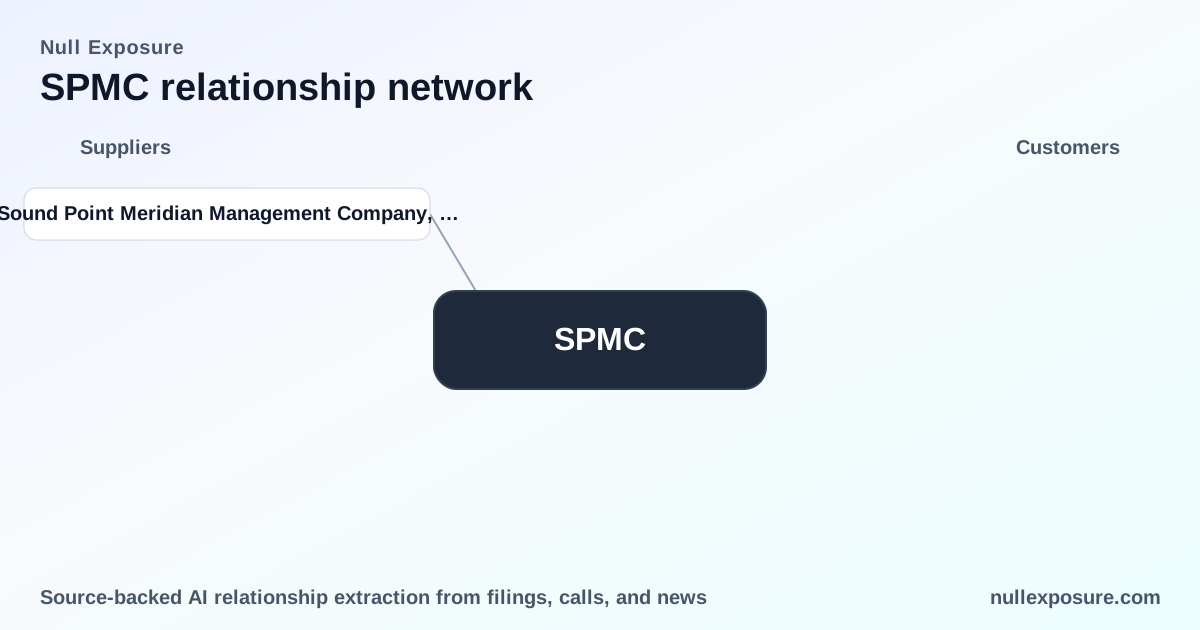
Sound Point Meridian Capital (SPMC): Customer-relationship intelligence for investors and operators
Sound Point Meridian Capital operates as a fee-driven alternative asset manager that monetizes through management fees, carried interest/performance fees, and investment returns across credit, real estate and private equity strategies. For investors and operating partners, the critical lens is whether SPMC’s business relies on recurring contractual client relationships or on market-driven capital flows; the public record returned for customer-scope checks shows investor trading activity rather than recurring commercial customer contracts, a distinction that changes how counterparty risk and revenue stability should be assessed. For deeper, repeatable customer intelligence, visit https://nullexposure.com/.
Single relationship returned — what that actually means for revenue and counterparty risk
The customer-scope search returned one discrete relationship: a transaction in which an institutional investor purchased SPMC shares. This is investor ownership activity, not a vendor-client or service contract, and therefore it is not evidence of customer revenue concentration or operational dependency on a counterparty. From an operator or acquirer’s perspective, an equity purchase by a third party is a market signal about sentiment and liquidity, not a commercial revenue contract that drives asset-manager fee income.
- Contracting posture: The return set contains no contractual client terms; the relationship is an equity investment event.
- Concentration and criticality: The single item does not indicate client concentration; it reflects a one-off or portfolio-level trade by an investor, not a core customer providing recurring fees.
- Maturity and permanence: Equity purchases are transient and can be reversed; they are not a substitute for multi-year management or advisory contracts.
Relationship detail: Assured Guaranty (AGO) — institutional purchase activity
Assured Guaranty executed a purchase of SPMC shares valued at approximately $6 million on April 30, 2026, recorded in market alerts on May 4, 2026. A MarketBeat instant alert, citing Investing.com data, reported the purchase as a notable block trade on April 30, 2026; the alert was first seen on May 4, 2026. This is an investor-level position change, not a commercial customer engagement, and should be treated as a liquidity and investor-interest signal rather than a source of fee revenue for SPMC.
Source: MarketBeat instant alert referencing Investing.com (first seen May 4, 2026), report of Assured Guaranty buying $6m of SPMC shares on April 30, 2026.
Why this investor activity matters to investors and operators
Equity purchases by named institutional entities like Assured Guaranty are useful market signals: they can indicate underwriting-level confidence, hedging strategies, or balance-sheet allocation moves at insurance companies. For SPMC, the practical implications are limited:
- Not a revenue contract: The trade does not create recurring fees or platform commitments for SPMC.
- Sentiment and liquidity: A $6 million buy signals liquidity and interest in the stock at that time and can influence trading dynamics and short-interest flows.
- Corporate governance effects: If an investor scaled ownership meaningfully over time, it could affect governance or strategic options — but the single reported purchase alone is not evidence of a control or strategic stake.
Company-level signals and constraints (what the data did and did not show)
The customer-scope results contained no contractual constraints or vendor-customer clauses returned against SPMC. In short, the scan did not surface supplier agreements, SaaS contracts, or commercial counterparties that would indicate customer-driven revenue dependency. That absence is itself an operational signal: the publicly indexed customer relationships available through this scope are thin and skew toward investor-market events rather than contractual customers.
Financial and capital signals from the company profile provide additional context for evaluating customer risk and operational posture:
- Market capitalization: $217.7M.
- Revenue (TTM): $96.2M; trailing P/E: 3.29; price-to-book: 0.62.
- Dividend profile: dividend per share $3.296 and dividend yield reported at 0.315 (as provided in company data).
- Ownership: institutional ownership at 6.37%, indicating relatively low institutional stake concentration at the time of the latest profile. These company-level metrics position SPMC as a compact publicly listed manager where market trading and capital allocation decisions by external investors can have outsized stock-price effects, but they do not imply customer-revenue concentration from the single relationship returned.
Operational implications for investors and acquirers
For investors underwriting equity or credit exposure to SPMC, the principal takeaways are straightforward and actionable:
- Treat the Assured Guaranty trade as a market-liquidity and sentiment data point, not a customer revenue event.
- Do not factor this single transaction into models of recurring fee revenue or counterparty dependency; there is no evidence of contractually committed AUM or advisory mandates tied to this buyer.
- Focus due diligence on AUM stability, fee schedules, and client contract disclosures (if any) rather than anecdotal trading reports when assessing long-term revenue risk.
For operators considering partnerships or vendor selection, the lack of customer-scope contractual returns suggests limited public visibility into SPMC’s client roster through search returns alone, so direct reference checks and contract-level diligence remain necessary.
Final checklist for analysts evaluating SPMC customer exposure
- Confirm whether investor trades (like the Assured Guaranty purchase) correspond with parallel commercial relationships — in this case, they do not.
- Prioritize primary-source contract review for client revenue assessment; public market trades are insufficient.
- Monitor short-interest, block trades and institutional filings for follow-through that could signal a growing strategic stake.
- For ongoing customer intelligence and repeatable relationship mapping, specialist tools and direct disclosures are required — see more at https://nullexposure.com/.
Bold takeaway: The single customer-scope hit is an investor purchase (Assured Guaranty, ~$6M) and not evidence of contractual customer dependence; treat it as a liquidity/sentiment signal, not a recurring revenue relationship.