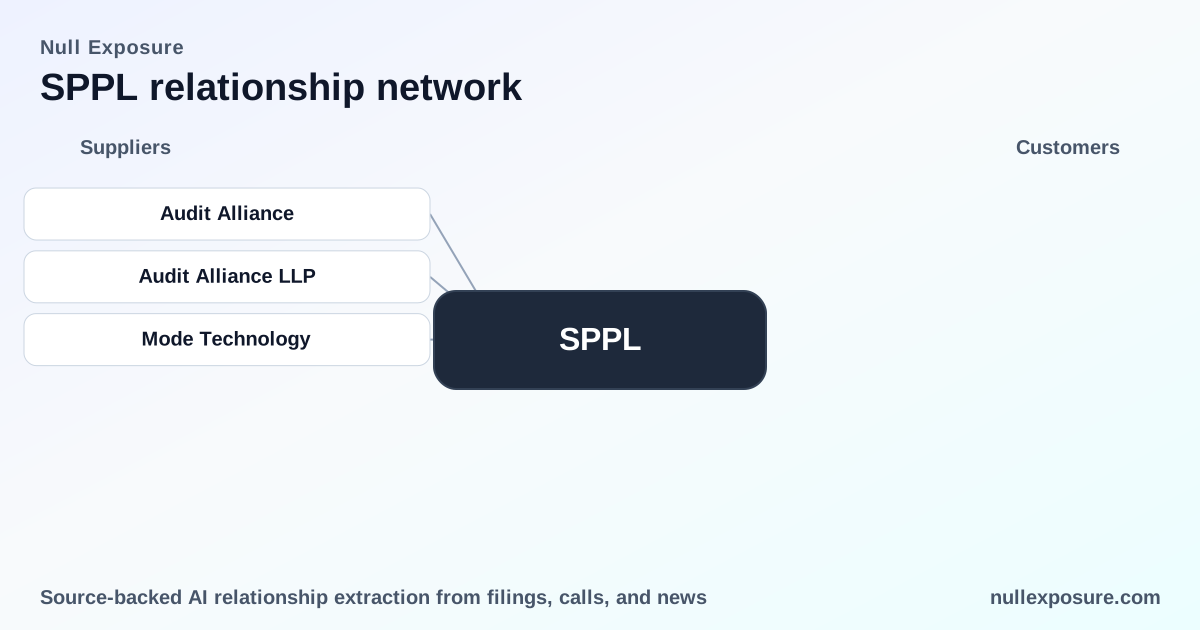
Simpple Ltd. (SPPL): Customer footprint and what it says about commercial upside
Simpple Ltd. designs and supplies autonomous cleaning robots to large infrastructure operators and monetizes through sale-and-deployment contracts for robotics across transit and airport assets. Recent contracts demonstrate a commercial strategy focused on institutional customers in Singapore, with revenue driven by unit sales and follow-up orders for additional fleet deployments and implementations. For a concise look at the company’s customer signals and how they shape risk/reward, review the coverage here and visit https://nullexposure.com/ for the underlying source references.
Why customers matter more than headlines for SPPL
Simpple’s near-term valuation depends on converting headline wins into recurring commercial scale. Customer concentration in critical infrastructure (MRT lines and Changi Airport) gives Simpple both strong reference accounts and meaningful single-market exposure. The company has real revenue — Revenue TTM $5.908m and Gross Profit TTM $2.930m — but profitability remains negative (Operating Margin TTM -88.8%, Net Profit Margin -70.8%), underscoring an early-stage commercial profile where revenue growth must outpace persistent operating losses to support valuation. Simpple’s market capitalization (~$25.3m) and elevated beta (4.21) reflect both small-cap volatility and sensitivity to contract news.
Customer relationships: who is buying Simpple robots today
SMRT Trains — deployment across three major MRT lines
A GlobeNewswire release dated November 22, 2024 reports that Simpple, through a subsidiary, sold and deployed 89 autonomous cleaning robots across three major MRT lines operated by SMRT Trains. This deployment is a material commercial proof point for urban mass-transit operations and validates revenue generation from unit sales and deployment programs (GlobeNewswire, Nov. 22, 2024: https://www.globenewswire.com/news-release/2024/11/22/2985964/0/en/SIMPPLE-Ltd-Announces-Sale-and-Deployment-of-89-Autonomous-Cleaning-Robots-Across-Three-Major-MRT-Lines-in-Singapore-Operated-By-SMRT-Trains.html).
Singapore Changi Airport — follow-on contract for additional units
An industry report from AirportIndustry News on May 4, 2026 states that Simpple was awarded a follow-up contract to supply new autonomous cleaning robots to Singapore Changi Airport, indicating repeatable procurement and client-level expansion within a major international airport (AirportIndustry News, May 4, 2026: https://airportindustry-news.com/simpple-awarded-follow-up-contract-at-singapore-changi-airport/).
What these relationships imply about Simpple’s operating model
- Contracting posture: Agreements are direct B2B sale-and-deployment contracts with large institutional operators. The Changi follow-up award and SMRT fleet deployment indicate a commercial sales model that secures platform-level rollouts rather than isolated pilot projects.
- Customer concentration: Current publicized customers are concentrated in Singapore’s transportation and aviation hubs. This concentration yields strong local referenceability but creates geographic and sector exposure that investors must price into growth assumptions.
- Criticality to customers: Cleaning robotics integrated into transit and airport operations are operationally relevant; successful deployments suggest high client stickiness and potential for service, maintenance, and expansion revenues.
- Commercial maturity: Financials show an early commercial stage: Revenue TTM $5.908m and Gross Profit TTM $2.93m exist, but negative operating and net margins point to either scaling costs or ongoing R&D/SG&A investment. The company’s small market cap (~$25.3m) and low institutional ownership (0.9%) reflect a microcap profile with significant illiquidity and execution risk.
Note: No contract-level constraints were extracted in the feed. Company-level signals above synthesize public customer wins and the public financial profile.
Risks that flow directly from the customer picture
- Concentration risk: Reliance on a few large institutional clients in a single market magnifies the earnings impact if renewal cycles slow or procurement budgets shift.
- Execution and margin risk: The business converts revenue into gross profit but not operating profit; a sustained margin improvement is required for positive free cash flow.
- Delivery and service obligations: Hardware deployments create ongoing service and maintenance responsibilities that can be revenue-accretive but also capital- and labor-intensive.
- Market and valuation sensitivity: High beta (4.21) and a Price/Sales ratio of 4.29 reflect market volatility and premium expectations for growth that must be realized through repeat orders and geography expansion.
Valuation context and balance-sheet signals
Investors must weigh meaningful reference contracts against the reality of tight capitalization and negative earnings. Key public metrics: Market Capitalization ~$25.3m, Revenue TTM $5.908m, Gross Profit TTM $2.93m, Operating Margin TTM -88.8%, Net EPS (TTM) -$0.57, EV/Revenue 5.46, EV/EBITDA negative. Insider ownership is non-trivial (~6.7%), while institutional presence is minimal, enhancing idiosyncratic risk and upside from any material contract expansions.
For the full situational context and ongoing updates to customer signals, visit https://nullexposure.com/.
How investors should monitor progress
- Track order flow and follow-on contracts beyond Singapore as the clearest indicator of sustainable revenue scale.
- Monitor quarterly updates for service and recurring revenue lines; a shift from one-time unit sales to ARR-like service contracts is a valuation inflection.
- Watch margins and SG&A trends; turning operating losses into positive operating income will be the critical inflection for valuation re-rating.
- Observe customer concentration metrics and any disclosed contract durations or recurring revenue clauses; diversification outside a small domestic market reduces systemic customer risk.
Bottom line
Simpple’s publicly disclosed customer wins — SMRT Trains’ 89-unit deployment and a follow-on award at Singapore Changi Airport — establish credible product-market fit in mission-critical infrastructure. However, company-scale and profitability are early-stage and require demonstrable repeatable orders and margin improvement to justify the current market multiple. Investors should treat Simpple as a proposition where commercial proof points are real but nascent, and near-term valuation will hinge on broadened customer adoption and the conversion of deployments into recurring service revenue.