Spero Therapeutics (SPRO): Partnered commercialization and milestone-driven monetization
Spero Therapeutics is a clinical-stage biotech that monetizes by licensing late‑stage assets and capturing milestone and collaboration revenue, while supplementing R&D funding through U.S. government contracts. The company advances antibiotics and rare‑disease candidates through clinical development and then transfers development and commercialization rights to large pharmaceutical partners in exchange for upfront payments, equity investments, regulatory milestones and future royalties.
If you want a concise partner map and contractual signal analysis that investors can act on, see the Null Exposure coverage: https://nullexposure.com/
How Spero’s commercial model actually generates cash
Spero’s revenue profile is dominated by discrete collaboration events rather than recurring product sales. Upfront license fees, equity investments and milestone payments drive near‑term cash, and those items feed into revenue recognition when Spero is the principal in development activities or when contractual milestones are triggered. At the same time, government awards under BARDA and NIAID provide program funding tied to specific R&D deliverables—another non‑recurring but material income stream.
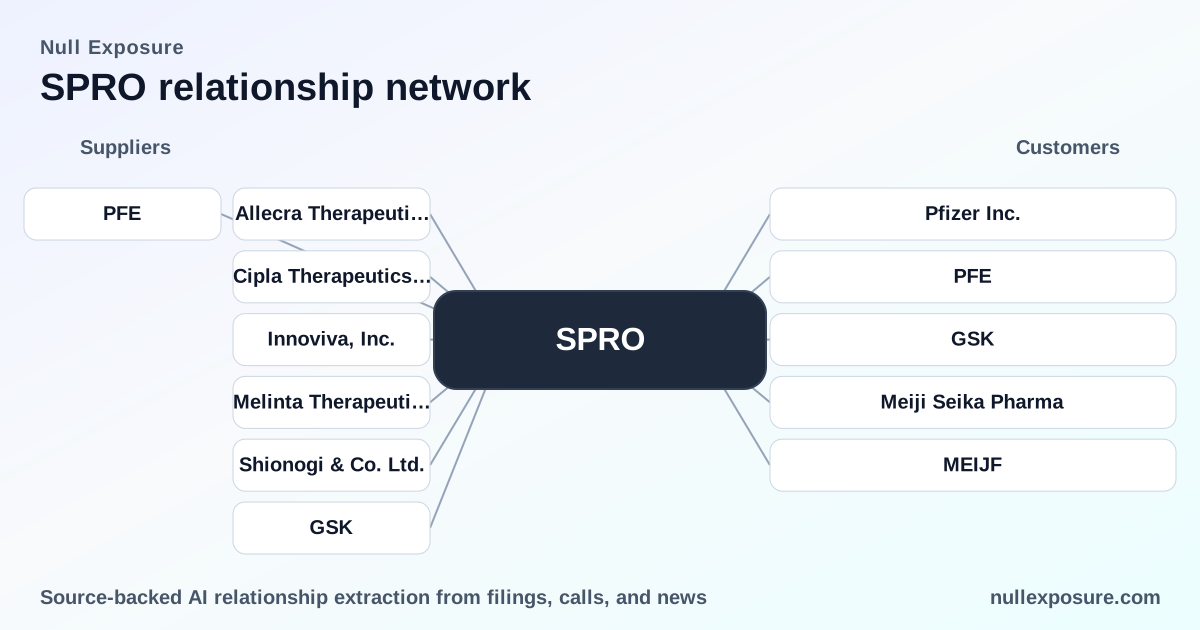
Counterparty map — who pays, who develops, who commercializes
Below I list every counterparty referenced in the available relationship results with a short plain‑English summary and a source note.
-
Pfizer Inc.
Spero granted Pfizer rights to develop, manufacture and commercialize SPR206 outside the U.S. and certain Asian markets, and Pfizer made a strategic equity purchase of Spero common stock ($40.0 million) tied to that collaboration. This commercial and financial package creates both near‑term financing and long‑term commercial upside for Spero. (See Spero Form 10‑K FY2024; GlobeNewswire and CityBiz press release covering the 2021 licensing and $40M equity investment.) -
GSK (GlaxoSmithKline plc)
GSK holds an exclusive license to develop and commercialize tebipenem HBr in most global territories (with explicit carve‑outs for certain Asian territories retained by Meiji), and Spero received a large upfront and subsequent regulatory milestone payments — including a reported $25 million milestone tied to an NDA resubmission in Q1 2026. This relationship is the principal driver of Spero’s 2025 collaboration revenue. (See multiple press releases and news coverage: GlobeNewswire business updates FY2024–FY2026; trading and earnings reports documenting the $25M milestone in early 2026.) -
Meiji Seika Pharma / Meiji (MEIJF)
Meiji retains development and commercialization rights in certain Asian territories for tebipenem‑related products, creating a geographically carved licensing structure alongside the GSK deal. That allocation confines GSK’s rights in Asia and preserves regional economics tied to Meiji. (See GlobeNewswire and Medical Dialogues coverage announcing the territorial split, FY2022–FY2026.) -
U.S. Government partners — BARDA and NIAID (NIH)
Spero is a recipient of program funding and contracts from U.S. government agencies: a five‑year NIAID award under the Omnibus BAA (awarded May 2021) and a BARDA contract (original 2018 award and later modifications) that together represent material program funding for SPR206 and related programs. Spero recognizes BARDA and NIAID funding as revenue because it acts as the principal in delivering the funded R&D activities. (See evidence excerpts summarized from Spero filings: contract texts and Form 10‑K statements referencing BARDA/NIAID funding and committed amounts through Dec 31, 2024.)
What the relationships tell you about Spero’s operating posture
- Contracting posture — partner‑centric, milestone‑oriented. Spero systematically licenses late‑stage assets to large pharmas (GSK, Pfizer) and structures deals with upfront payments, equity purchases and milestone triggers. The company also accepts government contracts that fund R&D while keeping operational control over execution—Spero acts as the principal for government‑funded development work (per management disclosure).
- Concentration and revenue profile. Collaboration revenue is concentrated: the GSK and Pfizer transactions accounted for the bulk of 2025 recognized collaboration revenue (Spero disclosed $47.0M from GSK in 2025 including a $25M NDA milestone). Single large partner events drive most reported revenue, so future quarter‑to‑quarter volatility is likely as milestones are discrete.
- Criticality of partners. GSK and Pfizer are strategic commercial and development counterparts: GSK holds a global carve‑out license for tebipenem HBr and drove the NDA resubmission that produced a $25M payment; Pfizer controls ex‑U.S. ex‑Asia rights to SPR206 and provided a $40M equity infusion. These partners are operationally critical to Spero’s ability to convert its clinical work into commercial receipts.
- Maturity and stage. Relationships with GSK and Pfizer are beyond discovery—they involve Phase‑3 programs, joint development committees and regulatory submissions. Government contracts are similarly execution‑focused, funding late preclinical/clinical development. This is a partner portfolio at the pre‑commercial to regulatory‑submission maturity level, not an early discovery licensing book.
Financial and operational implications for investors
- Upside: Milestone receipts and royalties from GSK and Pfizer provide clear de‑risking pathways that convert clinical progress into cash. The $25M NDA milestone and the $66M upfront reported in disclosures materially improved Spero’s near‑term liquidity profile in 2025 and early 2026 (see trading and earnings press coverage FY2025–FY2026).
- Downside: Revenue concentration around a few collaboration events produces earnings lumpyness and elevates dependency risk on counterparties executing regulatory and commercialization steps on schedule. Government funding is durable for programs but tied to deliverables; any change in award scope or option exercise could materially affect funded runway.
- Balance sheet signal: The combination of partner upfronts, equity investment and government funding places Spero in a milestone‑funded operating model where cash inflows are timing‑sensitive and contingent on partner activity and regulatory outcomes.
Risks that matter for valuation
- Regulatory milestones and NDA outcomes are binary events that determine large cash inflows (the $25M milestone is a recent example).
- Geographic carve‑outs (Meiji in Asia) reduce single‑partner exclusivity and therefore compress potential global royalty pools.
- Contractual split of responsibilities—Spero funds certain clinical supplies and initial trial costs while partners assume commercial supply and commercialization costs—means Spero carries some near‑term cash burdens even as it expects partner payments.
If you want a one‑page partner risk/return memo and modeled milestone timing for SPRO, review full coverage at Null Exposure: https://nullexposure.com/
Bottom line
Spero’s strategy is execution through licensing: large pharmas pay upfront and milestone dollars to acquire commercialization rights while government contracts fund R&D execution. That structure delivers clear cash inflection points but concentrates revenue risk in a small number of counterparties and regulatory milestones. Investors should underwrite Spero’s valuation against partner execution timelines, NDA outcomes, and the cadence of government contract funding as the primary drivers of near‑term cash generation.
Sources referenced in this article include Spero’s Form 10‑K (FY2024) and public press releases and news coverage from GlobeNewswire, CityBiz and multiple news services documenting the GSK license and $25M NDA milestone (Q1 2026), Pfizer licensing and $40M equity investment (2021), and government awards from BARDA and NIAID (award notices and Spero filing excerpts through Dec 31, 2024).