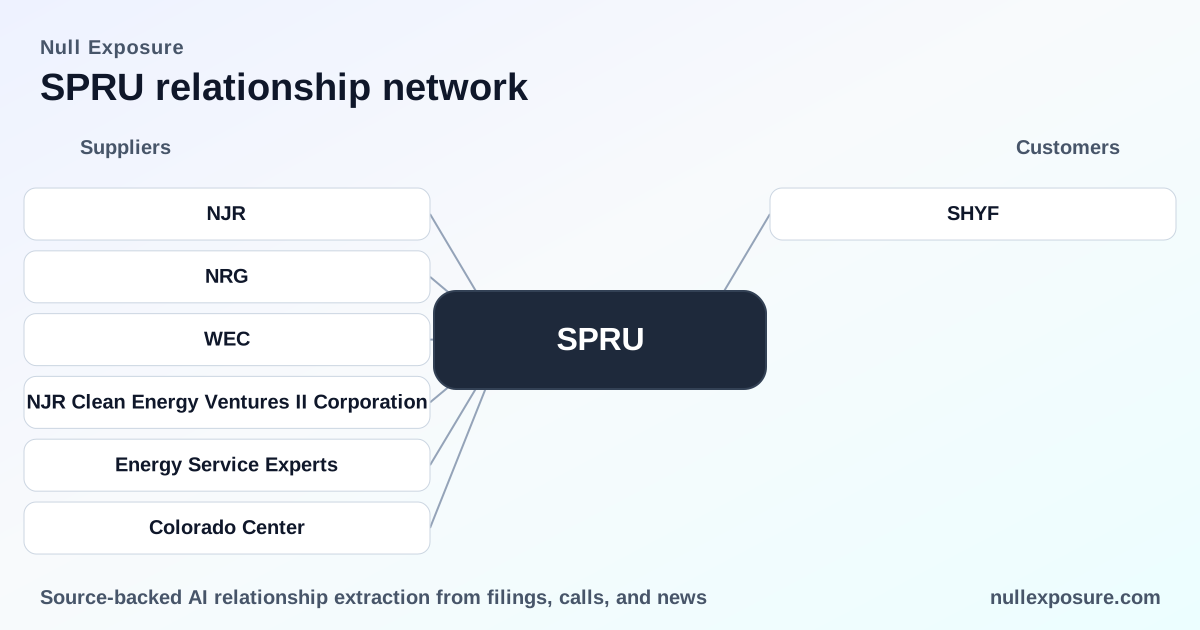
Spruce Power (SPRU) — Customer Relationships, Contracting Posture, and What the Shyft Deal Changes
Spruce Power is an owner-operator of distributed residential solar assets that monetizes through long-term customer agreements and subscription-style servicing. The company collects recurring monthly payments from homeowners under power purchase agreements (PPAs) and solar lease arrangements while also generating fees by servicing third-party portfolios; these cash flows are packaged into multi-portfolio investments and sold or retained as yield assets. For investors and operating partners, Spruce’s value proposition is cashflow predictability from long-duration contracts coupled with operational scale in residential servicing. For a quick overview of the platform and data-driven signals, visit https://nullexposure.com/.
How Spruce actually contracts with its customers — the operating model in plain English
Spruce’s commercial model is dominated by subscription and long-term contracts. Company filings and investor materials through 2024 describe a portfolio of customer agreements that:
- Are long-dated, frequently stretching into multi-decade horizons (company disclosures reference 20-year use rights in specific portfolios).
- Target individual homeowners as the primary counterparty, creating a very large base of small, recurring cash flows rather than a few large corporate customers.
- Operate principally within the United States, with portfolios diversified across multiple states to limit localized regulatory or weather-related concentration.
- Combine two revenue roles: Spruce acts as seller of electricity to homeowners under PPAs/leases and as a service provider managing third-party-owned systems through the Spruce Pro servicing platform.
These characteristics produce sticky, annuity-like revenue but also require disciplined portfolio management: collections, customer service, and warranty/maintenance operations are operationally critical to preserve cashflow value.
The full set of referenced counterparty relationships
Below are the relationships surfaced in the review of external references; each entry is summarized concisely with source attribution.
-
The Shyft Group, Inc. (SHYF) — The Shyft Group completed the acquisition of certain assets of Spruce Power on January 5, as reported by Simply Wall St; the note was captured in March 2026. This transaction represents an asset-level transfer rather than a corporate merger and affects how certain cash flows and portfolios are owned and serviced going forward. Source: Simply Wall St reporting (March 2026) referencing the January 5 announcement.
-
SHYF (ticker referenced separately) — A duplicate reference in the same Simply Wall St piece also lists SHYF as completing the acquisition of certain Spruce Power assets on January 5; it reiterates the same event from the market reporting feed. Source: Simply Wall St reporting (March 2026) referencing the January 5 announcement.
Both entries point to the same market event documented by the same external report; including both preserves completeness of the surfaced relationships.
Why the Shyft asset purchase matters to customers and investors
The sale of specific Spruce portfolios to The Shyft Group is not merely a one-off disposal; it alters the ownership and servicing map for a subset of Spruce’s cash flows. Key implications:
- Cashflow reallocation: Asset sales shift which organization receives the recurring homeowner payments and which entity bears collection and performance risk.
- Servicing continuity and counterparty risk: If servicing transfers with the sale, operational responsibility moves to the acquirer; if Spruce retains servicing, Spruce remains economically involved but with different credit exposure.
- Portfolio-level diversification: Spruce’s corporate profile — multiple portfolios across many states and thousands of contracts — reduces single-transaction concentration, but each sale changes the residual portfolio composition and capital return prospects.
Source context: market coverage of the completed January 5 asset sale reported by Simply Wall St in March 2026.
Customer and contract characteristics that drive valuation and risk
Use these company-level signals to assess Spruce’s contracting profile and what underpins enterprise value:
- Contracting posture — defensive, long-duration revenue: The business derives revenue from long-term, subscription-like agreements; that posture supports valuation models that rely on long-duration discounted cash flows rather than volatile spot sales.
- Concentration profile — broad retail base but portfolio-level concentration: Revenue comes from many homeowners, which reduces idiosyncratic household risk, but Spruce groups contracts into discrete portfolios that are material enough to be sold or securitized; that creates portfolio-level concentration risk.
- Criticality — operationally high: Servicing, collections, customer care and uptime are critical to preserve cash flows; operational failures create immediate financial impact through lost collections and higher maintenance costs.
- Maturity and predictability — relatively mature cash streams with servicing dependency: Long-term agreements provide predictability, but the economics depend on sustained servicing excellence and regulatory stability across multiple states.
These signals are grounded in company disclosures describing approximately 85,000 home solar assets under management and references to 20-year use rights in specific portfolios as of late 2024.
Financial context that colors the customer picture
Spruce’s platform-level economics and market valuation must be interpreted against its revenue and profitability profile. The company reported roughly $112 million in trailing revenues and a gross margin that supports positive operating margin trends; at the same time, the equity market capitalization and valuation multiples indicate investor scrutiny over profitability and growth conversion. When evaluating customer relationships, investors should marry contract longevity and servicing quality with the balance-sheet and liquidity position implied by public filings.
What investors should watch next
- Post-sale servicing arrangements: Whether servicing transfers with sold portfolios materially affects Spruce’s future revenue and operational footprint. Reports of the Shyft transaction indicate asset transfer activity; follow-up disclosures will clarify servicing commitments.
- Collection performance on long-duration contracts: Long-term contracts are only as good as ongoing collections and customer satisfaction; look for KPIs tied to adjusted gross collections and customer care metrics in quarterly updates.
- Portfolio sales vs. hold strategy: The frequency and scale of portfolio disposition will influence capital allocation, margin stability, and the company’s role as an owner-operator vs. a servicing-first business.
For an investor-focused synthesis of Spruce Power’s customer relationships and portfolio exposures, see more at https://nullexposure.com/.
Bottom line — actionable takeaways
- Spruce monetizes through long-term, subscription-style homeowner contracts and servicing fees; that structure yields durable cashflow if operational execution holds.
- The Shyft Group’s January asset purchase reassigns ownership of certain Spruce cash flows, which impacts where revenue and risk reside on the balance sheet.
- Operational excellence in collections and servicing is the single largest driver of value because long-term contracts depend on persistent performance, not one-time sales.
Investors and partners should prioritize diligence on post-sale servicing terms, portfolio composition after dispositions, and near-term collection metrics when underwriting Spruce’s future cash flows.