ARS Pharmaceuticals (SPRY): Commercial Relationships That Drive neffy’s Revenue Curve
Thesis: ARS Pharmaceuticals builds revenue by commercializing neffy, an intranasal epinephrine product, through a hybrid model of direct U.S. sales and regional licensing partnerships; the company sells product domestically via its commercial organization while capturing milestone payments and royalties from international partners who hold marketing rights in key markets. Investors should value SPRY as a concentrated, product-led commercial story where near-term cash flow and upside are tied to partner execution and payer access. For more on commercial partner risk and concentration, see https://nullexposure.com/.
How ARS monetizes neffy and runs the commercial engine
ARS retains U.S. rights and a direct selling model domestically while outsourcing commercialization in other regions to established pharmaceutical partners. Domestic monetization comes from product sales through wholesalers and retail channels; international monetization takes the form of upfront and regulatory milestone payments, transfer-price sales, and ongoing royalties from licensees. The company’s FY2025–FY2026 disclosures show product revenue in the U.S. and collaboration income from partner milestones—illustrating a two-track revenue stream: direct sales plus licensed revenue and royalties.
Key operational characteristics: neffy is the company’s sole approved product and therefore material to near-term value, ARS has an active commercial footprint in North America and a partner network across EMEA and Asia, and revenue recognition already includes both product sales and partner milestone/royalty receipts. These dynamics create concentrated exposure to one product and to partner execution outside the U.S.
Relationship roll call: partners, payers and what they mean for investors
Below I list every partner and counterparty referenced in the source set, with a concise commercial summary and source citation for each.
-
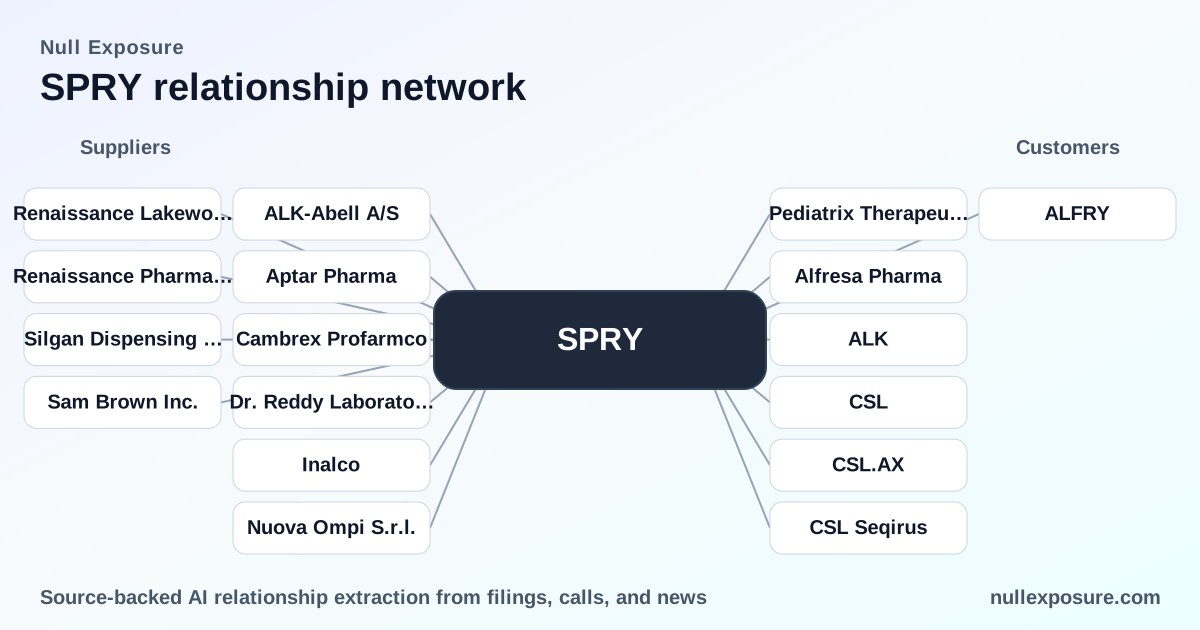
ALK‑Abelló A/S (ALK / ALK‑Abelló / ALK‑ Abelló A/S) — ARS has an exclusive agreement with ALK to commercialize neffy in Europe and Canada, and ALK handles distribution of EURneffy in the EU; ARS records royalties from ALK (small cash royalties recorded in late 2025/early 2026). Source: ARS financial results and press releases (GlobeNewswire, Mar 2026; Nov 2025 filings referenced in FY2025–FY2026 disclosures).
-
Pediatrix Therapeutics — Holds regional commercialization rights in China and is the partner through which ARS secured a regulatory milestone payment; ARS will manufacture and supply neffy to Pediatrix at cost and recorded a $4 million regulatory milestone included in 2025 collaboration revenue following Chinese approval. Source: SEC exhibit and company financial results (SEC filing/exhibit and Globenewswire/QuiverQuant reporting, FY2026).
-
CSL Seqirus (CSL / CSL.AX) — ARS entered a license agreement with CSL Seqirus for commercialization in Australia and New Zealand, reflecting a regional partner approach for Oceania markets. Source: Company investor materials and conference disclosures (Investing News / GlobeNewswire, FY2026).
-
Alfresa Pharma (Alfresa / ALFRY) — Alfresa holds the Japanese commercialization relationship; ARS expects to sell product to Alfresa at a transfer price and is eligible for a final regulatory milestone upon listing of neffy on Japan’s NHI drug price list (reported milestone: $2 million under the terms disclosed). Source: Company press releases and FY2025 results (GlobeNewswire, Nov 2025 and related FY2025 filing).
-
Anthem (ANTM) — Identified in analyst coverage and company commentary as a payer engaged in access and formulary discussions; management highlighted progress with Anthem as part of payer access expansion. Source: Analyst write‑ups and media coverage summarizing management commentary (Investing.com, May 2026 analyst note recap).
-
CVS Caremark (CVS) — Cited alongside other payers as a target for formulary placement, with management noting potential CVS Caremark formulary inclusion as a near-term access catalyst. Source: Analyst and media reporting on payer access (Investing.com, May 2026).
-
Aetna — Named by management and analysts as an active payer engagement, contributing to expected coverage expansion in the U.S. Source: Analyst commentary and company statements summarized by the financial press (Investing.com, May 2026).
Each of these relationships is active in the public record and appears in ARS’ FY2025–FY2026 communications; where ARS retains supply obligations, it records transfer‑price sales and/or royalty flows in its revenue line. For a deeper look at partner-level revenue flows and timing, visit https://nullexposure.com/.
What the disclosed constraints say about ARS’s operating posture
The company-level constraints drawn from filings and investor materials signal several structural commercial features investors must price:
-
Contracting posture: ARS sells to wholesalers domestically and licenses rights internationally, which creates a mix of commercial and contractual commitments—direct seller in the U.S. and licensor internationally, with obligations to manufacture and supply for some partners (company disclosures).
-
Concentration and criticality: neffy is the company’s only approved product and accounts for the majority of near-term revenue potential, a material concentration that makes partner execution and payer acceptance critical to valuation (company statements, FY2025–FY2026).
-
Geographic focus: The commercial effort is North America–centric for direct sales while the EU and select APAC markets are covered by partners; origin of product revenue is primarily the U.S., with EU commercialization a near‑term strategic priority (company disclosures).
-
Counterparty mix & maturity: End‑customers include both individual patients (large addressable market in the U.S.) and government/covered entities subject to chargebacks and discounted pricing—this creates a predictable but margin‑pressured sales mix where government pricing rules can affect realized revenue (filing excerpts).
-
Relationship stage: The company’s commercial program is active—FDA approval in 2024 and product shipments starting Sept 2024 mean ARS has moved from R&D to sales execution, and early royalty and milestone receipts are already reported.
These are company-level signals; they should be incorporated into forecasts for margins, pricing risk, and partner-related revenue timing.
Investment implications: how partners and payers shape upside and downside
-
Upside: Partner approvals and milestone payments (China, EU, Japan, Australia) generate near-term non‑recurring revenue and establish distribution reach without ARS having to build full local commercial infrastructure. Payer wins with Anthem, Aetna and CVS Caremark will scale U.S. adoption and recurring sales.
-
Downside: Concentration in a single product and the requirement to manufacture for partners transmit execution risk directly into revenue, and government/chargeback pricing exposure will pressure gross margins in certain channels.
-
Valuation lens: Model neffy revenues as a hybrid stream—core recurring U.S. sales plus discrete partner milestones and royalties—and stress test for slower formulary penetration or transfer‑price margin erosion.
Final takeaway: SPRY is now a commercial-stage, partner‑levered bio‑commercial company; near-term investor returns will track sales penetration in the U.S., partner rollouts in EMEA/APAC, and the cadence of milestone and royalty receipts. For customized partner exposure mapping and scenario analysis, visit https://nullexposure.com/ for detailed product‑commercial intelligence.