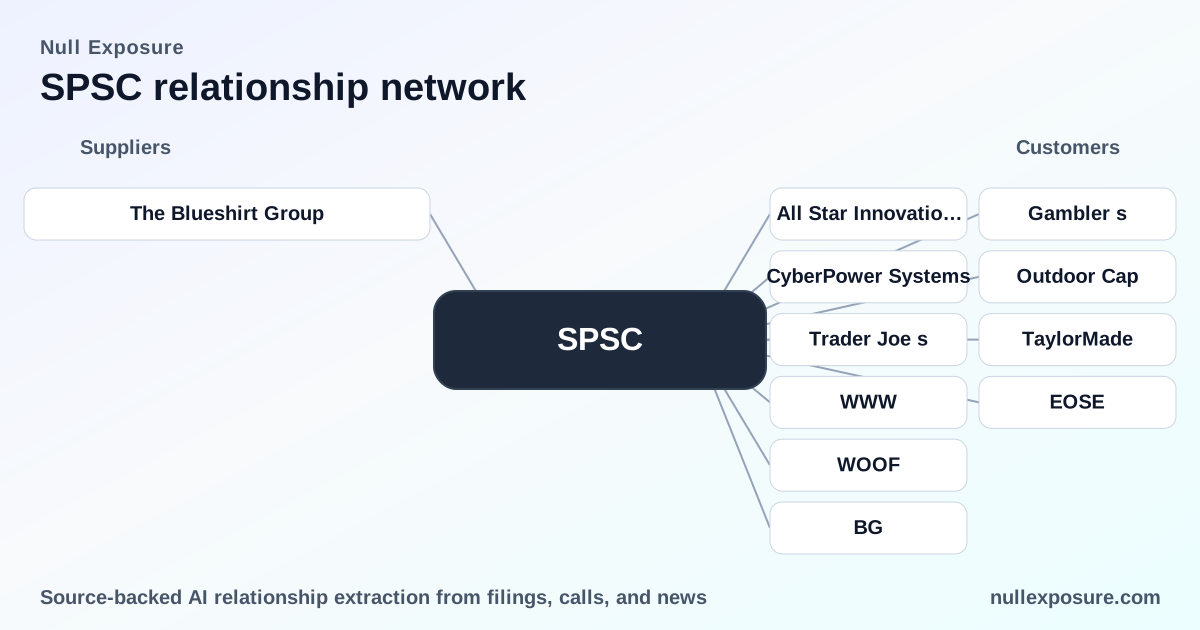
SPS Commerce: Customer relationships that underpin recurring revenue
SPS Commerce operates a cloud-based supply chain platform that charges subscription and recurring service fees to suppliers, retailers, distributors and logistics partners for connectivity, fulfillment and analytics. The business monetizes through a high-volume, short-term subscription model (contracts generally one year or less) combined with implementation and setup services that create stickiness and material renewal economics. For investors, the key read is simple: scale in customers and connections drives predictable recurring revenue and margin expansion, while setup fees and professional services create optionality and renewal incentives. Visit https://nullexposure.com/ for more relationship-driven signals on platform companies.
What SPS actually sells and why it matters to revenue
SPS sells a mix of cloud software and services: subscription-based connectivity and analytics, fulfillment and retailers’ vendor management, plus one-time professional services and set-up fees. Revenue for subscription services is recognized ratably over the contract term, which creates stable recurring revenue but also concentrates sensitivity to renewal economics and short contract durations. The company reports a global customer base — roughly 45,350 active recurring revenue customers across ~90 countries as of December 31, 2024 — while domestic (U.S.) customers account for roughly 83% of revenue, signaling global reach but U.S. revenue concentration. These attributes create an operating model that is scalable, vendor-agnostic, and reliant on broad adoption rather than a handful of outsized customers.
Key structural characteristics:
- Contracting posture: predominantly short-term, subscription contracts (generally one year or less) with recurring recognition; set-up fees are material renewal incentives.
- Concentration: global footprint but U.S.-heavy revenue mix (~83% domestic in 2024).
- Criticality: platform provides operational connectivity and compliance for suppliers and retailers, making it operationally important for customers.
- Maturity: mature recurring model with significant installed base and a mix of add-on services (fulfillment, analytics) that deepen customer lifetime value.
Customer snapshots: what executives highlighted on recent calls
Below I summarize every customer mention in the recent coverage; each entry is a concise 1–2 sentence take with the source noted.
Explore Scientific
Explore Scientific transitioned to SPS Commerce to “reestablish a reliable operational foundation,” signaling a supplier upgrade to SPS’s fulfillment/connectivity stack. According to the Q1 2026 earnings call transcript published on InsiderMonkey (May 4, 2026), management highlighted this transition as an operational stabilization for the customer.
Siete Foods
Siete Foods is cited as a multi-year customer (since 2018) exemplifying supplier value extraction from SPS’s product portfolio. Management referenced Siete Foods on the Q1 2026 earnings call transcript on InsiderMonkey (May 4, 2026) as a long-tenured example of realized value.
Wolverine Worldwide (WWW) — fulfillment to analytics expansion
Wolverine Worldwide began with a single fulfillment connection and expanded within SPS’s network to additional retailer connections and analytics subscriptions, illustrating cross-sell motion from integration to insights. Management discussed this customer story on the Q4 2025 earnings call transcript on InsiderMonkey (March 10, 2026).
CyberPower Systems
CyberPower Systems is described as a longstanding fulfillment customer, indicating SPS’s role as a durable operational vendor for hardware manufacturers. This mention is in the Q4 2025 earnings call transcript posted on InsiderMonkey (March 10, 2026).
WWW (duplicate listing)
The duplicate WWW entry reiterates Wolverine Worldwide’s progression from fulfillment to analytics subscriptions and underlines the repeatable client expansion pattern management is emphasizing. Source: Q4 2025 earnings call transcript on InsiderMonkey (March 10, 2026).
All Star Innovations
All Star Innovations adopted SPS fulfillment in 2022 and recently added SPS’s revenue recovery product for major retailers including Walmart, Target, Home Depot and Amazon, demonstrating product adjacency and retailer-specific capabilities. This example appears in the Q4 2025 earnings call transcript on InsiderMonkey (March 10, 2026).
Trader Joe’s
Trader Joe’s is using SPS’s fulfillment solution to accelerate progress toward vendor compliance, indicating SPS’s role in retailer vendor standardization initiatives. Management referenced Trader Joe’s on the Q4 2025 earnings call transcript on InsiderMonkey (March 10, 2026).
Petco (listed as WOOF)
Petco leveraged SPS’s retailer management solution to transition over 700 suppliers to standardized digital supply chain requirements, illustrating large-scale supplier onboarding and compliance enforcement. This was noted on the Q4 2025 earnings call transcript on InsiderMonkey (March 10, 2026).
Bunge
Bunge was highlighted among customers realizing benefits from the revenue recovery product suite, underscoring adoption across agribusiness and food companies. Management cited Bunge in the Q4 2025 earnings call transcript on InsiderMonkey (March 10, 2026).
Outdoor Cap
Outdoor Cap is identified as a beneficiary of the revenue recovery offering, reflecting adoption by global manufacturers and importers focused on margin recovery. Source: Q4 2025 earnings call transcript on InsiderMonkey (March 10, 2026).
Gambler’s
Gambler’s moved to SPS Commerce to improve order automation and support omnichannel growth, a typical SMB/retail migration case that emphasizes order automation as a buyer trigger. This example comes from the Q4 2025 earnings call transcript on InsiderMonkey (March 10, 2026).
TaylorMade
TaylorMade is another revenue recovery customer callout, indicating penetration into sporting goods manufacturing for margin reclamation services. Cited in the Q4 2025 earnings call transcript on InsiderMonkey (March 10, 2026).
EOS / EOSE (EOS referenced twice)
EOS (beauty and skincare) was listed among customers realizing revenue recovery benefits, signaling cross-industry applicability of SPS’s recovery and analytics products. Both EOS and its ticker variant EOSE were referenced in the Q4 2025 earnings call transcript on InsiderMonkey (March 10, 2026).
Spreetail
Spreetail’s CTO praised SPS’s new MAX capabilities and the embedded network expertise, illustrating customer endorsement for SPS’s product innovation and knowledge capture across its network. This comment is from a Quantisnow article introducing MAX (May 4, 2026).
What these relationships collectively tell investors
Collectively, these customer vignettes demonstrate three repeatable commercial dynamics: onboarding + compliance, cross-sell from fulfillment to analytics, and adoption of revenue-recovery offerings across retail, manufacturing and distribution verticals. The customer set ranges from SMBs to large global enterprises, which supports SPS’s scale-focused growth thesis and explains why the company highlights both short-term subscriptions and material setup fees that drive renewals.
- Revenue durability: ratable subscription recognition with short contract terms requires continuous customer acquisition and retention.
- Monetization runway: professional services and setup fees act as renewal incentives and deepen integration.
- Industry reach: examples span retail, pet, sporting goods, agribusiness and beauty, showing product applicability.
For a deeper look at relationship-level signals across mid-market and enterprise customers, explore the platform at https://nullexposure.com/.
Investment implications and risks
SPS’s model is attractive: predictable recurring revenue and cross-sell opportunities combined with a large installed base (45k+ recurring customers) create a durable revenue stream. Key risks are concentrated U.S. revenue exposure, dependence on continual renewals within short-term contracts, and execution risk in upselling analytics and revenue recovery to produce margin expansion.
Bottom line
SPS Commerce’s recent disclosures and call highlights present a coherent commercial playbook: scale connectivity, convert fulfillment customers to analytics, and monetize setup and recovery services. That mix supports stable recurring revenue growth but requires disciplined customer success and continuous product evolution to protect renewals and drive lifetime value.