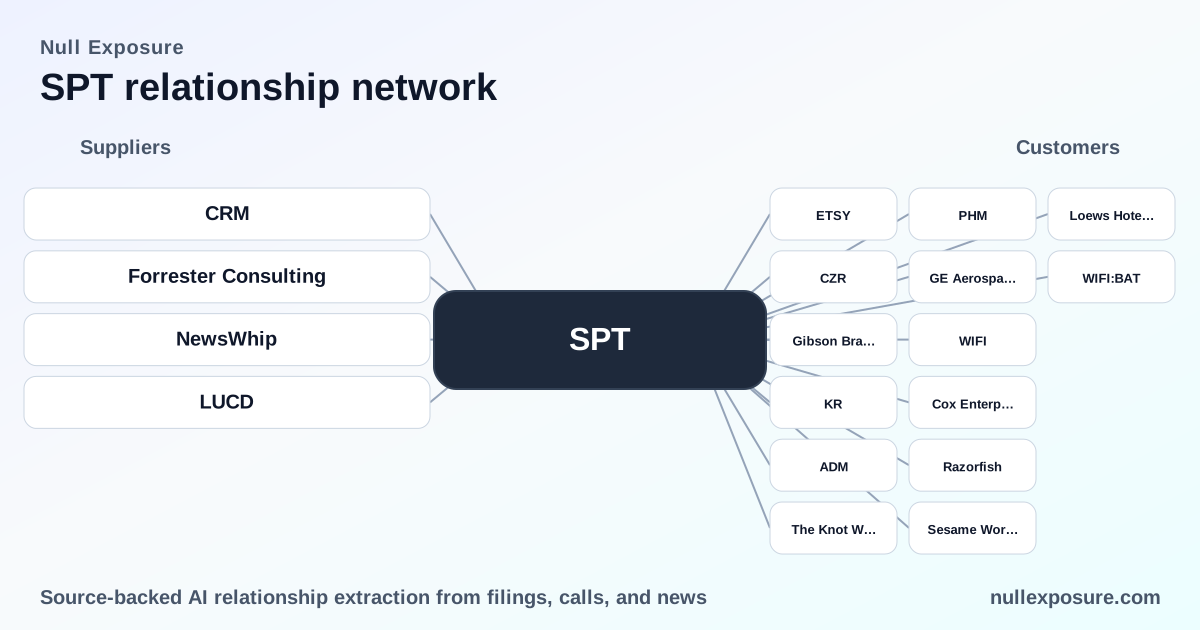
Sprout Social (SPT) — Customer relationships that underwrite a subscription business
Sprout Social sells a web-based social media management platform on a subscription basis to roughly 30,000 customers worldwide, monetizing through recurring SaaS fees and modest professional services. Revenue is almost entirely subscription-driven, with differentiated customer segments (SMB → enterprise) and a focus on expanding higher-value enterprise accounts; that commercial mix drives unit economics, retention metrics and guidance for margin expansion. For a concise overview of services and platform positioning, see NullExposure’s coverage: https://nullexposure.com/.
Why customer names in earnings matter for valuation
Sprout’s customer list is not vanity — it is the operating signal investors use to judge retention, expansion and enterprise traction. Subscriptions range from monthly to multi‑year, are generally non‑cancellable during term, and account for over 99% of revenue, which makes the identity and health of customers a direct driver of recurring cash flows and rule‑of‑40 dynamics. The company reports differentiated retention dynamics (stronger net retention after excluding SMB) and explicitly emphasizes longer sale cycles and pricing pressure when chasing enterprise accounts, so wins with large brands are both commercially valuable and operationally consequential.
If you want a compacted view of enterprise expansion and customer signals, visit NullExposure’s homepage for related research: https://nullexposure.com/.
Operating constraints that shape customer economics
- Contracting posture: Sprout offers subscription plans from monthly to multi‑year, with contracts generally non‑cancellable during the subscription term; this produces predictable near‑term revenue but requires effective onboarding and renewal management to secure lifetime value.
- Concentration & criticality: Company‑level signals classify software subscriptions as critical revenue (over 99% of 2024 revenue), while professional services are immaterial (<1%); this elevates the importance of retention and product stickiness.
- Counterparty mix: The customer base is highly diverse by size and sector — SMBs, mid‑market, large enterprises, agencies, government and non‑profit — which smooths concentration risks but creates variable cost-to-serve and sales cycle length across segments.
- Geography & scale: Customers span 100+ countries with meaningful exposures across NA, EMEA and APAC; international revenue ran around 27–28% of total in recent years, which partially diversifies macro risks but introduces FX and regional go‑to‑market considerations.
- Relationship roles and maturity: Sprout functions primarily as a seller of subscription software and as a service provider through customer success; relationships are active with staged expansion patterns where customers often start small and scale user seats and modules over time.
Collectively, these constraints explain why investor focus is on dollar‑based net retention, enterprise deal progression, and gross margin leverage as the company pursues higher non‑GAAP profitability.
Who’s on Sprout’s customer list — and what each relationship signals
Below I cover every customer relationship referenced in the available results, with a short investor‑facing takeaway and the original source context.
PulteGroup (PHM)
Sprout cited PulteGroup among new and existing customers in its fourth‑quarter FY2025 results, signaling traction with large consumer‑facing builders that have regional marketing needs. Source: Sprout’s FY2025 Q4 press release aggregated on The Globe and Mail (May 4, 2026).
Gibson Brands
Gibson Brands was listed as a customer in Sprout’s Q4 FY2025 disclosure, indicating adoption across entertainment and consumer electronics verticals where brand social presence matters. Source: Sprout FY2025 Q4 press release (The Globe and Mail, May 4, 2026).
Cox Enterprises
Sprout named Cox Enterprises in the same Q4 release, reflecting engagement with diversified media and services groups that can scale Sprout across subsidiaries. Source: Sprout FY2025 Q4 press release (The Globe and Mail, May 4, 2026).
Caesars Entertainment (CZR)
Caesars was highlighted among Q4 customers, an example of hospitality & gaming adoption that leverages social for real‑time customer engagement and promotions. Source: Sprout FY2025 Q4 press release (The Globe and Mail, May 4, 2026).
Archer‑Daniels‑Midland (ADM)
ADM appears in Sprout’s Q4 customer roster, demonstrating reach into large agribusiness and industrial enterprises where corporate PR and stakeholder communications are important. Source: Sprout FY2025 Q4 press release (The Globe and Mail, May 4, 2026).
GE Aerospace
GE Aerospace was called out as a Q4 customer, suggesting Sprout’s platform is being used in complex B2B and enterprise settings beyond pure consumer marketing. Source: Sprout FY2025 Q4 press release (The Globe and Mail, May 4, 2026).
The Knot Worldwide
The Knot Worldwide was listed among Q4 customers, reflecting adoption within vertical platforms that operate high‑engagement consumer communities. Source: Sprout FY2025 Q4 press release (The Globe and Mail, May 4, 2026).
Etsy (ETSY)
Sprout’s corporate materials reference Etsy as a customer and an example of brands that place social at the forefront of brand vision, underlining category credibility with marketplace brands. Source: Sprout Social insights post “Sprout 15 Years” (published on sproutsocial.com, FY2025).
Razorfish
Razorfish is named on Sprout’s insights page as a customer example, indicating agency and digital services adoption where Sprout’s platform sits inside broader client engagement stacks. Source: Sprout Social insights “Sprout 15 Years” (sproutsocial.com, FY2025).
Sesame Workshop
Sesame Workshop is cited as a customer example on Sprout’s insights page, showing non‑profit and educational institution usage for mission‑driven social programs. Source: Sprout Social insights “Sprout 15 Years” (sproutsocial.com, FY2025).
Boingo Wireless (WIFI)
Multiple Sprout case studies and insights reference Boingo Wireless as a customer that “seamlessly switched to Sprout Social,” signaling a practical win with a network services provider and repeat case study usage across years. Source: Boingo Wireless case study pages on sproutsocial.com (FY2022–FY2026).
WIFI (symbol variant)
The results include entries listed under the ticker-style name WIFI and WIFI:BAT which correspond to Boingo Wireless references in Sprout’s content; these reiterate the same case study adoption and marketing proof point. Source: Sprout Social case study and insights pages (various FY postings on sproutsocial.com).
WIFI:BAT (alternate listing)
This variant appears in Sprout content metadata and is functionally the same Boingo Wireless relationship used across Sprout’s marketing collateral. Source: Sprout Social insights pages where the case study is indexed (FY2025–FY2026).
The Kroger Co. (KR)
Kroger is quoted on Sprout’s influencer marketing product, with a Kroger social media manager describing influencer marketing as core to customer outreach, which shows product acceptance in large grocery retail. Source: Sprout press coverage on QuiverQuant about the rebranded Influencer Marketing platform (FY2025).
KR (symbol variant)
KR appears as a separate item in the results tied to the same influencer marketing announcement; it reinforces Kroger’s public endorsement of Sprout’s influencer features. Source: QuiverQuant article on Sprout’s product launch (FY2025).
Loews Hotels & Co.
Loews is showcased in Sprout’s hospitality insights as a customer using social listening to elevate guest experiences, highlighting sector‑specific use cases for real‑time operational intelligence. Source: Sprout Social insights “Social Media and Hospitality” (sproutsocial.com, FY2026).
VIAV
An outlier entry (VIAV) appears in the results but is linked to broader market commentary rather than a Sprout case study; its inclusion in the set suggests scraped news coverage overlap rather than a direct Sprout customer testimonial. Source: InsiderMonkey coverage noting VIAV activity (March 2026).
KEYS
An earnings‑call excerpt referencing KEYS was present in the feed; this item is not tied to a Sprout case study and likely reflects aggregation of financial news in the results feed. Source: Q4 2025 earnings call excerpt (March 2026).
Investment implications and risks distilled
- Positive: High subscription mix and a diverse customer roster — including recognizable enterprise names — support recurring revenue visibility and the potential for expansion ARR and margin improvement as enterprise mix grows. Enterprise wins are valuable because they lengthen average contract value and create expansion opportunities.
- Risks: Enterprise pursuit increases sales complexity and elongates sales cycles, creating pricing pressure and execution risk; retention among SMBs remains a different operating dynamic. The materiality of subscription revenue means any deterioration in net retention or enterprise upsell execution directly impacts near‑term cash flow.
- Operational focus: Continue tracking dollar‑based net retention excluding SMB, quarterly disclosures of large customer additions, and any shifts in international revenue mix.
For a focused dashboard on customer signals and to download our relationship tracker, visit NullExposure: https://nullexposure.com/.