Complete Solaria (SPWRW) — Customer Relationships and Contracting Profile
Complete Solaria operates and monetizes by designing, selling and installing residential and small commercial solar systems in the United States, generating revenue from direct system sales and installation services and from financing structures where third‑party leasing partners take ownership and homeowners pay via PPAs, leases or loans. The company recognizes all revenue in the U.S., reported roughly $300 million in trailing twelve‑month revenue with $129.2 million gross profit, while operating margins remain negative. This note synthesizes customer relationships disclosed in the company’s FY2024 filing, summarizes legal counterparties in public filings, and distills company‑level contracting and concentration signals relevant to investors and operators. For a concise portal to our broader coverage, visit https://nullexposure.com/.
What Complete Solaria sells, and how that shapes customer relationships
Complete Solaria runs a services‑led residential solar installation business that sells systems to homeowners, home builders and small‑to‑medium commercial customers primarily through third‑party sales partners. The company also contracts with leasing partners who take ownership of installed systems; homeowners then finance systems through power purchase agreements (PPAs), leases or loans, which places the leasing partner in the purchasing role for the installer.
- Client mix is residential‑heavy, with homebuilders and small businesses as secondary channels. The company explicitly identifies homeowners as the primary customer base.
- Contracting posture is intermediary‑centric: Complete Solaria typically contracts with leasing partners and third‑party sales channels rather than directly with end homeowners, creating a two‑tier commercial relationship model.
- Revenue is geographically concentrated in the U.S., as the filing states all revenue for FY2024 and FY2023 was U.S.-sourced.
- Financial profile matters for counterparties: revenue is meaningful ($300M TTM) but operating losses and negative book value indicate a capital‑intensive, growth‑oriented services model with margin pressure.
These characteristics imply contract relationships that are often longer‑duration and usage‑linked (PPAs/leases), routed through channel partners, and sensitive to counterparty credit and litigation exposures.
Key operational and risk signals from the filing
Investors should treat the following as company‑level signals that frame counterparty and contract risk:
- Contract types and monetization: The company sells systems outright and through financing arrangements; its homeowners utilize “power purchase agreements (PPAs), leases, loans and other products and services.” This creates a mix of upfront installation revenue and recurring or usage‑based cash flow profiles.
- Contracting posture: Complete Solaria often contracts with leasing partners that become the customer and system owner, rather than contracting directly with homeowners; this increases reliance on third‑party finance partners while insulating the company from some end‑customer credit risk.
- Customer concentration nuance: Accounts receivable concentration is low—no customer accounted for more than 10% of receivables as of December 29, 2024—but revenue concentration is meaningful historically; for FY2024 three customers represented 36% of gross revenues, indicating top‑line concentration risk even if receivables are dispersed.
- Counterparty types: The company explicitly serves individual homeowners, home builders, and small/mid‑market commercial customers through third‑party partners.
- Geographic concentration: All revenue is U.S.-based, concentrating regulatory and market risk domestically.
- Segment focus and maturity: The business sits in the residential solar installation segment, a mature but competitive market where margins are under pressure and scale across installation, warranty and financing operations is decisive.
These signals point to an operator that depends on channel and leasing partners for growth and cash conversion, faces top‑customer revenue concentration, and carries litigation and warranty exposure tied to system performance and supplier relationships.
Legal counterparties disclosed in the FY2024 report
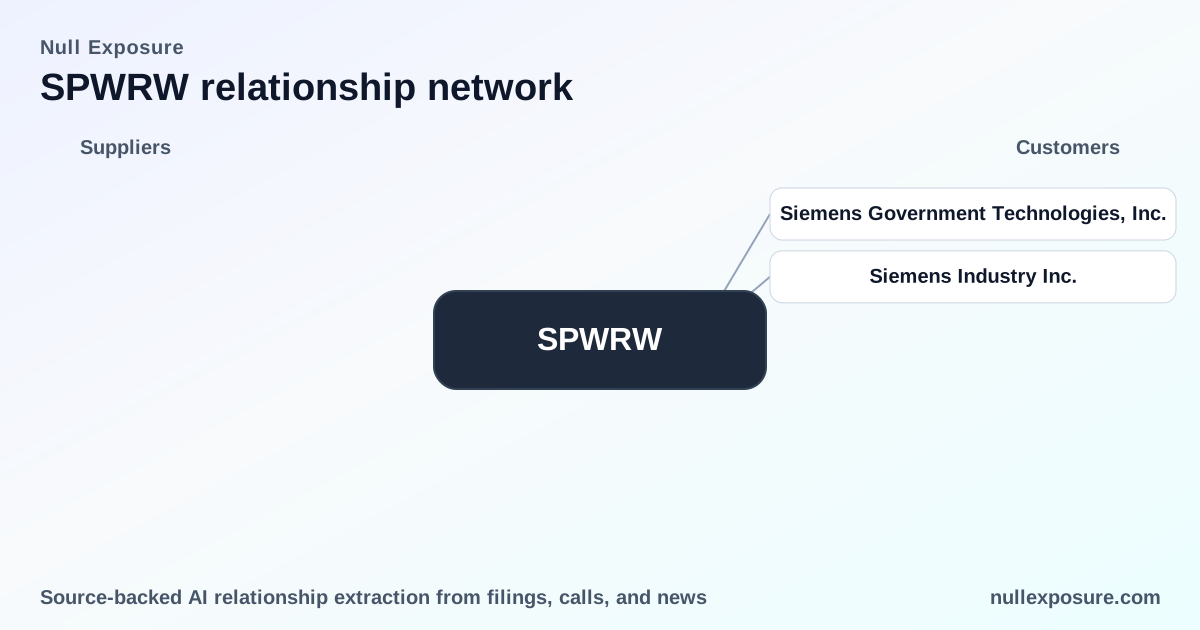
Complete Solaria discloses active litigation involving Siemens entities in its FY2024 Form 10‑K. Both relationships arise from a dispute over a solar module system purchase order.
Siemens Government Technologies, Inc.
Siemens Government Technologies, Inc. sued Complete Solaria’s subsidiaries, alleging breach of express and implied warranties under a purchase order for a solar module system. The allegation ties directly to system performance and warranty obligations around supplied modules. This is described in Complete Solaria’s FY2024 Form 10‑K filing. (Form 10‑K, fiscal 2024)
Siemens Industry Inc.
On July 27, 2023, Siemens Government Technologies moved to add Siemens Industry Inc. as a co‑plaintiff in the same lawsuit; the company records that the motion was granted on August 25, 2023. The 10‑K lists Siemens Industry Inc. as a co‑plaintiff in the ongoing litigation. (Form 10‑K, fiscal 2024)
Takeaway: Both Siemens entities are plaintiffs in litigation tied to a purchase order for a solar module system, highlighting counterparty legal risk linked to supplier and system warranty performance.
How these relationships affect credit, operations and investor calculus
- Operational criticality: Litigation with Siemens affiliates concerns module systems and warranty claims—areas that affect installation timelines, replacement costs and reputational risk. For an installer that relies on supplier quality and financing partners, these disputes are operationally relevant.
- Concentration vs. receivable dispersion: The filing creates a dual narrative—while receivables are not dominated by a single counterparty, a small number of customers drove a large share of revenue in the most recent fiscal year, which increases downside in case a major partner or channel weakens.
- Contractual maturity and revenue profile: The use of PPAs, leases and loans creates longer‑tenor and usage‑linked revenue streams for financed systems, but the company’s practice of contracting through leasing partners means cash collection and residual value management are partially outsourced to those finance partners.
- Investor implication: Given negative operating margins and litigation exposure, investors should weight counterparty legal risk, top‑line concentration and the resilience of leasing partner relationships when modeling downside scenarios or assessing capital needs.
For further context on customer exposure and to see additional related company signals, visit our resource hub at https://nullexposure.com/.
Final summary for investors and operators
Complete Solaria runs a U.S.‑centric, services‑driven residential solar installation business that monetizes through system sales, installation services and financing arrangements that create both upfront and recurring revenue profiles. Key risks are supplier/warranty litigation, revenue concentration among a few large customers, and reliance on leasing partners to take ownership of installed systems. The disclosed litigation with Siemens Government Technologies and Siemens Industry underscores the operational importance of supplier quality and contract terms.
If you need comparative profiles, counterparty risk scoring, or contract‑level analytics for portfolio stress testing, start with the company overview at https://nullexposure.com/ — it’s designed for investors and operators evaluating counterparties and contract structures.